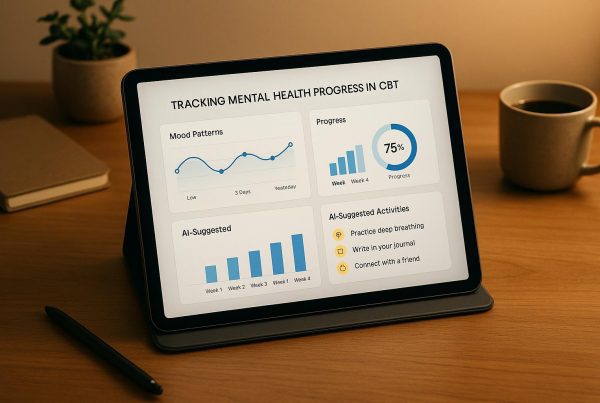


Cognitive behavioural therapy (CBT) is one of the best-evidenced talking therapies we have — but waiting lists are long and a single hour a week leaves a lot of time in between. That gap is where AI tools have stepped in: chat and voice apps that walk you through CBT techniques on demand, learn your patterns over time, and nudge you to practise between (or instead of) human sessions. This guide compares the AI tools worth knowing for personalized CBT in 2026 — what each does well, what the research actually shows, what it costs (and what’s genuinely free), and how to pick one without overpaying or overtrusting it.
One thing to know up front: this market is changing fast. Since we first wrote this guide, Youper closed on 30 September 2026, Woebot’s consumer app had already shut in 2025, and Nuna has become an employer-only stress tool. So we’ve widened the comparison to the tools you’ll actually meet in search results today, and been plain about which ones you can still use.
First, a grounding fact: in the United States alone, roughly 137 million people live in areas with a shortage of mental-health professionals, and the federal government estimates only about a quarter of that need is currently met (HRSA, 2025). AI can’t fix that shortage, but it can make evidence-based techniques available at 2 a.m. on a Tuesday — which, for many people, is exactly when they’re needed.
What “personalized CBT” from an AI actually means
CBT works on a simple loop: the way you interpret a situation shapes how you feel and what you do, so if you can catch and reframe the distorted interpretations, the feelings and behaviours shift too. Decades of research back the approach. A landmark review of meta-analyses found the strongest evidence for CBT in anxiety disorders, anger problems, somatic complaints, bulimia and general stress, with solid support across many other conditions (Hofmann et al., 2012).
“Personalized” is the word every app uses, so it’s worth being precise about what it can mean:
- Tailored exercises — the tool picks which CBT technique to offer (thought records, cognitive restructuring, behavioural activation) based on what you’re describing.
- Pattern tracking — it logs your mood, triggers and progress over time, so the support adapts as you change rather than restarting from zero each session.
- Conversational memory — the better tools remember earlier conversations and follow up, the way a good coach would, instead of treating every chat as a blank slate.
The depth of that personalization is the main thing separating one tool from another. Some are essentially a fixed library of exercises with a friendly interface; others genuinely build a picture of you and adjust.
What the evidence really shows about AI and CBT
Be a little wary of the bold numbers in app marketing. The honest picture from peer-reviewed research is “promising and modest,” not “miracle cure.” A 2023 systematic review and meta-analysis of conversational-agent (chatbot) interventions found they reduced depression symptoms with a small pooled effect (Hedges’ g ≈ 0.29) across 27 comparisons (Li et al., 2023). Small effects, spread across millions of people who otherwise get nothing, still matter — but they are small.
A few individual results are worth knowing:
- An early randomized trial of the Woebot chatbot found a moderate reduction in depression (Cohen’s d = 0.44) over two weeks versus an information-only control, with no significant advantage for anxiety, in 70 young adults (Fitzpatrick et al., 2017). Tellingly, Woebot’s direct-to-consumer app was shut down in June 2025 — a reminder that this is a fast-moving, financially fragile space.
- A real-world study of Wysa (observational, not a controlled trial) found bigger mood improvements among more engaged users (Inkster et al., 2018); Wysa later received an FDA Breakthrough Device designation — a review fast-track, not a clearance.
- In England’s NHS, an AI tool used alongside human-led group CBT looked promising. In a real-world study of 244 patients across five NHS Talking Therapies services, the 150 who used Limbic’s AI support tool for their between-session exercises attended more sessions, dropped out less and had higher recovery rates than the 94 who used standard workbooks (Habicht et al., 2025). It wasn’t randomized, and most of the authors work for or hold shares in Limbic — so treat it as encouraging, not settled.
- The most striking recent result is the first randomized controlled trial of a generative-AI therapy chatbot, “Therabot,” run by researchers at Dartmouth. Across 210 participants it reported average symptom reductions of about 51% for depression and 31% for anxiety versus a waitlist — while the authors stressed that no generative AI is yet ready to operate fully autonomously in mental-health care (Heinz et al., 2025, NEJM AI).
The takeaway: AI CBT tools are a real, useful adjunct — good for practising skills, tracking patterns and getting support between sessions — but not a replacement for a human therapist when you need one.
Quick comparison
| Tool | What it is now | Who can use it | Cost |
|---|---|---|---|
| aidx.ai | AI coaching and therapy (CBT, ACT, DBT, NLP), chat + voice, remembers you | Anyone, worldwide | Free tier; $29.99/mo ($288/yr) |
| Wysa | CBT- and DBT-based chatbot plus self-help exercises; optional human coaching | Anyone (app stores) | Free chat; Premium ~$75–$100/yr |
| Limbic | Clinical AI for NHS and health providers: intake, between-session CBT support | Only via a provider that uses it | Free to patients where offered |
| Woebot | Pioneering CBT chatbot; consumer app closed June 2025 | Partner organisations only | Not sold to individuals |
| Youper | CBT mood-tracking chatbot | Discontinued 30 Sept 2026 | — |
| Nuna | Danish workplace stress-insight tool (no longer a CBT chat app) | Employers | Sold to companies |
Prices checked against each vendor’s live pricing or app-store listing in October 2026; they change, so confirm before you buy.
1. aidx.ai
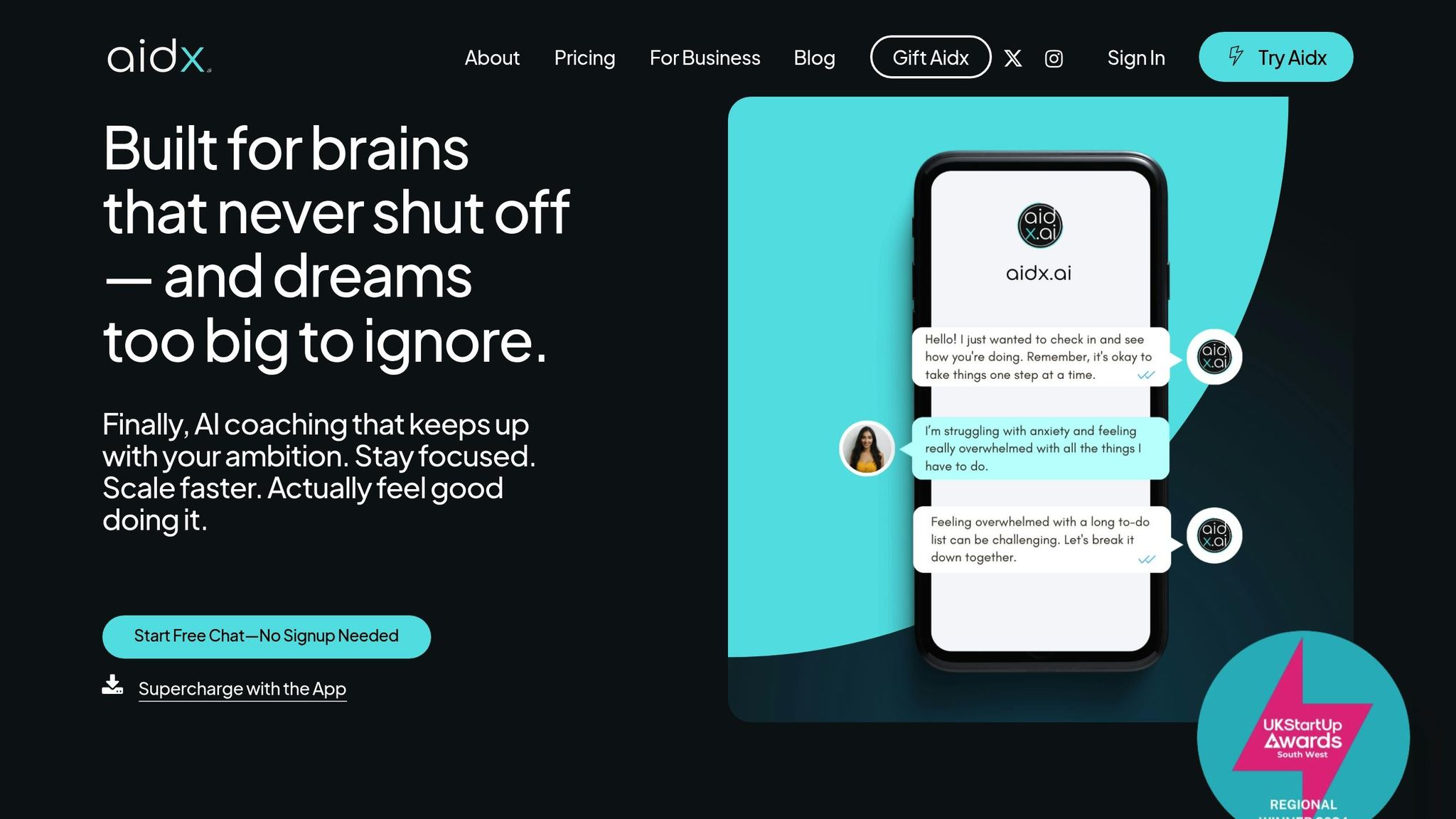
aidx.ai is an award-winning AI coaching and therapy service — named AI Startup of the Year at the UK Startup Awards (South West) — built around chat and natural voice conversation. Where many CBT apps hand you a fixed menu of exercises, aidx.ai is designed to get to know you over time and adapt, the way a human coach would.
Techniques. Its main modes (Life, Business and Performance) draw on a range of evidence-based methods — CBT, ACT, DBT and NLP — rather than a single approach. The default Life mode blends genuine therapeutic technique with practical coaching, so the same conversation can help you reframe a spiralling thought and then turn that insight into a concrete next step.
Personalization. Under the hood is a proprietary AI system Aidx calls Adaptive Therapeutic Intelligence (ATI). In plain terms: it remembers your past conversations, tracks patterns and goals, and asks pointed questions instead of just reacting to the last thing you typed. A built-in planner and roadmap turn realizations into tracked goals, and follow-ups arrive by push notification or email so momentum doesn’t evaporate between chats.
Voice and availability. The voice-first design lets you talk things through hands-free — on a walk, a commute or during a late-night low — which is often when typing feels like too much. Support is available 24/7.
Privacy. aidx.ai is GDPR-compliant, encrypts data in transit and at rest, and no human reads your conversations; you can delete your data at any time. An Incognito toggle (a switch you can turn on in any conversation, not a separate mode) keeps a chat out of long-term storage when you want to talk about something sensitive.
Cost. There’s a free Starter tier (a weekly message allowance in Life mode, plus voice) and a free anonymous demo. The paid Elevate plan is $29.99/month (or $288/year) for unlimited messages, all modes and web search, with a 30-day money-back guarantee.
Best for: people who want emotional support and a push toward their goals in one place, and who value being able to speak rather than type.
2. Wysa
Wysa is the best-known AI mental-health chatbot still open to the public — a friendly penguin that talks you through techniques drawn from CBT and DBT, alongside meditation and sleep tools. It’s used both directly by individuals and by health services and employers.
Personalization. Wysa suggests exercises based on what you tell it and tracks your mood, but it leans more on a structured library of tools than on long-term memory of your life. Its recent updates added the ability to send several messages before it replies and to have answers read aloud — though you still type rather than talk.
Evidence. More than most consumer apps. Beyond the engagement study above, Wysa’s conversational agent received an FDA Breakthrough Device designation in 2022 for adults with chronic musculoskeletal pain and associated depression and anxiety. That designation speeds up FDA review; it is not an approval, and it covers that specific use, not the everyday app.
Cost. The core AI chat is free, along with some of the exercises. Premium (all tools) is listed on the US App Store at about $75–$100 a year; plans that add a human coach cost considerably more.
Best for: anyone who wants a free, low-pressure place to try CBT-style exercises by text.
3. Limbic
Limbic is a clinical AI company, not a consumer app — which is exactly why it matters if you live in England. Its Limbic Access chatbot handles self-referral and assessment for NHS Talking Therapies services, and Limbic describes it as the first AI chatbot to gain Class IIa medical-device status in the UK. Limbic Care supports patients with CBT exercises between their human-led sessions.
Evidence. In a study of 129,400 patients across NHS services in England, services that used Limbic Access saw referrals rise by 15% compared with 6% in control services, with larger increases among nonbinary people (179%) and people from ethnic minorities (29%) (Habicht et al., 2024, Nature Medicine). It was observational and Limbic-authored, but it was peer-reviewed in a leading journal.
Cost. Nothing to you: you meet Limbic when an NHS or health-plan service you’re referred to uses it. Limbic says it is used by about 45% of NHS Talking Therapies services. You can’t sign up for it on your own.
Best for: people in England looking for free, human-delivered CBT — the chatbot may well be your front door.
4. Woebot
Woebot was the pioneer: a scripted CBT chatbot built by clinical psychologists, and the subject of the 2017 trial above. Its direct-to-consumer app shut down in June 2025; founder Alison Darcy pointed to the cost of meeting the FDA’s requirements for marketing authorization, and to the rise of large language models that regulators hadn’t yet worked out how to handle. Woebot Health now works with organisations rather than selling to individuals.
If you came here looking for Woebot: the closest open alternative for structured, text-based CBT exercises is Wysa; if you want something that remembers you and lets you talk it through out loud, try aidx.ai.
5. Youper (discontinued)
Youper was one of the more research-backed apps in this space — a CBT-, ACT- and DBT-based “emotional health assistant” built around daily mood check-ins. Its website now states that Youper discontinued its services on 30 September 2026.
Its research is still worth knowing because it’s often quoted: a longitudinal study of more than 4,500 Youper users reported reductions in anxiety (d = 0.57) and depression (d = 0.46) over the first two weeks of use (Mehta et al., 2021). It was a single-arm observational study with no control group, so the change can’t be cleanly attributed to the app — the authors themselves called for a randomized trial.
6. Nuna (now workplace-only)
When we first reviewed it, Nuna was a Danish AI mental-health assistant offering CBT, ACT and mindfulness exercises. It has since repositioned as a workplace stress-prevention tool sold to employers: a short phone-camera reading plus a monthly stress questionnaire, with anonymised dashboards for HR. Nuna itself says it is not a medical tool and doesn’t offer clinical assessment. It’s no longer a CBT chat app for individuals.
Can ChatGPT do CBT therapy?
ChatGPT can explain CBT well, and if you ask, it will walk you through a thought record or help you plan small, doable activities. For a reflective adult with everyday stress, that can be genuinely useful. But it isn’t therapy, and research gives three solid reasons to be careful:
- Telling it to “act as a CBT therapist” doesn’t make it one. Brown University researchers worked with licensed psychologists and trained peer counsellors to review sessions with CBT-prompted models from the GPT, Claude and Llama families. They identified 15 ethical risks across five themes, including ignoring a person’s context, “deceptive empathy,” bias, and weak handling of crisis moments (Iftikhar et al., 2025).
- General chatbots can agree with you too readily. A Stanford-led study found that large language models showed stigma towards some mental-health conditions and sometimes responded inappropriately, including going along with delusional thinking. Larger and newer models did no better (Moore et al., 2025). CBT works by gently testing your thoughts, so a tool that tends to agree with you works against it.
- Professional bodies say: adjunct, not substitute. In November 2025 the American Psychological Association advised that generative-AI chatbots and wellness apps shouldn’t replace a qualified provider or be relied on in a crisis, though they may support an ongoing therapeutic relationship (APA, 2025).
If you do use a general chatbot, use it like a worksheet partner: give it a specific situation, ask it to take you through the steps one at a time, and notice if it is simply agreeing with you. Keep identifying details out, and never rely on it if you’re in crisis.
How much does an AI therapist cost?
Usually far less than human therapy, and often nothing to start. As of October 2026:
- Free: Wysa’s core chat, aidx.ai’s Starter tier, and the free versions of general chatbots.
- Around $75–$100 a year: Wysa Premium, which unlocks its full exercise library.
- $29.99 a month or $288 a year: aidx.ai Elevate (unlimited messages, all modes, voice).
- Paid by someone else: Limbic and Woebot are now funded by the NHS, health plans or employers, so you only get them through a service that offers them.
Plans with a human coach or therapist in the loop cost more, because you’re paying for a person’s time. Whatever you choose, try the free version first. The research effects are real but modest, so a higher price doesn’t guarantee better support.
Is there a free AI therapy?
Yes, with limits. No AI tool is a free substitute for therapy, but several let you practise CBT-style skills at no cost:
| Option | What’s free | The catch |
|---|---|---|
| Wysa | AI chat and some exercises | Full library is paid |
| aidx.ai Starter | Chat and voice in Life mode, with memory | Weekly message allowance |
| General chatbots | Open-ended chat | Not built or tested for mental health (see above) |
| NHS Talking Therapies (England) | Real CBT with a human therapist | Waiting lists; England only |
That last one is the free option many people overlook. If you live in England and are 18 or over (16 or 17 in some areas), you can refer yourself to NHS Talking Therapies without seeing a GP first. It’s free at the point of use, and in many areas your referral will go through an AI chatbot like Limbic Access.
What is the best free CBT app?
It depends on what you want help with:
- For conversational CBT practice: Wysa’s free tier is the most established structured option; aidx.ai’s free Starter tier suits you better if you’d rather talk than type and want something that remembers the last conversation.
- For sleep: Insomnia Coach, from the US Department of Veterans Affairs’ National Center for PTSD, is free, open to everyone and based on CBT for insomnia (CBT-I). It isn’t AI, just a well-designed self-guided programme. Its sister app CBT-i Coach is designed to be used alongside a clinician.
- For the full treatment: in England, NHS Talking Therapies beats any app, because a trained human runs it.
AI CBT techniques and exercises: what it looks like in practice
Most AI CBT tools are built on a handful of classic exercises. Knowing them helps you judge whether a tool is doing real CBT or just being pleasant.
The thought record. This is the core CBT exercise for catching and testing a thought. A good AI walks you through it one step at a time instead of dumping a form on you:
- Situation: what happened? (“My manager moved our 1:1 without explanation.”)
- Automatic thought: what went through your mind? (“I’m about to be let go.”)
- Feeling: name it and rate it from 0 to 100. (Anxiety, 80.)
- Evidence for and against: what supports the thought, and what doesn’t?
- A balanced thought: something more accurate, not just more positive. (“A rescheduled meeting is common; I don’t actually know why.”)
- Re-rate the feeling. Even a drop from 80 to 55 counts.
(The example is an illustration, not a real user’s session.) A tool with memory can then spot when the same thought keeps coming back, and that pattern is often more useful than any single record. For a deeper walkthrough, see our guide to challenging automatic negative thoughts.
Behavioural activation. Low mood shrinks your world, and a shrinking world lowers your mood further. Behavioural activation breaks that loop by scheduling small, specific activities that bring a sense of pleasure or achievement, then checking how they went. A meta-analysis of 26 randomized trials (1,524 participants) found it outperformed control conditions for depression, though the authors noted that most of the studies were of low quality and had short follow-up (Ekers et al., 2014). This is where AI is genuinely useful: it can help you pick a ten-minute walk rather than “get fit,” remind you, and ask afterwards how it actually felt.
How to choose the right tool for you
Rather than chasing the longest feature list, match the tool to how you actually want to use it:
- Can you actually get it? Four of the six tools above can’t be signed up for by an individual today. Check that a tool is open to you before you compare features.
- Do you want to talk or type? If speaking aloud helps you process, voice support (aidx.ai) changes the experience. If you prefer the privacy of typing, Wysa or aidx.ai both work.
- Support, or support plus goals? Some tools are pure emotional check-ins; others (aidx.ai) fold in planning and follow-through if you’re working toward something.
- Free vs. paid. Try a free tier or trial before you commit. Effects in the research are modest, so don’t overpay for promises.
- Read the privacy policy. You’re sharing sensitive thoughts. Look for encryption, GDPR compliance, clear data-deletion options and a no-human-review default.
- Check for honesty about limits. A trustworthy tool tells you plainly that it isn’t a clinician and points you to real help in a crisis. Be sceptical of anything promising to “cure” you.
Where AI CBT fits — and where it doesn’t
Used well, an AI CBT tool is a companion: a way to practise techniques daily, catch unhelpful thinking as it happens, and keep momentum between human sessions or when therapy isn’t available. That’s a genuinely valuable role, and for mild-to-moderate stress, low mood or everyday anxiety it can make a real difference.
It is not a substitute for professional care when you’re dealing with severe depression, trauma, an eating disorder, or any kind of crisis. If you’re having thoughts of harming yourself, please reach out to a human now — in the US, call or text 988 (Suicide & Crisis Lifeline); in the UK and Ireland, call 116 123 (Samaritans); elsewhere, contact your local emergency services or a crisis line.
If you want to go deeper on the techniques themselves, see our guides to detecting cognitive distortions with AI, challenging automatic negative thoughts, and breaking bad habits with CBT.
Last reviewed: October 2026.
This article is general information about CBT and AI tools, not medical advice or a substitute for professional diagnosis or treatment. If you’re struggling with your mental health, please speak to a qualified professional; in an emergency, contact your local crisis line or emergency services.
References
- Hofmann SG, et al. (2012). The Efficacy of Cognitive Behavioral Therapy: A Review of Meta-analyses. Cognitive Therapy and Research. PMC3584580
- Li H, et al. (2023). Conversational Agent Interventions for Mental Health Problems: Systematic Review and Meta-analysis. JMIR. PMC10182468
- Fitzpatrick KK, Darcy A, Vierhile M (2017). Delivering CBT via a Conversational Agent (Woebot): RCT. JMIR Mental Health. PMC5478797
- Inkster B, Sarda S, Subramanian V (2018). Real-World Evaluation of Wysa. JMIR mHealth uHealth. PMC6286427
- Mehta A, et al. (2021). Effectiveness of AI Therapy for Anxiety and Depression (Youper). J Med Internet Res. jmir.org
- Habicht J, et al. (2024). Closing the accessibility gap to mental health treatment with a personalized self-referral chatbot. Nature Medicine 30:595–602. doi:10.1038/s41591-023-02766-x
- Habicht J, Dina LM, et al. (2025). Generative AI–Enabled Therapy Support Tool for Improved Clinical Outcomes and Patient Engagement in Group Therapy: Real-World Observational Study. J Med Internet Res. PMC11933774
- Heinz MV, et al. (2025). Randomized Trial of a Generative AI Chatbot for Mental Health (Therabot). NEJM AI. Dartmouth
- Iftikhar Z, et al. (2025). How LLM Counselors Violate Ethical Standards in Mental Health Practice: A Practitioner-Informed Framework. Proceedings of the AAAI/ACM Conference on AI, Ethics, and Society. ojs.aaai.org
- Moore J, et al. (2025). Expressing stigma and inappropriate responses prevents LLMs from safely replacing mental health providers. arXiv:2504.18412
- American Psychological Association (2025). Health advisory: Use of generative AI chatbots and wellness applications for mental health. apa.org
- Ekers D, et al. (2014). Behavioural activation for depression; an update of meta-analysis of effectiveness and sub group analysis. PLoS One 9(6):e100100. PMC4061095
- HRSA (2025). Designated Health Professional Shortage Areas Statistics. data.hrsa.gov