
Bad habits don’t break by willpower. They break when you change the cue, design a replacement, and practise it until the new response runs on its own. That’s the heart of how cognitive behavioural therapy (CBT) approaches habit change — and it’s a far cry from the usual advice to “just be more disciplined.” This guide walks through what the science actually says about why habits stick, how CBT helps you loosen their grip, and where an AI coach like aidx.ai can keep that work going between the moments when an old habit reaches for the wheel.
Why bad habits are so hard to break
If breaking a habit were simply a matter of deciding to, you’d have done it already. The reason you haven’t isn’t weak character — it’s how habits are built.
Psychologist Wendy Wood and her colleagues have spent decades mapping this. Their central finding: a habit is a learned association between a context and a response. Repeat an action enough times in the same setting — same place, same time of day, same preceding action — and your brain stops routing the decision through conscious thought. The context cue alone triggers the behaviour, with, in Wood and Neal’s words, “no mediating goal” required (Wood & Neal, 2007, Psychological Review).
That has two consequences worth sitting with. First, habits are cued by your environment, not by your intentions in the moment. Second, they’re “insensitive to short-term changes in goals” — meaning the resolution you made this morning does little to stop the automatic response this evening (Wood & Rünger, 2016, Annual Review of Psychology). In a well-known diary study, roughly 43% of everyday actions were performed habitually — in the same place, often while thinking about something else entirely (Wood, Quinn & Kashy, 2002).
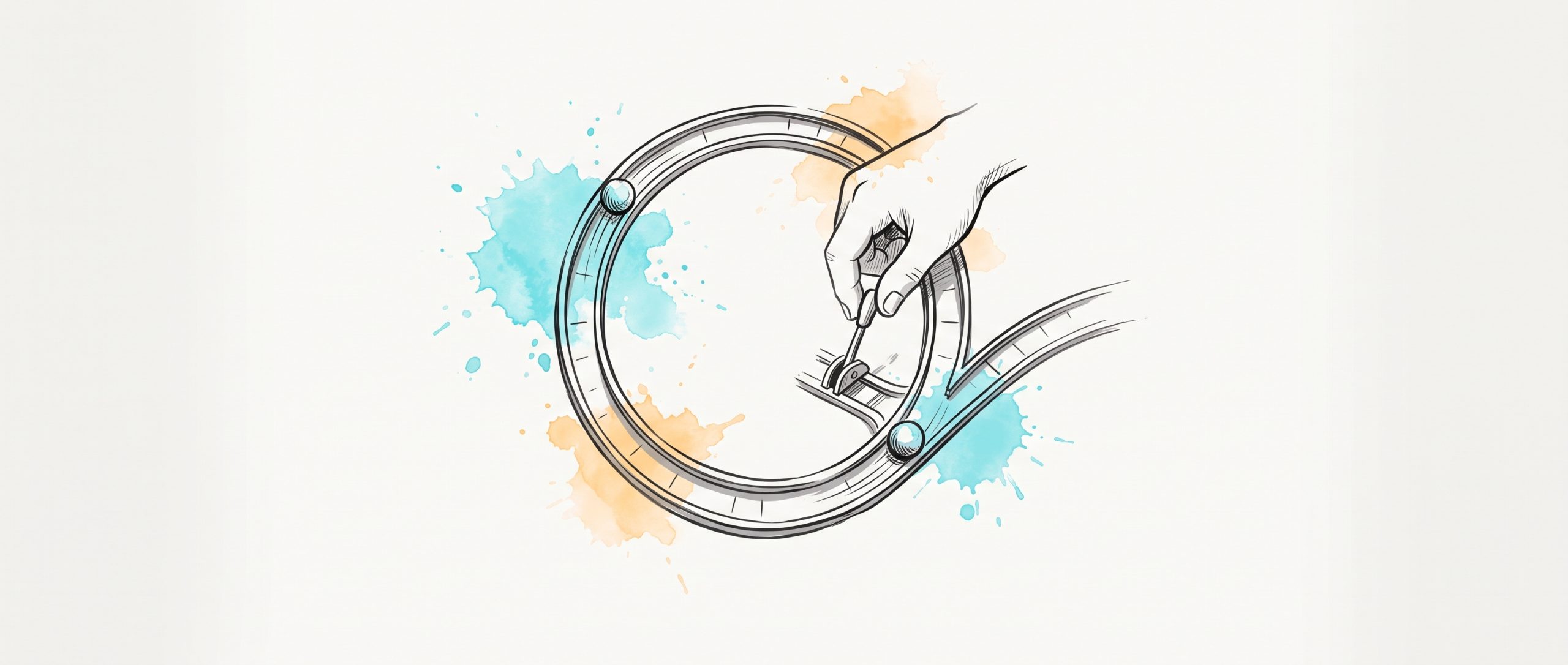
This is why the popular “habit loop” — cue, routine, reward — is a useful picture: a trigger sets off a behaviour, the behaviour delivers a small payoff, and the payoff strengthens the link for next time. It’s a fair framing drawn from solid neuroscience on how the brain automates routines (Graybiel, 2008). The practical lesson is the one that matters: to break a habit, you work on the loop, not on your willpower.
How long does it really take?
Two numbers float around the internet, and both deserve correcting before you set yourself up to fail by them.
“21 days to form a habit” is a myth — it traces back to a 1960s observation by a plastic surgeon about patients adjusting to their new appearance, not to any habit research. The better number comes from a 2010 study that asked 96 people to adopt a new daily behaviour and rate how automatic it felt over 12 weeks. The median time to reach near-maximum automaticity was 66 days — but the range ran from 18 to 254 days (Lally et al., 2010, European Journal of Social Psychology). The study’s author, Dr Phillippa Lally, has since been blunt that “66 days” is not a target: “for most people most of the time, no… how long habit formation takes is highly variable” (University of Surrey).
One reassuring detail from the same study: missing a single day didn’t meaningfully set people back. Consistency matters far more than perfection — a point worth remembering the first time you slip.
How CBT breaks the habit loop
Cognitive behavioural therapy is built on a simple, well-evidenced idea: your thoughts, feelings, physical sensations and behaviours are interconnected, so changing one can shift the others (American Psychological Association; NHS). Applied to a habit, that means you don’t have to win a brute-force battle against the behaviour itself. You can intervene at the cue, at the thought that rides alongside it, or at the response — and any of those can weaken the loop.
Here is how the CBT toolkit maps onto the loop, step by step.
1. Make the habit conscious (functional analysis)
You can’t change a pattern you can’t see. CBT starts with functional analysis: noticing the antecedent (what came just before), the behaviour, and the consequence (what you got out of it). That A-B-C sequence is the clinical mirror of cue → routine → reward. The antecedent is your context cue; the consequence is the reward quietly keeping the habit alive.
In practice this means catching the moment. What was I doing, feeling, or where was I, just before I reached for the phone / the snack / the cigarette? Most people are genuinely surprised. The reach for the phone turns out to track a feeling — boredom, anxiety, a lull between tasks — far more than a conscious wish to check it. Naming that link is the first real lever, because a habit you can predict is a habit you can interrupt.
2. Disrupt the cue (stimulus control)
If context triggers habits, then changing the context disrupts them — and this is one of the most robust findings in the field. When Wood and colleagues followed students who moved to a new university, their old exercise, reading and TV-watching habits broke down — but only where the supporting context changed. Where the setting stayed the same, the habits survived the move intact (Wood, Tam & Guerrero Witt, 2005, Journal of Personality and Social Psychology). Crucially, when a habit was disrupted, the behaviour came back under deliberate control — opening a window to choose something different.
You don’t need to move house to use this. The everyday version is stimulus control: remove or reshape the cue. Charge the phone in another room. Don’t keep the biscuits in the cupboard you open ten times a day. Take a different route home that doesn’t pass the place you stop for a drink. You’re not relying on resisting the cue a hundred times — you’re removing the hundred temptations.
3. Install a replacement behaviour
A habit rarely vanishes into a vacuum; it leaves a gap where the routine used to be, and an unfilled gap tends to get refilled by the old behaviour. So CBT doesn’t just subtract — it substitutes.
This is the logic behind habit reversal training (HRT), one of the better-evidenced behavioural techniques. Its core moves are awareness training (spotting the urge early) and a competing response — a different action, ideally incompatible with the habit, performed when the urge arrives. The NHS describes it plainly for tics: if the tic is a shoulder shrug, you practise gently stretching the arms instead until the urge passes (NHS). A meta-analysis of 18 studies covering tics and habit disorders such as nail-biting found a large pooled effect for HRT (Cohen’s d = 0.80) (Bate et al., 2011, Clinical Psychology Review).
The everyday application: when the boredom-cue hits, the replacement might be a two-minute walk, a few slow breaths, or a glass of water — something you’ve decided on in advance so you’re not negotiating with yourself in the moment.
4. Pre-decide the new response (if-then plans)
Deciding “in advance” is itself a technique with strong evidence. Implementation intentions are specific “if-then” plans — if situation Y happens, then I will do X — and they reliably help people follow through. A meta-analysis of 94 tests and over 8,000 participants found a medium-to-large effect on goal attainment (d = 0.65) (Gollwitzer & Sheeran, 2006).
An if-then plan does something elegant: it pre-links your cue to your chosen replacement, borrowing the habit’s own machinery to build the new behaviour. “If I sit down at my desk and feel the urge to open social media, then I’ll write one sentence of the task first.” Over enough repetitions, the new response starts to feel as automatic as the old one once did.
If your habit also rides on a recurring thought — “I’ve had a hard day, I deserve this” — that thought is itself a fair target. Learning to notice and question the automatic thoughts that grease a habit is core CBT work, and it’s worth its own deeper read: see how to challenge automatic negative thoughts and how to spot the cognitive distortions that distort the story you tell yourself in the moment.
The CBT approach at a glance
| Part of the loop | What’s happening | The CBT move |
|---|---|---|
| Cue (antecedent) | A context — place, time, feeling — triggers the behaviour automatically | Functional analysis to spot it; stimulus control to remove or reshape it |
| Routine (behaviour) | The habit runs on autopilot | A competing replacement behaviour, pre-chosen with an if-then plan |
| Reward (consequence) | A small payoff reinforces the link for next time | Notice what the habit really gives you, and meet that need another way |
| The thought alongside it | An automatic thought justifies or invites the behaviour | Notice and question it (cognitive restructuring) |
CBT isn’t a fringe approach to lean on here. The APA notes it has been shown effective across a wide range of problems and, in many studies, performs as well as or better than other psychological therapies or medication (APA). What makes it well-suited to habits specifically is that it’s structured, practical, and aimed at what you do — not just how you feel about it.
Where an AI coach fits in
Here’s the honest snag with all of the above: habits don’t keep office hours. The urge to fall back into an old pattern shows up at 11pm, mid-commute, or in the flat ten minutes after a stressful meeting — rarely in next Tuesday’s appointment. The CBT work is sound; the gap is in practising it in the moment the habit fires.
That gap is exactly where an always-available AI coach earns its place. It isn’t a replacement for a therapist, and it doesn’t pretend to be — it’s a way to keep the in-between work going. A few concrete examples of how that looks with aidx.ai:
- Catch the pattern as it happens. You can talk or type the moment you notice an urge, and work through the functional analysis — what triggered it, what you’re really after — while it’s still fresh, rather than reconstructing it from memory days later.
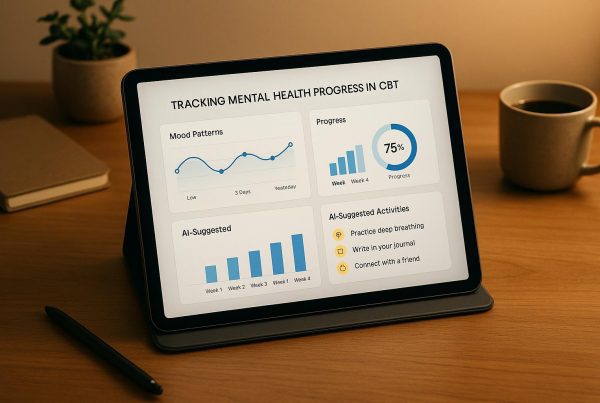
- Rehearse the replacement. When you’ve decided on a competing response and an if-then plan, the planner turns it into something concrete — reminders, notes, and goals you can actually check off — so the new behaviour has scaffolding instead of relying on memory.
- Reflect without the fear of judgement. A lot of habit work involves admitting things that feel embarrassing. aidx.ai is private and encrypted, and you can switch on Incognito to keep a conversation from being stored at all — which can make it easier to be honest about a setback and just keep going.
Under the hood, aidx.ai draws on a proprietary system (its Adaptive Therapeutic Intelligence, or ATI) that blends evidence-based methods — including CBT, ACT and DBT — and adapts to your goals and history over time. The point isn’t novelty for its own sake; it’s that the techniques in this article work best with frequent, low-friction practice, and an AI coach makes that practice available whenever the habit actually shows up. As Aidx is award-winning AI coaching and therapy, it’s designed for exactly this kind of ongoing, in-the-moment support — while still pointing you toward a human professional when something runs deeper.
If you want the broader science of why habits stick and how to build good ones, our companion guide on the science of breaking and building habits goes wider; this piece stays on the CBT angle.
The takeaway
Breaking a bad habit isn’t about wanting it badly enough. It’s about understanding the loop and dismantling it deliberately: see the cue, disrupt it, choose a replacement, pre-decide when you’ll use it, and practise until the new response carries itself. CBT gives you that structure, the evidence backs each step, and an AI coach can keep the work alive in the moments that matter most — which, with habits, are the moments you’re least likely to be sitting in a therapy room.
Start small, expect the timeline to be uneven, and don’t let a single missed day convince you you’ve failed. The research is clear that you haven’t.
Last reviewed: June 2026.
This article is for general information and isn’t a substitute for professional advice. Habits tied to substance dependence, an eating disorder, self-harm, or compulsions that feel beyond your control deserve support from a qualified professional — and if you’re in crisis, please contact your local emergency or crisis service.
Related reading: Habit Coaching: How an AI Habit Coach Builds Lasting Habits