
If you’ve been showing up to therapy or coaching for a while, it’s natural to ask: is this actually working? Progress in inner work is rarely a straight line, and it almost never announces itself the way a fever breaking does. The good news is that there are real, recognisable signs your therapy is working — and simple ways to track them so you’re not just going on a hunch.
This is a guide to spotting genuine progress, measuring it without turning your life into a spreadsheet, and knowing what to do if the signs aren’t there yet. It’s written for you as the person doing the work, not for a clinician — though the research behind it is the same research clinicians use.
Why progress in therapy is so hard to judge from the inside
Two things make “is it working?” a genuinely difficult question to answer on your own.
First, progress is non-linear. Good weeks and bad weeks alternate. Sometimes you feel worse for a stretch precisely because you’re finally facing something you used to avoid — a normal, well-documented part of the process, not a sign of failure. A single rough session tells you very little.
Second, we’re poor judges of our own trajectory. This isn’t just true of clients — it’s true of therapists too. Research on measurement-based care has found that clinicians tend to hold overly optimistic views of progress and frequently overlook when someone isn’t improving; in one study, therapists who knew the deterioration rate was around 8% still flagged only a tiny fraction of the clients who were actually struggling [1]. The lesson isn’t “trust no one.” It’s that some light, deliberate tracking beats memory and gut feeling — for everyone involved.
So the honest answer to “is it working?” comes in two parts: knowing the signs to look for, and gathering a little bit of evidence over time.
The signs your therapy (or coaching) is working
Across the research and clinical consensus, a consistent set of signals comes up again and again. You won’t have all of them at once, and they tend to arrive in roughly the order below — small shifts in awareness first, visible life changes later.
- You notice your patterns in real time. Early on, you spot a trigger or an old reaction after it’s happened. Later, you catch it as it happens — and eventually, before it takes over. Growing self-awareness is one of the earliest and most reliable signs of progress.
- You use what you learn outside the room. A skill from a session — a breathing technique, a reframe, a boundary — shows up in your actual life, on a Tuesday, without your therapist there to prompt it.
- You recover from setbacks faster. The dips still happen, but they’re shorter and less total. A bad day stays a bad day instead of becoming a bad fortnight.
- You can be honest about the hard things. You bring the topics you used to steer around. Paradoxically, talking about something painful or a recent slip is itself a sign the work is working.
- You feel understood, and you trust the relationship. The quality of the relationship — what therapists call the therapeutic alliance — is one of the strongest predictors of good outcomes; a review of more than 30,000 clients found the alliance reliably tracks with results [2]. Feeling genuinely heard isn’t a “nice to have” — it’s a working ingredient.
- Your goals evolve. You started in crisis or stuck mode; now the conversation is shifting toward growth, direction, and what you want to build. Outgrowing your original goal is progress, not drift.
- People around you notice. A partner, a friend, a colleague comments — unprompted — that you seem calmer, more present, more like yourself.
Signs it’s working vs. signs to raise with your therapist
It helps to separate “this is normal and good” from “this is worth a direct conversation.” The difference usually isn’t how intense a session feels — hard sessions can be the most productive — it’s the direction over weeks.
| Signs it’s working | Worth raising with your therapist |
|---|---|
| You catch patterns sooner, even if you can’t change them yet | Sessions feel like venting with no new insight, week after week |
| Skills from sessions show up in daily life | You leave each session unsure what you’re meant to do differently |
| Setbacks are shorter; you bounce back quicker | You feel consistently worse with no sense of why, over months |
| You feel safe being honest, including about slip-ups | You hold back, or don’t feel understood, and it isn’t improving |
| A hard session leaves you with something to work on | No measurable movement toward any goal after a fair stretch |
Notice that the right-hand column isn’t “quit.” It’s “say it out loud.” A good therapist or coach welcomes “I’m not sure this is helping” — naming it often is the next piece of the work, and can lead to adjusting the approach, the goals, or the fit.
How long before you should expect to feel something
There’s no universal clock, but research gives useful anchors. Roughly 75% of people who enter therapy show some benefit, and dose-response studies suggest about half of people meaningfully improve within somewhere around 13 to 20 sessions [1]. Many people notice early shifts — in mood, sleep, or self-awareness — within the first couple of months.
Two caveats worth holding. These are averages, not promises: your pace depends on what you’re working on, the fit with your therapist, and life outside the room. And “some benefit” is a low bar — the point of tracking is to make sure you’re actually clearing it, rather than assuming you are.
How to track your own progress (without overdoing it)
You don’t need clinical instruments to gather honest evidence. The aim is a simple, repeatable signal you can look back on — because, as the research above shows, memory flatters the present. A few lightweight methods:
- Set goals you can actually see. Vague goals (“feel better”) can’t be tracked; specific ones (“get through the week without cancelling plans”) can. There’s good evidence that the structure around a goal matters: in a study of 267 people at Dominican University, those who wrote their goals down, defined concrete action steps, and sent a weekly progress note to a friend achieved markedly more than those who only thought about their goals — more than 70% of the weekly-accountability group reported real success, versus 35% of those who kept goals private and unwritten [3]. Written goals, action commitments, and a regular check-in are the active ingredients.
- Rate a few things, briefly, on a schedule. A 0–10 mood, energy, or anxiety rating once a week takes ten seconds and turns “I think I’m doing better” into a line you can actually read. The value is the trend over a couple of months, not any single number.
- Keep a short journal. Even a few sentences after a hard moment — what happened, what you felt, what you did — builds a record you can revisit. Reading back over weeks often reveals progress that’s invisible day to day. (If you want to go deeper here, see our piece on how to track your mental health progress.)
The point of all this isn’t to grade yourself. It’s to give your future self honest data, so “is it working?” gets answered by a trend line instead of by whatever mood you happen to be in today.
Where AI coaching fits — honestly
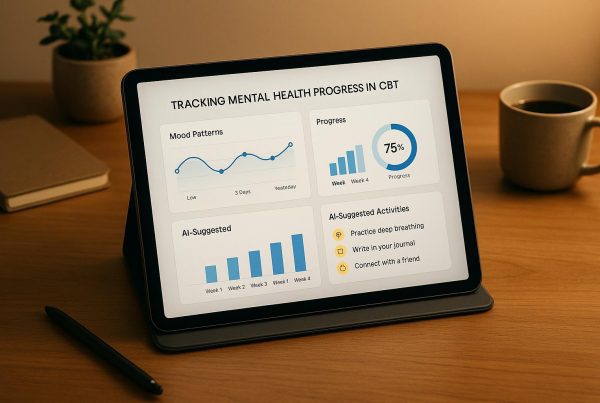
This is also where an AI coach can quietly help, and it’s worth being precise about what that does and doesn’t mean. aidx.ai is an AI coaching and therapy-informed service built on evidence-based methods — CBT, ACT, DBT, and NLP — and one of the things it does well is the boring-but-valuable part of progress: keeping a record. Because the conversation is the journal, it can chart wellbeing signals over time — things like stress and burnout risk drawn from what you talk about — and show that trend back to you. That’s the personal charting the research above keeps pointing to: a steady signal that’s more honest than memory.
For individuals, that charting is yours to see — your own private picture of how you’re trending. In workplace settings, depending on the plan, a manager may see either that data or an anonymised, aggregated view, so a company can support employee wellbeing without reading anyone’s conversations. Either way, the conversations themselves stay private.
What it is not: an AI coach is not a replacement for a human therapist, and it does not diagnose conditions, detect acute crises, or alert anyone on your behalf. It’s a between-sessions companion and a way to make your own progress visible — most useful alongside your own reflection or a human professional, not instead of them. If you’re in crisis or thinking about harming yourself, please skip the apps and reach a person now — in the US you can call or text 988 (the Suicide and Crisis Lifeline), or contact your local emergency services.
What to do if it isn’t working
Sometimes the honest read is that, after a fair stretch and a real effort, the signs just aren’t there. That’s important information, not a verdict on you. A few constructive moves:
- Name it in the room. “I don’t feel like I’m making progress” is one of the most useful sentences you can say. It often unlocks a change in approach or surfaces something you’ve both been circling.
- Revisit the goals. Progress can be real but aimed at the wrong target. Re-defining what “better” means can reset everything.
- Consider fit. The alliance matters too much to ignore. If you’ve raised it honestly and still don’t feel understood, it’s reasonable — and common — to try a different therapist. That’s not failure; it’s matching.
- Match the modality to the problem. Some difficulties respond better to a specific approach (CBT, EMDR, ACT, and others). Asking “is there a method better suited to what I’m dealing with?” is a fair question.
And if things are getting worse rather than plateauing — especially if you’re having thoughts of self-harm — treat that as a reason to reach a professional or crisis line promptly (in the US, 988), not as something to track and wait out.
The bottom line
Therapy and coaching work, for most people, but rarely in a straight line and rarely on a fixed schedule. You’ll know it’s working when you notice your patterns sooner, carry your skills into ordinary days, recover from setbacks faster, and trust the relationship enough to be honest in it. And you’ll know it more clearly if you do a little light tracking — written goals, the occasional rating, a short journal — so you’re judging by a trend, not a mood.
If the signs are there, let that be quiet encouragement to keep going. If they’re not, let that be permission to speak up, adjust, and — where it helps — get more support. Either way, the act of asking “is this working?” and looking honestly for the answer is itself part of the work.
This article is general information about recognising progress in therapy and coaching, not a substitute for professional advice, diagnosis, or treatment. If you’re struggling with your mental health, consider speaking with a licensed professional. If you’re in crisis or thinking about harming yourself, contact a crisis line — in the US, call or text 988 — or your local emergency services right away.
Related reading
Sources
- Society for the Advancement of Psychotherapy, “Why Psychotherapists Should Measure and Monitor Client Treatment Response” (summarising Lambert’s dose-response research) — link
- Psych Central, “Is My Therapy Working?: 7 Ways To Know” (therapeutic alliance review of 30,000+ clients) — link. Primary source: Flückiger, C., et al. (2018), The alliance in adult psychotherapy: a meta-analytic synthesis, Psychotherapy, 55(4).
- Gail Matthews, Dominican University of California, “Goals Research Summary” (267 participants; written goals, action commitments and weekly accountability) — link
Last reviewed: June 2026.