

A mental health check-in is a simple, regular habit of pausing to notice how you’re actually doing — your mood, sleep, stress, and energy — and writing it down so you can spot patterns over time. It’s an act of self-awareness, not a diagnosis. You don’t need an app, a clinician, or a clinical score to start. You need five quiet minutes and a consistent question: How am I, really?
This guide walks through what a check-in is, what’s worth tracking, how to build the habit so it sticks, and how to read your own patterns — plus how to keep the same record digitally if that helps you stay consistent. The whole point is to catch small shifts early, while they’re still easy to respond to.
What a mental health check-in actually is
A check-in is a deliberate moment of reflection: you stop, ask yourself a few honest questions, and note where you are. That’s it. Done regularly, it builds something genuinely useful — a baseline. Once you know what an ordinary week feels like for you, you can notice when something drifts: sleep fraying, energy dropping, a low mood that’s stuck around longer than usual.
The value is in the trend, not any single reading. One rough day tells you very little; the same low number three weeks running tells you something worth paying attention to. Regularly noticing these shifts is what lets you respond early — adjusting your routine, reaching out, or seeking support — before a small dip compounds into something harder to climb out of.
One boundary matters from the start: a check-in is self-awareness, not self-diagnosis. Rating your mood a 4 today doesn’t mean you “have” anything. Clinical conditions are diagnosed by trained professionals using far more than a daily number. Your check-in is a flashlight for noticing — not a verdict. Hold it lightly, and it stays useful instead of becoming one more thing to worry about.
What to track: mood, sleep, stress, and energy
You can track almost anything, but four signals carry most of the value for most people. They’re concrete, easy to rate, and tightly linked to how you feel day to day. Start with these, and add more only if a specific pattern makes you curious.
| What to track | A simple way to log it | Why it’s worth watching |
|---|---|---|
| Mood | Rate it 1–10, or name the feeling in a word or two | Your headline signal — and the one that drifts first |
| Sleep | Hours slept and how rested you feel (1–10) | Poor sleep both worsens and signals low mood; often the earliest tell |
| Stress | Rate the day’s pressure 1–10, plus what drove it | Reveals recurring triggers you can plan around |
| Energy | Rate it 1–10, morning and evening if you can | Flags burnout and motivation dips before they fully land |
Two optional additions earn their place once the basics are a habit: a one-line note on what happened (a hard meeting, a good walk, a skipped meal) so you can later connect events to mood, and the basics of self-care — did you eat properly, move your body, drink enough water, do one thing you enjoy? These are the unglamorous variables that quietly move how we feel, and they’re easy to overlook until they’re written down next to the day they affected.
How to build a check-in habit that sticks
A check-in only works if you actually do it, so design it to be almost effortless. The research and the practitioners broadly agree on the same few principles.
- Anchor it to a fixed time. Right after you wake up or just before bed both work well — the key is the same time daily, attached to something you already do, so it becomes automatic rather than another decision.
- Keep it short. Two or three minutes is plenty. A check-in you’ll do badly every day beats a thorough one you abandon after a week.
- Ask the same questions each time. Consistency is what makes patterns visible. A reliable set: How do I feel right now? How did I sleep? What’s taking up most of my headspace? Have I done one thing for myself today?
- Choose a frequency you’ll sustain. Daily is great for the four core signals; a longer, more reflective check-in works well weekly or monthly. During calmer stretches, monthly can be enough to catch gradual change; during hard ones — a big transition, a loss, a stressful season — weekly or daily helps you stay close to yourself.
Whether you use a paper notebook, a notes app, or a dedicated tool matters far less than showing up consistently. Pick whatever you’ll reach for without friction.
Journaling: the simplest tool, with real evidence
If you want to go a step beyond rating numbers, writing a few sentences about your day is the most accessible deeper practice — and it’s better supported than most wellness advice. A 2022 systematic review and meta-analysis of 20 randomized controlled trials found that journaling interventions produced a small but statistically significant reduction in mental-health symptom scores, with somewhat larger benefits for anxiety (around a 9% reduction) than for depression (Sohal et al., Family Medicine and Community Health, 2022) [1].
It’s worth being honest about the size of that: the effect is modest, and the authors rated the overall evidence as limited in quality. Journaling is a helpful, low-cost habit for many people — not a treatment, and not a substitute for care when you need it. What it does well is make the invisible visible. Putting a feeling into words forces a vague unease into something specific, and writing regularly surfaces the cause-and-effect links — between sleep and mood, a person and your stress, a habit and your energy — that are easy to miss while you’re living them.
You don’t need to write much. A few honest lines about how the day felt, what triggered it, and how you handled it is enough to build a record worth re-reading.
How to read your own patterns
Tracking is only half the practice; the value arrives when you look back. Set a recurring time — the end of each week or month — to read over your logs and ask what they’re telling you. You’re looking for connections, not perfection.
- Links between events and mood. Do certain people, tasks, or times of day reliably precede a dip — or a lift?
- Recurring triggers. The same stressor showing up repeatedly is information you can plan around.
- What actually helps. When your mood or energy recovers, what did you do? Those are your proven strategies — worth repeating on purpose.
- Slow drifts. A single low day is noise. A gentle slide over several weeks is the signal a check-in exists to catch.
Reviewing your own data this way is also what turns a conversation with a doctor, therapist, or coach from “I think I’ve been a bit off” into “here’s what the last six weeks actually looked like” — far more useful for everyone involved.
Tracking your mental-health progress digitally
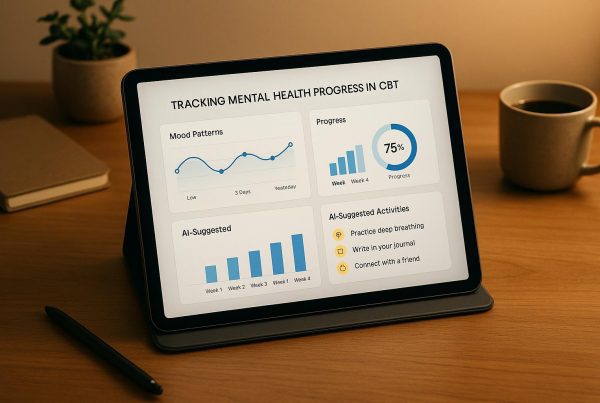
Pen and paper is a perfectly good check-in. But many people stay more consistent with a digital tool, and a phone is always within reach — useful for a habit that depends on showing up daily. The digital approach has clear advantages: automatic reminders so you don’t forget, timestamps and charts that make trends easy to see at a glance, and everything searchable in one place rather than scattered across notebooks.
If you go digital, the principles don’t change — you’re still tracking mood, sleep, stress, and energy over time and reading the patterns. A few things worth looking for in any tool:
- Genuine privacy. This is sensitive data. Favour tools with clear, strong privacy practices and encryption.
- Low friction. If logging takes more than a moment, you’ll stop. Quick entry beats elaborate features.
- Trends, not just snapshots. The point is the line over weeks, so a tool that charts your history is more useful than one that only shows today.
- Honest framing. Be wary of anything promising to “diagnose” or “screen” you from a few taps — that’s a claim no consumer tool can responsibly make.
For a closer look at how digital tools — including AI-assisted reflection grounded in CBT — fit into tracking progress over time, see our guide to tracking mental health progress with AI in CBT.
Where reflective AI fits — and where it doesn’t
A check-in is, at heart, a conversation with yourself. Some people find that conversation easier to sustain with a prompt and a response — which is part of why AI tools have a place here. aidx.ai is an AI coaching and therapy companion that draws on validated reflective frameworks — CBT, ACT, DBT, and NLP — to help you reflect, notice patterns, and track how things shift over time, in plain conversation rather than forms and sliders.
It’s worth being clear and honest about what that is and isn’t. An AI companion can help you build the habit, ask better questions, and stay consistent. It is not a clinician, it does not diagnose or screen for conditions, and it doesn’t replace professional care when that’s what’s needed. Used for what it’s good at — supporting self-awareness and steady reflection — it’s a genuinely helpful way to keep a check-in going. Held to honest limits is exactly where it belongs.
Start small, today
You don’t need the perfect system. Tonight, before bed, ask yourself how you slept, how your mood was, and what took up most of your headspace — and write down a sentence. Do it again tomorrow. Within a couple of weeks you’ll have something most of us never give ourselves: an honest, longitudinal look at how you’re actually doing, and the early warning that comes with it. That’s the whole practice, and it starts with one line.
References
- Sohal, M., et al. (2022). Efficacy of journaling in the management of mental illness: a systematic review and meta-analysis. Family Medicine and Community Health, 10(1). (20 RCTs; a small but statistically significant reduction in mental-health symptom scores, with somewhat larger benefits for anxiety than depression; the authors rated the overall evidence as limited in quality.)
Last reviewed: June 2026.
This article is for general information and self-reflection only; it is not medical advice, a diagnosis, or a substitute for care from a qualified professional. A self check-in cannot diagnose a mental-health condition — if your low mood, anxiety, or distress is persistent or worsening, please talk to a doctor or mental-health professional. If you’re in crisis or thinking about harming yourself, you don’t have to wait: in the US, call or text 988 (the Suicide & Crisis Lifeline) any time, or contact your local emergency services.