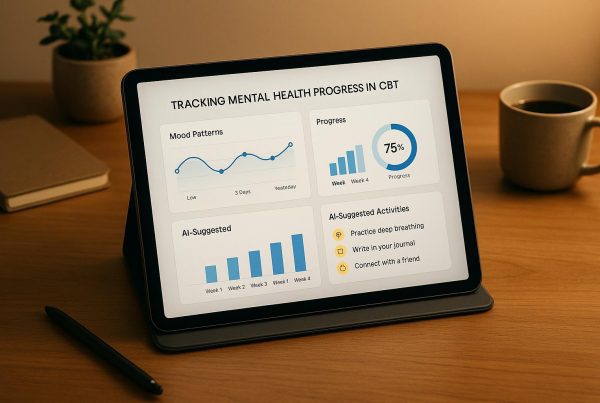


Mood tracking is the simple practice of noticing how you feel and writing it down — a number, a word, or a short note — often enough to see the shape of your emotional life over time. Done well, it turns vague feelings (“this week has been rough”) into something you can actually read: I feel flat on the mornings I skip a walk; I’m calmer the days I eat lunch away from my desk. That’s the whole point. You can’t change a pattern you can’t see, and most of us can’t see our own moods clearly in the moment.
This guide covers what mood tracking is, what the research honestly says it does (and doesn’t do), and how to do it in a way that helps rather than turns into one more thing to feel bad about.
What is mood tracking?
At its plainest, mood tracking means recording your emotional state at intervals — once a day, a few times a day, or whenever something shifts — usually alongside a little context: what you were doing, who you were with, how you’d slept. Over days and weeks, those entries become a record you can look back on and learn from. It’s one of the most accessible forms of self-monitoring — the broader skill of observing your own patterns on purpose.
In psychology research, the rigorous version of this has a name: ecological momentary assessment (EMA). In their foundational review, Shiffman, Stone and Hufford describe EMA as the “repeated sampling of subjects’ current behaviors and experiences in real time, in subjects’ natural environments.” The reason researchers bother is straightforward — they were tired of relying on memory. Ask someone at a clinic visit how their month went and you get a “global retrospective self-report,” which is “limited by recall bias.” Ask them how they feel right now, repeatedly, in their actual life, and you capture something far truer.1
That gap between what we remember feeling and what we actually felt is the quiet case for tracking. Memory smooths things over and lets the loudest moments dominate. A record kept close to the moment doesn’t.
Does mood tracking actually work?
Here’s where it pays to be honest, because the answer is more interesting than a clean yes.
The act of noticing changes things — a little
There’s a well-documented effect called reactivity: the simple act of monitoring something tends to nudge it. A 2022 systematic review and meta-analysis of in-the-moment digital self-measurement found a “small but meaningful” effect on the behaviour being tracked — a pooled effect size (Cohen’s d) of roughly 0.27 to 0.30.2 In plain terms: watching yourself a little changes you a little. Awareness has a gentle gravity of its own — when you notice you’ve been irritable every afternoon, you start, almost involuntarily, to do something about it.
Two honest caveats. First, that effect is modest, not transformative — tracking is a nudge, not a treatment. Second, most of that reactivity research is on behaviours like physical activity, not on mood itself. So treat it as encouraging context, not a promise that logging your feelings will lift them.
What the mood-tracking trials actually show
When researchers test mood monitoring as a standalone intervention for diagnosable conditions, the picture is sobering. A 2026 systematic review and meta-analysis in JMIR Mental Health pooled eight randomized controlled trials (1,230 people across depression and bipolar disorder) and found that mood-monitoring interventions “do not increase or decrease mood symptoms in people with [bipolar disorder], nor is there robust evidence of such effects in people with unipolar depression.” The effects on symptom scores were small and mostly not statistically significant.3
The same authors offer a line worth sitting with: “the popularity of the process may be disproportionate to the direct effects of mood monitoring as an intervention.” In other words — millions of people track their moods and value it, even though tracking by itself doesn’t reliably move clinical symptoms. That’s not a contradiction. It tells you what tracking is genuinely for: insight, self-understanding, and a foundation for action — not a cure you can do on your own.
The clearest takeaway: mood tracking is a tool for seeing, not a treatment for fixing. Its value comes from what you do with what you see.
Why naming a feeling helps — the science of “name it to tame it”
If tracking has one ingredient that does real work in the moment, it’s this: putting a feeling into words.
In a now-classic neuroimaging study, Lieberman and colleagues had people label the emotion in photographs of faces. Simply naming an emotion (“angry,” “afraid”) “diminished” the response of the amygdala — the brain’s threat-and-alarm hub — compared with other ways of processing the same images, while increasing activity in a prefrontal region associated with regulation.4 The popular shorthand is “name it to tame it,” and there’s a real mechanism under it.
A later review by Torre and Lieberman frames this as affect labeling as implicit emotion regulation: naming what you feel quietly does some of the same work as deliberately reframing a situation — even though, oddly, it rarely feels like you’re regulating anything while you do it.5 And it isn’t only a lab effect: in one study, spider-fearful people who labelled their fear during exposure to a live tarantula showed reduced physiological arousal a week later, in a new context.6
There’s a refinement that matters for how you track: precision. Research on emotional granularity — the ability to tell your feelings apart with specificity — finds that people who experience emotions in finer detail (not just “bad” but “disappointed,” “lonely,” “restless”) tend to regulate them more skilfully and rely less on harmful coping — a skill at the heart of emotional intelligence.7 These are associations rather than proof, but the practical implication is clear and useful: a specific word beats a vague number. “Anxious about the 3pm review” tells you far more than “mood: 4/10.” If finding any word at all is hard, that is a recognised trait called alexithymia, and it can improve with practice.
Mood tracking is already at the heart of therapy
If self-monitoring feels clinical, that’s because it quietly underpins several of the most evidence-based forms of therapy. You may already have met it without the label.
- Cognitive behavioural therapy (CBT) uses a thought record: you note the situation, the automatic thought, the emotion (rated for intensity), the evidence for and against the thought, and a more balanced alternative — then re-rate the emotion. (That last step is cognitive restructuring in action.) Tracking the feeling is built into the instrument.8
- Behavioural activation, a frontline approach for low mood, has you log your activities and the mood and sense of accomplishment each one brings — so you can deliberately schedule more of what genuinely lifts you.
- Dialectical behaviour therapy (DBT) uses a daily diary card to track emotions, urges and the skills used to handle them.
The common thread: in each, tracking isn’t the destination — it’s the raw material. You gather honest data, then you and a therapist (or you and a good framework) work out what to do with it.
How to track your mood well
Most mood tracking fails not because the idea is wrong but because the method is fiddly, shaming, or aimless. Here’s how to do it so it actually earns its place. (These are practical recommendations grounded in the research above — not a rigid prescription.)
| Instead of… | Try… | Why |
|---|---|---|
| A bare 1–10 score | A specific word plus a number | Naming the feeling precisely is itself mildly regulating |
| Mood alone | Mood + context (activity, sleep, who you were with) | Patterns live in the context, not the number |
| Logging from memory at week’s end | Logging close to the moment | Cuts recall bias — the whole reason EMA exists |
| Recording and never reviewing | A short weekly look-back for patterns | Reviewing is where insight (and any nudge) happens |
| Tracking forever, every hour | A focused stretch, then easing off | It’s a tool to find patterns, not a permanent duty |
A few notes on the choices above. On timing, logging in the moment is the gold standard for accuracy, because it sidesteps the recall bias that EMA was designed to defeat.1 But an end-of-day check-in is far better than nothing and far easier to sustain — the best method is the one you’ll actually keep. On context, the gold is in the surrounding detail: sleep, food, movement, conversations, deadlines. The number tells you that you felt low; the context tells you why, which is the part you can change.
And on reviewing — this is the step most people skip and the one that does the work. Once a week, read back and ask: what lifted me, what drained me, what surprised me? You’re not auditing yourself; you’re getting to know yourself. This kind of structured noticing-and-reflecting is exactly what reflective tools — including AI coaching and therapy like aidx.ai — are built to support: you talk through what you’re noticing, and something on the other side helps you name it, connect the dots, and decide what to try next. Tracking gathers the dots; reflection joins them.
When mood tracking can backfire
Tracking isn’t right for everyone, all the time, and it’s worth saying so plainly.
For some people — particularly those prone to health anxiety, obsessive checking, or rumination — frequent self-monitoring can feed the very thing it’s meant to ease. Clinical guidance on health anxiety is clear that repeatedly checking and seeking reassurance tends to increase how much you notice and worry, with relief that’s short-lived — a cycle that maintains the anxiety rather than resolving it.9 If checking your mood ten times a day leaves you more on edge, that’s a signal to track less, not more — or to pause and talk to someone.
And tracking is a complement to care, not a substitute for it. The trial evidence is honest about this: monitoring alone doesn’t reliably shift clinical depression.3 If your low mood is persistent, heavy, or you’re having thoughts of harming yourself, that’s a moment for real human support — a GP, a therapist, or a crisis line — not a spreadsheet.
The bottom line
Mood tracking won’t fix you — and that’s the wrong job to give it. What it does, quietly and reliably, is help you see: it cuts through the fog of memory, surfaces the patterns hiding in your week, and — when you name what you feel with a little precision — gives your nervous system a small assist along the way. Start small. Track a specific word and a scrap of context for a couple of weeks, review it once, and let what you notice guide one small change. That’s mood tracking doing its real work: not measuring you, but introducing you to yourself.
References
- Shiffman S, Stone AA, Hufford MR. Ecological momentary assessment. Annual Review of Clinical Psychology. 2008;4:1–32. PubMed
- McDonald S, et al. A systematic review and meta-analysis of studies of reactivity to digital in-the-moment measurement of health behaviour. Health Psychology Review. 2022;16(4). Publisher
- Wright LA, et al. Mood monitoring, mood tracking, and ambulatory assessment interventions in depression and bipolar disorder: systematic review and meta-analysis of RCTs. JMIR Mental Health. 2026;13:e84020. PMC (open access)
- Lieberman MD, et al. Putting feelings into words: affect labeling disrupts amygdala activity in response to affective stimuli. Psychological Science. 2007;18(5):421–428. PubMed
- Torre JB, Lieberman MD. Putting feelings into words: affect labeling as implicit emotion regulation. Emotion Review. 2018;10(2):116–124. Publisher
- Kircanski K, Lieberman MD, Craske MG. Feelings into words: contributions of language to exposure therapy. Psychological Science. 2012;23(10):1086–1091. Publisher
- Kashdan TB, Barrett LF, McKnight PE. Unpacking emotion differentiation: transforming unpleasant experience by perceiving distinctions in negativity. Current Directions in Psychological Science. 2015;24(1):10–16. Publisher
- Beck Institute for Cognitive Behavior Therapy. Understanding CBT. beckinstitute.org
- Centre for Clinical Interventions (Government of Western Australia). Helping Health Anxiety: Reducing Checking and Reassurance Seeking. cci.health.wa.gov.au (PDF)
This article is general information about the practice of mood tracking, not medical or psychological advice. If you’re struggling with persistent low mood, anxiety, or thoughts of self-harm, please reach out to a qualified professional or, in a crisis, your local emergency services or a crisis helpline.