
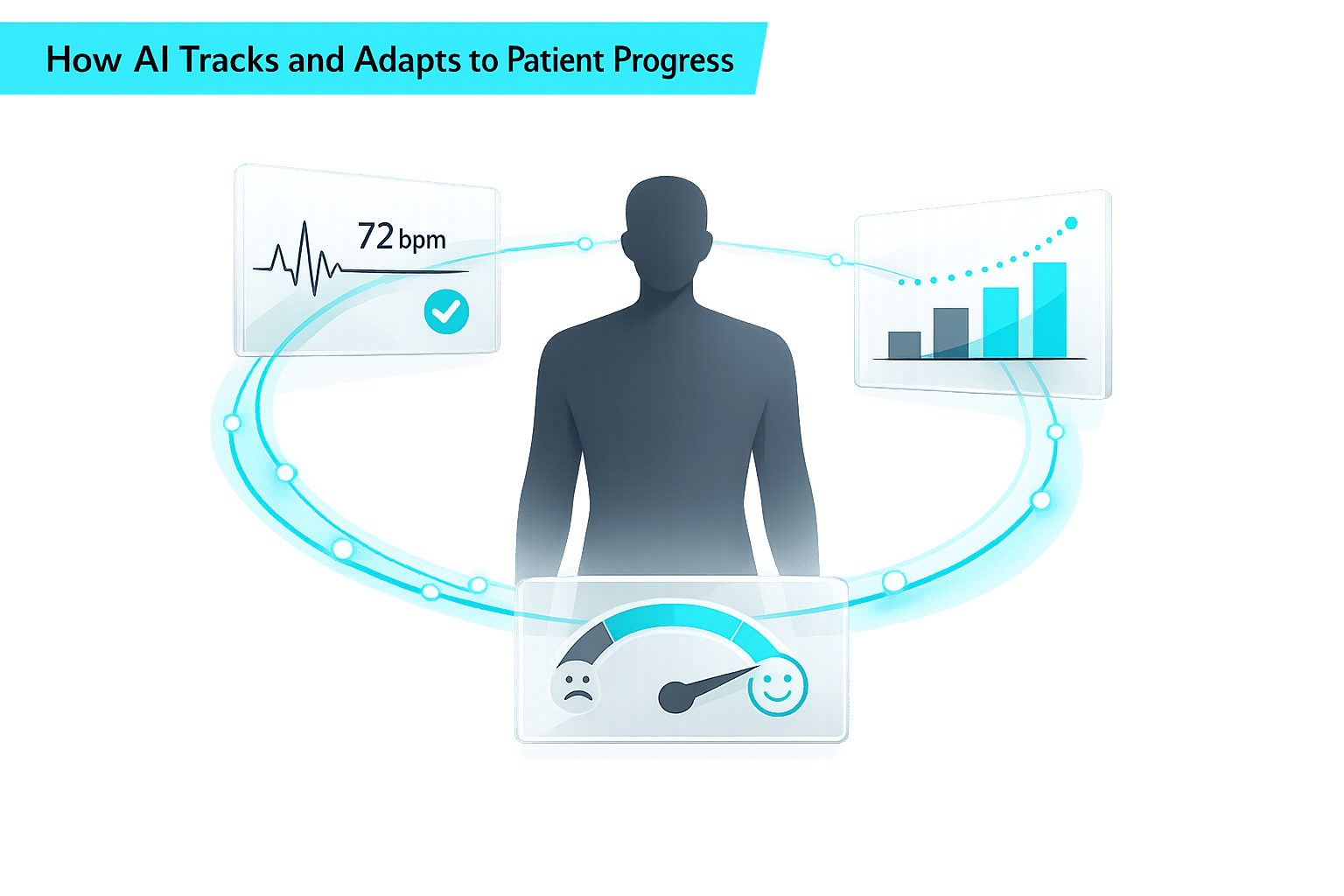
AI is transforming how patient progress is monitored, shifting from infrequent, subjective updates to continuous, data-driven insights. By analyzing real-time data from wearables, patient inputs, and behavior patterns, AI provides a clearer picture of mental health trends and therapy effectiveness. Tools like Natural Language Processing (NLP) and Dynamic Personalized Optimization (DPO) refine care by identifying emotional changes, tailoring therapy exercises, and predicting the best interventions based on individual needs.
Key takeaways:
- Continuous monitoring: AI tracks mood ratings, activity levels, and engagement patterns to fill gaps between therapy sessions.
- NLP and sentiment analysis: Detects emotional shifts in patient language to support timely care adjustments.
- Dynamic therapy adjustments: DPO customizes exercises and communication styles to align with patient progress.
- Scalability: AI enables personalized care for large patient groups while ensuring privacy and security.
This approach improves therapy outcomes by offering timely, personalized support, reducing symptoms of depression and anxiety, and increasing patient engagement. AI-powered platforms like Aidx.ai demonstrate how these tools are reshaping mental health care.
AI, Autopilot, & the Future of Patient Monitoring | James Mault, MD | NextMed Health
sbb-itb-d5e73b4
How AI Monitors Patient Progress in Teletherapy
AI vs. Traditional Teletherapy: Key Outcome Statistics
In traditional teletherapy, check-ins often happen every few weeks, leaving gaps where a patient’s condition can shift significantly. AI steps in to fill these gaps by continuously gathering and analyzing data between sessions, offering a clearer and more dynamic view of patient progress.
Types of Data AI Tracks
AI collects two main types of data to assess patient progress:
- Active data: This includes inputs like mood ratings, goal updates, and standardized assessments such as PHQ-9 and GAD-7 [4].
- Passive data: This refers to more subtle indicators, such as how often a patient interacts with the platform, their response times, and even patterns in the language they use [3].
Together, these data streams create a more comprehensive picture of a patient’s mental health. By using natural language processing (NLP), AI can analyze this information to uncover emotional trends that might otherwise go unnoticed.
How NLP and Sentiment Analysis Work in Patient Monitoring
Natural Language Processing (NLP) is a key tool in AI-driven teletherapy. It doesn’t just analyze what patients say during sessions – it also picks up on the emotional undertones in their language. Large Language Models (LLMs) process unstructured text from session transcripts and clinical notes to detect shifts in sentiment and patterns in how patients discuss their experiences [1].
For instance, AI systems can transcribe therapy sessions in real time, track evidence-based practice usage, and identify linguistic changes that might signal shifts in a patient’s emotional state. Importantly, NLP doesn’t replace clinical judgment. Instead, it serves as a supplementary tool, helping therapists spot subtle changes in engagement or emotional trends that might otherwise be missed. This additional layer of analysis supports more informed and timely care adjustments.
Why Continuous Monitoring Improves Patient Care
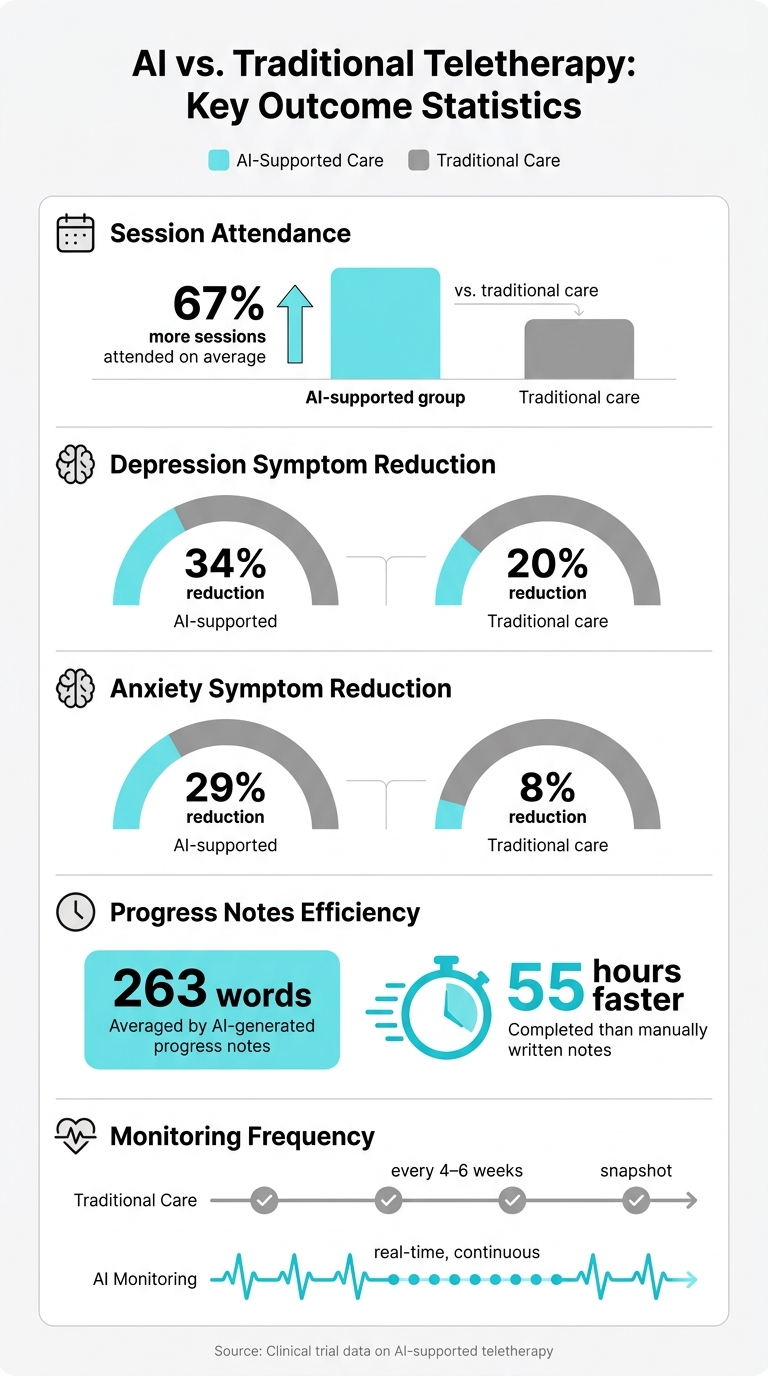
The main advantage of continuous monitoring over periodic assessments is the immediacy and depth of insights it provides. Traditional tools like the PHQ-9 offer a snapshot of a patient’s condition every 4–6 weeks. In contrast, AI tracks changes in real time, offering insights into therapeutic alliance, emerging themes, and emotional trends during each session [3].
The impact of this approach is backed by data. In one clinical trial, patients in an AI-supported group attended 67% more sessions on average, saw a 34% reduction in depression symptoms (compared to 20% with traditional care), and experienced a 29% reduction in anxiety symptoms (versus 8% for standard treatment) [4]. Additionally, AI-generated progress notes averaged 263 words and were completed 55 hours faster than manually written ones [4].
This ability to adapt treatment based on real-time insights – rather than relying solely on periodic assessments – highlights how AI-driven monitoring is reshaping teletherapy. By seamlessly integrating data collection and analysis, AI is playing a central role in enhancing the effectiveness of mental health care.
AI Methods for Detecting Patient Change and Progress
Collecting continuous data is only part of the equation. The real power lies in how AI interprets that data, identifying meaningful changes and translating them into actionable steps for improved care.
Pattern Recognition and Anomaly Detection
AI excels at learning individual patterns and spotting deviations. By analyzing time-series data like symptom logs, session transcripts, and engagement records, it can detect trends that might otherwise go unnoticed. For instance, if a patient who usually responds to messages within minutes suddenly takes hours or their language becomes more withdrawn, the system flags these changes. This approach shifts care from being reactive to proactive, enabling early intervention for critical issues like suicidal ideation [6]. Such methods also support tracking progress and tailoring interventions to individual needs.
Goal and Behavior Tracking
Beyond spotting anomalies, AI plays a key role in monitoring progress toward specific goals and behaviors. Using frameworks like DPO (Data, Prediction, Optimization), AI combines various data points – such as user background, status updates, treatment content, and feedback – to predict effective interventions and adjust treatment plans dynamically.
"Leveraging advanced AI models for DPO may facilitate the integration of heterogeneous patient data in ways previously unattainable, essentially serving as a ‘brain’ for DTx that learns and adapts to each patient." – Dohyoung Rim, PhD [1]
Platforms like Aidx.ai demonstrate how structured tracking can directly support therapy and coaching. For example, Aidx monitors conversations to assess stress levels, burnout risk, and emotional health, alerting care teams before patients even recognize these issues themselves. Supporting this approach, research by Dr. Gail Matthews from Dominican University shows that combining written goals with action steps and weekly accountability boosts goal achievement by 78% [5]. Aidx incorporates these principles into its features, offering roadmaps and accountability tools to help patients stay on track.
To refine these insights, AI integrates data from multiple sources.
Using Multimodal Data to Improve Mental Health Insights
Subjective reports are just one piece of the puzzle. AI enhances accuracy by combining subjective inputs with objective data, such as sleep patterns, physical activity, and vital signs collected from wearables. These data points are converted into numeric vectors using embedding techniques, allowing for unified analysis across different types of information [1].
One example of this approach comes from a DPO-based system designed for patients with Mild Cognitive Impairment (MCI). This system integrated user demographics, sleep data, daily activities, and cognitive assessments like Mini-Mental State Examination (MMSE) scores. By combining this data with performance in cognitive games, the system dynamically tailored training exercises to each patient’s unique behavioral profile, moving beyond self-reported information [1]. Multimodal methods like these are becoming the norm in AI-driven mental health monitoring, with half of the relevant research expected to emerge between 2024 and 2026 [6].
How AI Adjusts Therapeutic Approaches in Real Time
AI has transformed therapy by enabling real-time adjustments based on continuous monitoring. This ensures that care evolves as quickly as a patient’s needs do, offering a truly adaptive approach to treatment.
Selecting and Adjusting Therapeutic Exercises
The DPO framework (Dynamic Patient Optimization) plays a key role in tailoring therapy. By analyzing patient background, current status, treatment options, and past feedback, AI predicts the most suitable exercise for the moment.
"DPO differentiates itself by continuously optimizing treatment content through AI-based prediction of patient feedback, thereby extending the concept from temporal adaptation to content-level personalization." – Dohyoung Rim, PhD, Rowan Corporation [1]
This approach goes beyond traditional Just-In-Time Adaptive Interventions (JITAIs). While JITAIs focus on when to intervene, DPO emphasizes what to deliver. For example, it might select a mindfulness exercise, a CBT thought record, or a behavioral activation task based on what is most likely to help the individual at that specific time [1]. Platforms like Aidx.ai bring this concept to life by using evidence-based methods such as CBT, DBT, ACT, and NLP. Instead of following a rigid sequence, the system adapts to the user’s emotional state and progress data, ensuring therapy feels tailored rather than generic.
Personalizing Conversational Style and Support Level
AI doesn’t just adapt the content of therapy – it also fine-tunes the way it communicates. If sentiment analysis detects signs of heightened distress, the system may adopt a more empathetic tone, offering validation before introducing more challenging techniques like cognitive reframing. On the other hand, steady progress might prompt the system to introduce more complex cognitive tasks.
Every interaction, from word choice to engagement level, feeds into the model, refining it for future exchanges [1]. This creates a dynamic, responsive experience that feels more like a natural conversation than a pre-set script, strengthening the connection between real-time data and personalized therapy.
Flagging High-Risk Patterns and Managing Crisis Situations
AI systems are also designed to identify and respond to high-risk situations. For example, when patterns of severe distress – such as hopelessness or suicidal ideation – emerge, the system immediately flags the case for human intervention. Clinical tools like the PHQ-9 (used to evaluate depression severity on a 0–27 scale) and the GAD-7 help these systems measure symptom intensity [7]. If scores exceed critical thresholds, the case is routed to a licensed professional for review.
"AI must generate transparent recommendations while ensuring clinical validation and ethical oversight." – JMIR Medical Informatics [1]
Regulators are increasingly recognizing the importance of this human-in-the-loop model. A notable example is the FDA’s clearance of an AI virtual care assistant in March 2026, designed for joint replacement recovery. This system performs regular check-ins and alerts physicians to potential complications, showcasing how AI can seamlessly integrate into healthcare while maintaining clinical safeguards [2].
Scaling Personalized Care Across Diverse Patient Populations
AI has made it possible to scale personalized care across diverse patient groups without sacrificing quality. By leveraging real-time monitoring and adjustments, AI-powered teletherapy can now cater to thousands of users simultaneously, tailoring interventions to individual needs.
Grouping Patients by Profiles to Tailor Interventions
AI doesn’t rely on a one-size-fits-all approach. Instead, it categorizes patients into groups based on factors like symptoms, goals, engagement styles, and demographic trends. This ensures that the support provided is more relevant and effective. Research highlights how engagement patterns can differ across demographic lines, emphasizing the need for this tailored approach.
With advanced tools like natural language processing (NLP) and large language models (LLMs), AI can handle various data types – such as clinical notes, health metrics, and even images – within a unified framework [1]. This capability allows systems to identify specific "need groups" and direct each patient to the most appropriate intervention.
The Stanford Center for Digital Health has validated the effectiveness of these targeted AI interventions [9].
Reducing Bias in AI-Driven Care
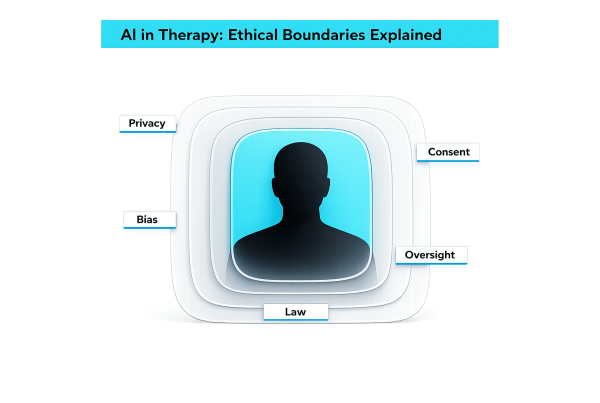
While personalization improves outcomes, it’s crucial to ensure that care remains fair and unbiased. AI models trained on incomplete or skewed data risk disadvantaging certain groups based on factors like age, gender, ethnicity, or health literacy. Achieving fairness requires intentional design choices and ethical oversight.
"The responsible use of AI-based DTx requires addressing ethical issues such as transparency, fairness, cybersecurity, and data protection, which must be implemented with accountability." – Dohyoung Rim, PhD, Rowan Corporation [1]
Practical strategies to address this include following Plain Language Guidelines to make educational content accessible to patients with varying literacy levels. Another approach is the Boundary-Aware Therapeutic Personalization (BTP) framework. By using techniques like strategic questioning and reflective summarization, this method keeps engagement levels high while minimizing risks like parasocial dependency. Studies show a strong link (r = .85) between personalization and therapeutic engagement [8].
Protecting Patient Privacy and Data Security in Teletherapy
As teletherapy platforms expand, safeguarding sensitive health information becomes even more critical. Patients must trust that their data is secure. The Privacy-by-Design model is the gold standard, ensuring that privacy measures are integrated into the system from the outset rather than added later [8].
This includes robust encryption, full HIPAA compliance, and giving users control over their data, including the option to delete it entirely. Platforms like Aidx.ai exemplify this commitment by encrypting conversations and allowing users full control over their information, meeting GDPR standards. Importantly, research shows that therapeutic engagement doesn’t depend on storing user identities – patients reported a continuance intention score of 6.9 out of 10 even when their identities weren’t stored [8].
"Engagement and safety may not necessarily be mutually exclusive: when grounded in boundary-aware design, therapeutic AI systems can support ethically aligned personalization while reducing risks related to dependency and boundary erosion." – Boyoung Kang [8]
Conclusion: What AI-Powered Progress Tracking Means for Patient Care
AI is reshaping how we track and enhance patient progress, moving beyond traditional methods to create a more dynamic, responsive approach. By combining real-time analytics, advanced pattern recognition, and the DPO framework we touched on earlier, AI systems are no longer just reactive tools – they’re proactive partners in care. This means patient support extends far beyond scheduled appointments, offering continuous and adaptive care.
As we’ve seen, structured goal tracking plays a key role in improving outcomes. AI platforms that weave this structure into therapy – through features like visual progress maps, automated reports, and tools to detect early signs of burnout – are delivering real benefits for patients. These tools not only provide clarity but also help maintain motivation and focus throughout the therapeutic journey.
What makes this approach even more impactful is its ability to scale without sacrificing precision. As discussed earlier, AI can manage thousands of patients at once, tailoring care to each individual’s unique needs. Whether it’s mood patterns, engagement styles, or early risk indicators, AI adapts interventions to fit the person. Dohyoung Rim, PhD, of Rowan Corporation, captures this potential perfectly:
"Leveraging advanced AI models for DPO may facilitate the integration of heterogeneous patient data in ways previously unattainable, essentially serving as a ‘brain’ for DTx that learns and adapts to each patient." [1]
This combination of dynamic data tracking and personalized therapeutic adjustments is already showing measurable results. For instance, Aidx.ai is a standout example of how AI can transform care. By integrating evidence-based approaches like CBT, DBT, ACT, and NLP with structured goal tracking, weekly accountability tools, and continuous wellness monitoring, Aidx offers 24/7 support – even starting with a free plan. Hali Holeszowski, Founder and Mobility Coach, summed it up well: "Aidx has been surprisingly human in identifying problems & asking the right questions. But faster!" [5]
This shift toward AI-powered progress tracking is paving the way for a more effective, personalized, and scalable future in patient care.
FAQs
What data does AI use to track my progress between sessions?
AI tools are designed to track your progress by analyzing how you interact, the language you use, and your behavior patterns over time. For example, platforms like Aidx.ai leverage Natural Language Processing (NLP) to assess emotional states, stress levels, and changes in sentiment. They also keep tabs on factors like mood check-ins, sleep quality, and goal achievements. By compiling this data, these tools can pinpoint triggers and patterns, presenting the information through visual roadmaps and weekly reports to help you measure progress over the long term.
How does AI personalize therapy exercises in real time without replacing my therapist?
AI tools are reshaping therapy by adjusting exercises on the spot, based on your emotional patterns, communication style, and past interactions. For instance, platforms like Aidx.ai utilize their Adaptive Therapeutic Intelligence (ATI) System™ to offer support between sessions. By analyzing elements like your voice, tone, and written text, these tools suggest evidence-based methods – such as Cognitive Behavioral Therapy (CBT), Dialectical Behavior Therapy (DBT), or Acceptance and Commitment Therapy (ACT) – that align with your unique needs. This ensures you receive consistent, personalized guidance alongside your work with a professional therapist.
How is my mental health data kept private and secure in AI teletherapy?
Aidx.ai prioritizes your privacy by using end-to-end encryption, ensuring your data is never sold or shared. Your conversations remain completely private – no one, not even humans, can read them. Plus, you have full control to delete all your data whenever you choose.
Additional security features include an incognito mode that automatically clears session data after 30 minutes of inactivity and a lock screen for added protection. Built with cybersecurity expertise, the platform is also GDPR compliant, offering robust safeguards for your information.