
If you’ve ever caught your mind running the same harsh loop — I always mess this up, they must think I’m an idiot, this is going to go badly — you already know how convincing a negative thought can feel. Cognitive behavioural therapy (CBT) is the most studied, best-evidenced way to loosen that grip: a structured method for catching automatic negative thoughts, testing them against reality, and replacing them with something more balanced. The newer question is whether an AI tool can help you do that work too — and where a human therapist is still irreplaceable.
The honest answer is that this isn’t a contest. AI-assisted CBT and traditional CBT are good at different things. This guide walks through how each one actually works on negative thinking, what the research says at its true magnitude, and how to decide — or combine — based on what you’re dealing with.
How CBT changes a negative thought
CBT is built on a simple, durable idea from psychiatrist Aaron T. Beck: the way you interpret a situation shapes how you feel and act far more than the situation itself. Two people miss the same deadline; one thinks I’m careless and people will lose faith in me and spirals, the other thinks that slipped — I’ll flag it and reset and moves on. The event is identical. The automatic thought — the fast, unbidden interpretation that pops up before you’ve reasoned anything — is what diverges. (The Beck Institute describes this as the cognitive model: thoughts, emotions, and behaviours are interconnected.)
So CBT for negative thinking is, at heart, a few repeatable moves:
- Catch the thought. Notice the automatic interpretation and the feeling attached to it, often by jotting it down in a thought record.
- Check it. Name the pattern (the cognitive distortion — catastrophising, mind-reading, all-or-nothing thinking) and ask what the actual evidence is, for and against.
- Change it. Build a more balanced, realistic alternative — not forced positivity, just a fairer reading — and notice how the feeling shifts.
This is the engine of CBT, and it’s worth learning regardless of how you access it. The American Psychological Association frames the core skill plainly: learning to recognise distortions in thinking and reevaluate them in light of reality. We go deeper on the practical mechanics in our guide to how to challenge automatic negative thoughts.
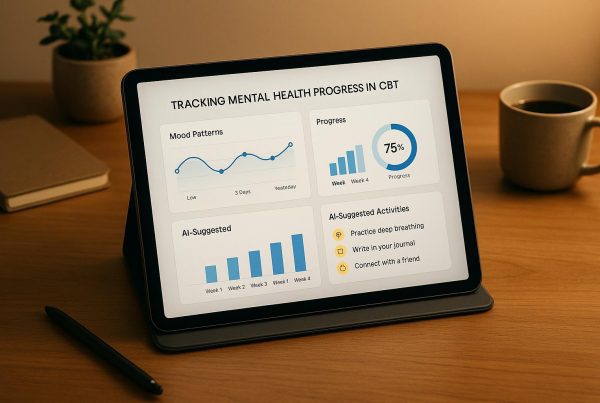
How strong is the evidence? A widely cited 2012 review of meta-analyses by Hofmann and colleagues concluded that the evidence base for CBT is “very strong”, with the most consistent support for anxiety disorders, and at least medium effect sizes for conditions such as social anxiety, panic disorder, and post-traumatic stress. (You’ll sometimes see a tidy “75% success rate” attached to CBT — that figure isn’t in the research; response rates vary widely by condition, so treat any single number with care.)
How AI assists the same work
AI-assisted CBT doesn’t reinvent any of the above. It delivers the same catch–check–change loop through a conversation — you describe what’s going on, and the tool helps you name the thought, question it, and reframe it, in the moment rather than at next week’s appointment. The useful difference is timing and access: negative thoughts rarely wait for office hours. They show up at 1am, before a presentation, or in the slow drift of a Sunday evening.
Two things make this more than a gimmick. First, the moment of a negative thought is exactly when reframing works best — while the thought and its evidence are still fresh. Second, the repetition. Restructuring a thought once is insight; doing it fifty times is a new habit. A tool that’s always there lowers the friction on the reps.
The evidence here is younger than CBT’s, but it’s real and growing — and worth reading at its true size rather than the hype:
- A 2023 meta-analysis in npj Digital Medicine (15 randomised trials, ~1,744 people) found AI conversational agents produced a significant reduction in psychological distress (Hedges’ g = 0.70) and in depression symptoms (g = 0.64). Notably, the effect on anxiety wasn’t statistically significant in that analysis — a useful reminder that “AI helps mental health” is too broad a claim. In a sub-analysis, generative AI agents outperformed older rule-based scripts on distress (g = 1.24 vs 0.52).
- The early Woebot randomised trial (2017) found that two weeks with a CBT chatbot significantly reduced depression symptoms versus an information-only control (a moderate effect, d = 0.44) — from a small, short pilot, but a genuine signal.
- More recently, a 2025 randomised trial of a purpose-built generative-AI therapy chatbot, run by researchers at Dartmouth and published in NEJM AI, reported meaningful symptom reductions over four weeks — roughly 51% for depression and 31% for generalised anxiety against a waitlist control, in a modest sample of 106 people.
The throughline: well-designed AI CBT can move the needle on negative thinking and low mood, especially for mild-to-moderate difficulty — while the strongest, most consistent evidence still belongs to traditional CBT delivered by a person.
AI vs traditional CBT: where each one wins
For the specific job of working with negative thoughts, here’s how the two compare on the dimensions that actually matter.
| For negative thoughts… | AI-assisted CBT | Traditional CBT |
|---|---|---|
| Catching them in the moment | Available the instant a thought hits — late night, before a meeting | Worked through at the next scheduled session |
| Repetition & practice | Unlimited reps; low friction to do the work daily | Skills taught in session, practised via homework between visits |
| Depth & nuance | Good for clear, surface-to-moderate patterns | Reads tone, history, and what’s left unsaid; handles complexity |
| Complex or deep-rooted issues | Not a substitute for clinical care | Trained to navigate trauma, severe depression, comorbidity |
| Cost & access | Lower cost, no waitlist, no travel | Higher cost per session; availability varies by region |
| Human connection | Private and non-judgemental, but not a relationship | The therapeutic alliance itself is part of what heals |
| Crisis & acute risk | Not appropriate — needs a human and emergency services | Equipped to assess risk and escalate care |
Two patterns are worth pulling out of that table.
AI’s real advantage is continuity, not cleverness. A therapist might be the better thinker in the room, but they aren’t in the room at 2am. The value of an always-available tool is that it closes the gap between learning a CBT skill and using it when it counts — the daily reps that turn a technique into a reflex.
The human alliance is doing real work, not just keeping you company. Decades of research find that the relationship between client and therapist is one of the most reliable predictors of outcome. An AI can be warm, consistent, and genuinely useful, and many people find it easier to be honest with something that can’t judge them — but it isn’t a substitute for that bond when deeper healing is the goal.
Which should you choose — or how to combine them
A reasonable way to decide, based on what you’re actually carrying:
- Everyday negative thinking, stress, mild-to-moderate low mood or worry. AI-assisted CBT is a sensible, low-barrier starting point — especially for building the daily habit of catching and reframing thoughts. Many people use it precisely because there’s no waitlist and no judgement.
- Persistent, severe, or complex difficulties — trauma, long-standing depression, anything that’s affecting your ability to function. This is where a trained human therapist is the right call, and the evidence base is strongest.
- Acute risk — thoughts of suicide or self-harm, or a crisis. This always needs a person and emergency services, not an app. (See the note at the end of this article.)
For a lot of people, the most realistic answer is “both.” The strongest professional consensus isn’t “AI replaces therapy” — the American Psychological Association’s 2025 health advisory is explicit that general-purpose AI tools should be a supportive adjunct, not a replacement, for a qualified provider. In practice that looks like seeing a therapist for the deeper work while using an AI tool between sessions to catch thoughts as they arise, keep practising the reframes you’re learning, and notice patterns you’d otherwise forget by Thursday.
This is the lane aidx.ai is built for: AI coaching and therapy that draws on evidence-based methods like CBT (alongside ACT, DBT, and NLP), available whenever a thought catches you — through chat or voice, on whatever device you have. It’s powered by a proprietary AI system (we call it ATI) that adapts to you over time, and you can switch on an incognito toggle in any conversation to keep a session from being stored. It’s honest about what it is: a genuinely useful companion for the everyday work of changing how you think, and a complement to — never a stand-in for — a human clinician when you need one.
The bottom line
Traditional CBT is the gold standard for changing negative thoughts, and for complex or severe difficulties a human therapist remains essential. AI-assisted CBT brings something traditional therapy structurally can’t: the same proven techniques, available the moment an unhelpful thought shows up, with unlimited room to practise. They’re not rivals. The technique is the same; what differs is when and how you can reach it — and for most people, the best result comes from knowing which tool fits the moment.
Last reviewed: June 2026.
This article is general information about cognitive behavioural therapy and AI-assisted tools, not medical advice or a substitute for professional diagnosis or treatment. If negative thoughts are affecting your daily life, consider speaking with a qualified mental health professional. If you are in crisis or having thoughts of harming yourself, contact your local emergency services or a crisis line immediately — in the US, call or text 988 (Suicide & Crisis Lifeline); in the UK, call 116 123 (Samaritans).