
The techniques that calm a stressed nervous system are not a secret. Slow breathing, muscle relaxation, a few minutes of mindfulness, a small shift in how you read a situation — these have decades of research behind them. The hard part was never knowing what to do. It’s doing it: remembering the technique at the exact moment your chest tightens, practising it often enough that it works, and not quietly abandoning it after three days.
That gap — between knowing and practising — is where an AI coach actually earns its place. Not by inventing a new cure for stress, but by putting a known, evidence-based technique in front of you in the moment you need it, and helping you come back to it tomorrow. This guide covers the stress-reduction techniques the evidence supports, how much they really help (honestly), and where AI fits in.
What stress actually does to you
Stress is your body’s response to a demand. Faced with a threat — a deadline, a hard conversation, a packed inbox — your brain activates the HPA axis (the hypothalamic–pituitary–adrenal system), releasing cortisol and adrenaline. Heart rate climbs, muscles tense, attention narrows. In short bursts, this is useful: it’s the system that helps you rise to a challenge.
The problem is when the alarm never fully switches off. According to the American Psychological Association, chronic stress keeps the HPA axis and cortisol elevated, and is associated with a long list of physical effects — persistent muscle tension and tension headaches, raised risk of hypertension and heart problems, disrupted digestion, and knock-on effects on sleep, mood, and immune function (APA, “Stress effects on the body”). These are associations and risks, not a guaranteed fate — but they’re the reason it’s worth having a few reliable ways to bring your arousal back down.
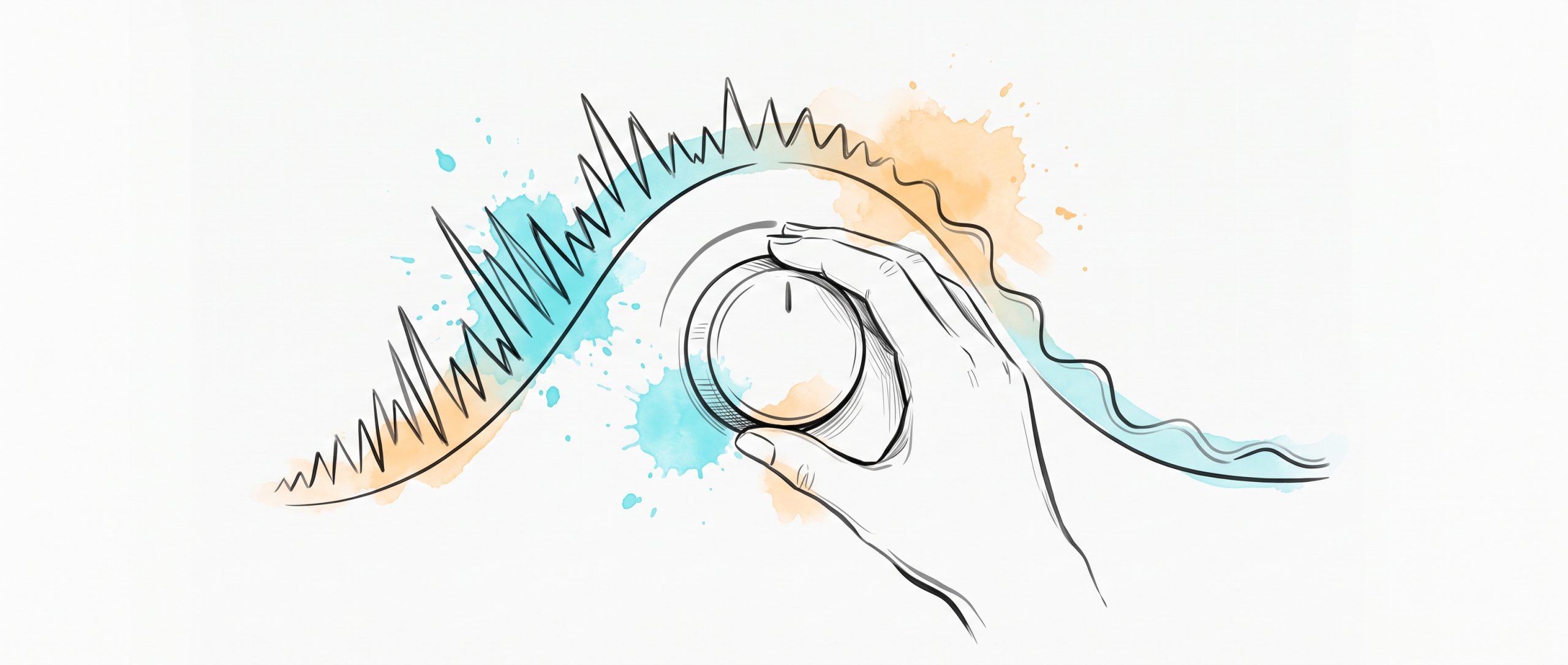
The good news: most evidence-based stress techniques work by doing the opposite of the stress response — deliberately engaging the parasympathetic (“rest and digest”) side of your nervous system. You can’t always control what’s stressful. You can practise lowering the body’s reaction to it.
The stress-reduction techniques that actually have evidence
Here’s the honest landscape. Each of these has real research support, and for most of them the effect is small-to-moderate — meaningful and worth doing, but not magic. We’ve noted the true size so you can set realistic expectations.
| Technique | What the evidence shows | Honest magnitude |
|---|---|---|
| Slow breathing | Lowers self-reported stress, anxiety and low mood | Small-to-moderate |
| Progressive muscle relaxation | Reduces anxiety and tension; strongest in distressed groups | Small-to-large by population |
| Mindfulness / MBSR | Reduces stress and anxiety | Small (smaller vs. active comparisons) |
| Cognitive reappraisal (CBT) | Reframing a situation lowers stress | Small alone; moderate-to-large as full ICBT |
| Expressive writing | Helps process stressful events | Small |
1. Slow, paced breathing
If you do only one thing on this list, make it this. Slowing your breath to roughly six breaths a minute — a long, smooth exhale being the key part — shifts your nervous system toward its calmer, parasympathetic state and is associated with increased heart-rate variability, a marker of a flexible, recovering system (Zaccaro et al., 2018, Frontiers in Human Neuroscience).
For the felt sense of “less stressed,” a 2023 meta-analysis of breathwork found a small-to-moderate reduction in self-reported stress (Hedges’ g ≈ 0.35) across 12 randomised trials (785 participants), with similar effects for anxiety and low mood. The authors are careful to note that most included studies had a moderate risk of bias, so the result should be read as “helpful, take it seriously, don’t oversell it” (Fincham et al., 2023, Scientific Reports).
How to do it: Breathe in gently through your nose for a count of four, then out slowly for a count of six. The longer exhale is what does the work. Three or four minutes is enough to feel a shift. If you’d like a guided version built specifically for moments of acute panic, see our breathing exercises for panic attacks.
2. Progressive muscle relaxation (PMR)
Stress lives in the body as tension. Progressive muscle relaxation works by deliberately tensing a muscle group for a few seconds, then releasing — moving up the body — which teaches you to notice and let go of tension you didn’t realise you were holding.
The size of the effect depends a lot on who’s being studied. In people under significant strain, the effect can be large: a 2022 meta-analysis of PMR in cancer patients found a substantial reduction in anxiety (12 RCTs, over 1,100 patients) (Tan et al., 2022, Complementary Therapies in Clinical Practice). For everyday stress in healthy people the benefit is more modest — but PMR remains one of the most accessible, side-effect-free tools for winding down a tense body. Our step-by-step PMR guide walks through the full sequence.
3. Mindfulness and MBSR
Mindfulness — paying attention to the present moment without judging it — is probably the most-studied stress technique, and it’s also where it’s easiest to overclaim. The most rigorous review, published in JAMA Internal Medicine, found that structured meditation programmes produced small improvements in anxiety and stress, and crucially, no evidence that meditation outperformed other active approaches like exercise (Goyal et al., 2014, JAMA Internal Medicine). In other words: mindfulness genuinely helps, the effect is real, and it’s modest. It’s a good tool, not the only tool.
How to start: You don’t need an hour. Set a timer for five minutes, rest your attention on the feeling of your breath, and each time your mind wanders — it will, that’s not failure, that’s the exercise — gently bring it back. The returning is the practice.
4. Cognitive reappraisal (the CBT move)
A great deal of stress comes not from the event itself but from the story you tell about it. “This is a disaster” and “This is hard, and I’ve handled hard things before” produce very different bodies. Cognitive reappraisal — the core skill of cognitive behavioural therapy (CBT) — means catching the automatic, catastrophic interpretation and deliberately testing a more balanced one.
As a single technique its effect is small, but delivered as a full structured programme it’s powerful: a 2022 meta-analysis found internet-delivered CBT produced a moderate-to-large reduction in self-rated stress (13 studies, over 1,800 adults) (Svärdman et al., 2022, Internet Interventions). The reframe isn’t about forced positivity — it’s about accuracy. Most stress-thoughts are exaggerations, and naming the exaggeration takes some of its charge away.
5. Expressive writing
Putting a stressful experience into words — writing honestly for a few minutes about what’s bothering you and how you feel about it — has a long research history. Be realistic about scale: across hundreds of studies the average benefit is small (Frattaroli, 2006, Psychological Bulletin), and it tends to help most when you’re carrying something genuinely heavy. As a way to get a swirling worry out of your head and onto a page, it costs nothing and is worth a try.
Where an AI coach actually helps
None of the techniques above are new, and an AI coach doesn’t replace them — it helps you use them. That’s a smaller, more honest claim than “AI cures stress,” and it’s the one the evidence supports. Here’s the real value.
It’s there in the moment. The hardest time to remember a breathing exercise is exactly when you need it — mid-spiral, at 11pm, between meetings. An AI coach is available at that moment, with no appointment and no waiting room, which is a genuine practical advantage of app-delivered support. Meta-analyses of smartphone-based mental-health tools find small but real benefits for stress (Hedges’ g ≈ 0.35 across 27 trials), anxiety and low mood, holding up even after adjusting for trial quality (Linardon et al., 2019, World Psychiatry).
It guides the technique instead of just naming it. “Try deep breathing” is useless advice in a crisis. A conversational coach can actually walk you through the four-count-in, six-count-out, pace it with you, and notice when your messages suggest you’re starting to settle. The most-cited trial of a CBT chatbot found it produced a meaningful reduction in depressive symptoms over two weeks compared with an information-only control — though, importantly, in that small two-week study it did not beat the control on anxiety, and the trial was run by the tool’s own makers (Fitzpatrick, Darcy & Vierhile, 2017, JMIR Mental Health). The signal is promising; the honest reading is “early and modest.”
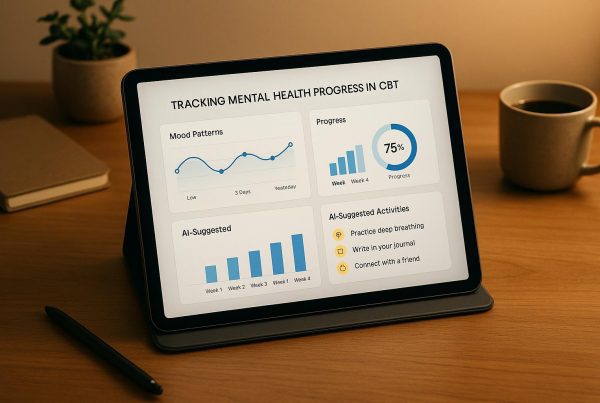
It helps you spot your own patterns. Stress has triggers, and they’re often invisible from the inside. Talking through your week with a coach that remembers what you’ve said can surface the pattern — the Sunday-night dread, the particular person, the recurring overwhelm — so you can do something upstream rather than just firefighting.
It helps you keep going. Most stress techniques only work with repetition, and repetition is where people quietly give up. A gentle check-in, a nudge to do today’s two minutes of breathing, a coach that’s genuinely non-judgemental when you’ve skipped a few days — that consistency is where small effects compound into a real change.
This is the niche aidx.ai is built for: AI coaching and therapy that draws on evidence-based methods — CBT, ACT, and related approaches — to help you practise, in the moment and over time. We’re honest that it’s AI, not a human clinician, and that the techniques it offers are well-established ones, used well.
A realistic way to start
Don’t try to adopt all five techniques at once — that’s its own kind of stress. Pick the one that fits your situation:
- Stress spikes in the body (racing heart, tight chest) → slow breathing, on the spot.
- Wound-up and can’t switch off → progressive muscle relaxation before bed.
- Stress that’s mostly in your head (worry loops, catastrophising) → cognitive reappraisal, or write it out.
- A general baseline that’s too high → a few minutes of daily mindfulness.
Practise it when you’re calm, so it’s available when you’re not. Then let something — a coach, a reminder, a habit — bring you back to it tomorrow. Much of stress is environmental; if yours is concentrated in your job, our guide to managing stress at work goes deeper on the workplace side. The techniques are simple. The repetition is the whole game, and that’s exactly the part an AI coach is good at helping with.
Last reviewed: June 2026. This article is general information about stress-reduction techniques, not medical advice or a substitute for care from a qualified professional. Chronic or severe stress, persistent anxiety, or low mood that affects your daily life are worth discussing with a doctor or therapist. If you’re in crisis or thinking about harming yourself, contact your local emergency services or a crisis line straight away.