
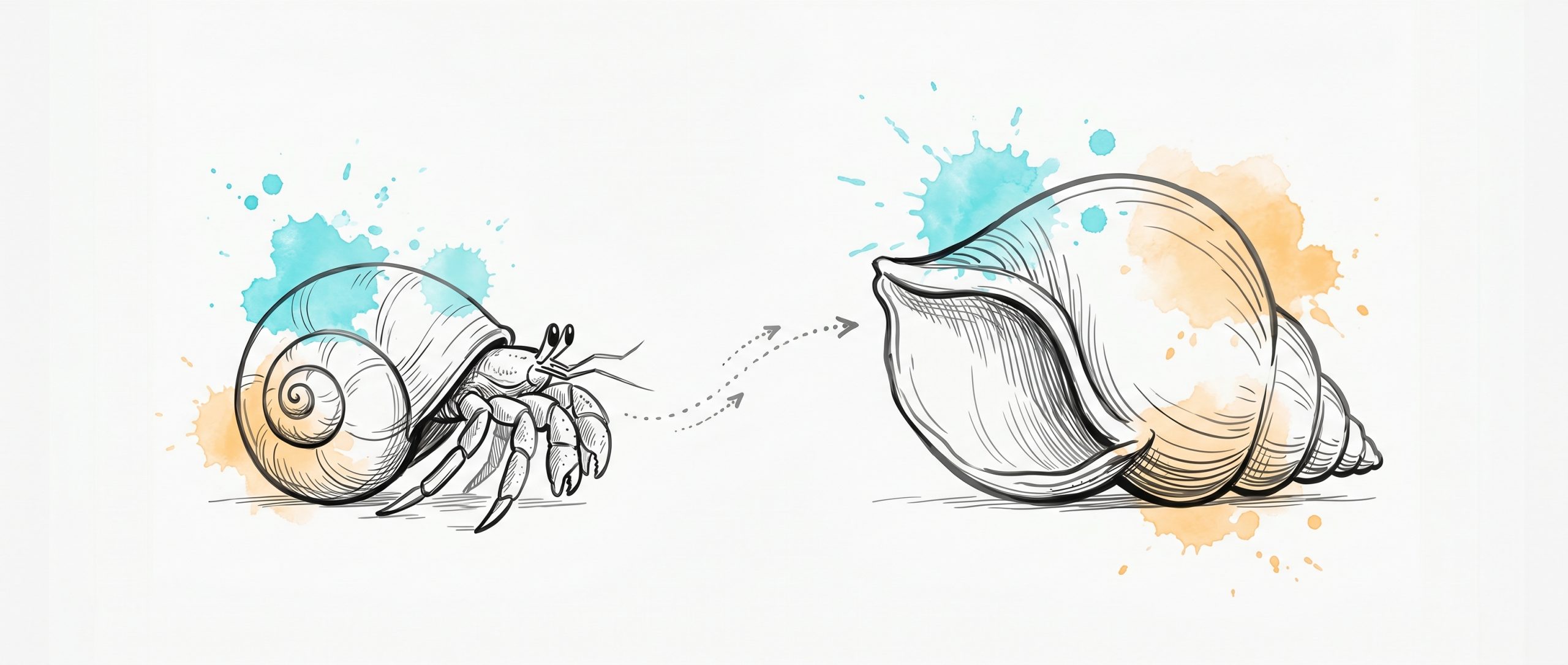
A career transition is rarely just a change of job. It’s a change in who you are — or at least in the story you’ve been telling about yourself. That’s why it can feel so disorienting even when the move is one you chose. You’re not only learning a new role; you’re letting go of an old identity and waiting, often uncomfortably, for a new one to take shape.
This piece is about that inner side of a career transition: the search for purpose, the loss of a familiar self, and the slow work of finding meaning on the other side. If you’re after the practical mechanics — assessing options, building a plan, making the move — we cover those step by step in how to change careers. Here, we stay with the part most guides skip: what’s actually happening to your sense of self, and how to navigate it well.
What a career transition really is
The career-change researcher Herminia Ibarra, a professor of organizational behavior, spent years studying professionals who reinvented their working lives. Her central finding is liberating once it lands: a career transition is not a logistics problem to be solved by better planning. It’s an identity change — a gradual shift in your “working identity,” the set of roles, values, and self-images you carry into your work (Ibarra, Working Identity, 2003).
That reframe matters because it explains why transitions are hard in a way that has nothing to do with competence. You can be excellent at your current job and still feel lost, because the difficulty isn’t skill — it’s that the familiar answer to “who am I and what am I for?” no longer fits, and the new answer hasn’t arrived yet.
It also explains why career change is so common. Most of us will move through many roles in a working life — the U.S. Bureau of Labor Statistics found that people born in the early 1960s held an average of 12.4 jobs between ages 18 and 54 (BLS, NLSY79, 2021). That figure counts jobs, not full career changes — there’s no agreed way to count those — but it makes the point: a working life is not one fixed identity. It’s a series of them.
Why the in-between phase feels so unsettling
The author William Bridges drew a distinction that’s worth holding onto. Change is external and situational — the new title, the resignation letter, the first day somewhere new. It can happen in an afternoon. Transition is internal and psychological — the slow reorientation of who you are — and it can’t be rushed (Bridges, Transitions: Making Sense of Life’s Changes, 1980).
Bridges mapped every transition into three phases, and naming them can be a relief in itself:
| Phase | What’s happening | What it feels like |
|---|---|---|
| The Ending | Letting go of the old role and the identity attached to it | Loss, even grief — sometimes for a job you were glad to leave |
| The Neutral Zone | The old self is gone; the new one hasn’t formed | Ambiguity, doubt, a sense of being nowhere |
| The New Beginning | A new identity and sense of purpose take hold | Direction, energy, a quieter confidence |
The middle phase is the one people try hardest to escape — and it’s the one that does the real work. Anthropologists call this in-between state liminal: betwixt and between, no longer what you were, not yet what you’ll be. Far from a sign that something has gone wrong, the discomfort of the neutral zone is where a new working identity is actually formed (Ibarra & Obodaru, “Betwixt and between identities,” Research in Organizational Behavior, 2016). Rushing through it tends to leave the transition half-finished.
If the transition arrives somewhere in your forties, it often gets a different name — and a misleading one. What people call a midlife crisis is usually this same neutral zone, triggered by a specific event rather than by an age.
You don’t find purpose by thinking harder. You find it by doing.
The most common piece of transition advice is to look inward — reflect deeply, identify your one true passion, then go find the job that matches it. Ibarra’s research turns this on its head. We don’t carry a single hidden “true self” waiting to be uncovered by introspection. We hold many possible selves, and we discover which ones fit by testing them in the real world (Ibarra, “Provisional Selves,” Administrative Science Quarterly, 1999).
Her memorable inversion: we act our way into a new way of thinking, rather than think our way into a new way of acting. Purpose isn’t excavated; it’s assembled, through small experiments:
- A side project that lets you try a kind of work without quitting anything.
- A conversation with someone already doing the thing you’re curious about.
- A short course, a volunteer role, a weekend prototype of the life you’re imagining.
Each experiment returns real information — not “is this my passion?” but “did this energize me or drain me? Did it feel like me?” Over time those answers compose a clearer direction than any amount of staring at a blank page ever could. If you’ve been waiting to feel certain before you move, this is your permission to move in order to feel certain.
What “meaningful work” actually means
Part of finding fulfillment in a transition is getting honest about what you’re really seeking. A classic study identified three distinct ways people relate to the same work: as a job (a means to a paycheck), a career (a path to advancement and status), or a calling (work that feels intrinsically meaningful and worthwhile in itself). Strikingly, all three orientations showed up among people in the same occupation — meaning fulfillment depends less on the job title than on your relationship to the work (Wrzesniewski et al., “Jobs, Careers, and Callings,” Journal of Research in Personality, 1997).
That finding cuts two ways. It’s a caution against assuming a new field will hand you meaning automatically. But it’s also genuinely hopeful: because meaning is partly about how you frame and shape your work, you have more agency than it feels like in the middle of a hard stretch.
Self-determination theory points to where that meaning tends to live. Decades of research by psychologists Edward Deci and Richard Ryan find that people thrive when work satisfies three basic needs: autonomy (a real say in how you work), competence (the sense you’re good at something that matters), and relatedness (genuine connection to the people around you) (Ryan & Deci, American Psychologist, 2000). When a role feels quietly depleting, it’s often one of these three that’s missing — and naming which one can sharpen what you’re actually transitioning toward.
Sometimes the transition you need is inside your current role
Not every search for purpose requires leaving. The same researchers behind the job-and-calling study showed that people actively reshape their roles from within — a practice called job crafting. You can adjust the tasks you take on, the relationships you invest in, and the way you think about your work’s purpose — and in doing so genuinely change the meaning of the job, without changing jobs (Wrzesniewski & Dutton, “Crafting a Job,” Academy of Management Review, 2001).
Before you conclude the whole career has to go, it’s worth asking: is it the field, or is it the shape of this particular role? Could crafting your current work — taking on more of what energizes you, less of what doesn’t — give you much of the fulfillment you’re chasing, with far less upheaval? Sometimes the answer is no, and the bigger move is right. But the question is worth sitting with first.
Being kind to yourself in the neutral zone
The in-between phase is where self-doubt gets loud. You compare your messy middle to other people’s finished stories. You wonder if you’ve made a mistake. Here, how you treat yourself matters more than usual.
Research by psychologist Kristin Neff describes self-compassion as a more stable foundation than self-criticism for getting through hard passages. It has three parts: self-kindness instead of harsh self-judgment when things are uncertain; common humanity — remembering that feeling lost mid-transition is a near-universal human experience, not a personal failing; and mindfulness — holding the difficult feelings honestly without being swept away by them (Neff, “Self-Compassion,” Self and Identity, 2003). Treating yourself the way you’d treat a friend in the same spot isn’t soft; it’s what keeps you steady enough to keep experimenting.
If the uncertainty has tipped into feeling genuinely stuck, our guide on how to get unstuck offers concrete ways to restart momentum, and building career resilience looks at how to recover steadiness after a setback.
A few questions to sit with
You don’t need every answer before you act — that’s the whole point. But these are the questions worth returning to as you experiment your way forward:
- When was the last time work made you lose track of time — and what were you doing?
- Which of autonomy, competence, and connection feels most missing right now?
- Are you craving a different field, or a different relationship to the work you already do?
- What’s one small, low-cost experiment that would tell you something real this month?
- If a good friend were standing exactly where you are, what would you tell them?
A career transition asks more of you than a new résumé. It asks you to loosen your grip on who you’ve been, tolerate a stretch of not-knowing, and build a new sense of purpose through action rather than analysis. That’s genuinely hard — but it’s also how almost everyone who’s done it well has done it. Talking it through can help, whether with a trusted friend, a coach, or a tool like aidx.ai, which offers AI coaching and therapy, including an AI life coach, to help you think clearly when the path ahead is still forming. The clarity you’re looking for isn’t behind you, waiting to be remembered. It’s ahead of you, waiting to be made.
Last reviewed: June 2026.