
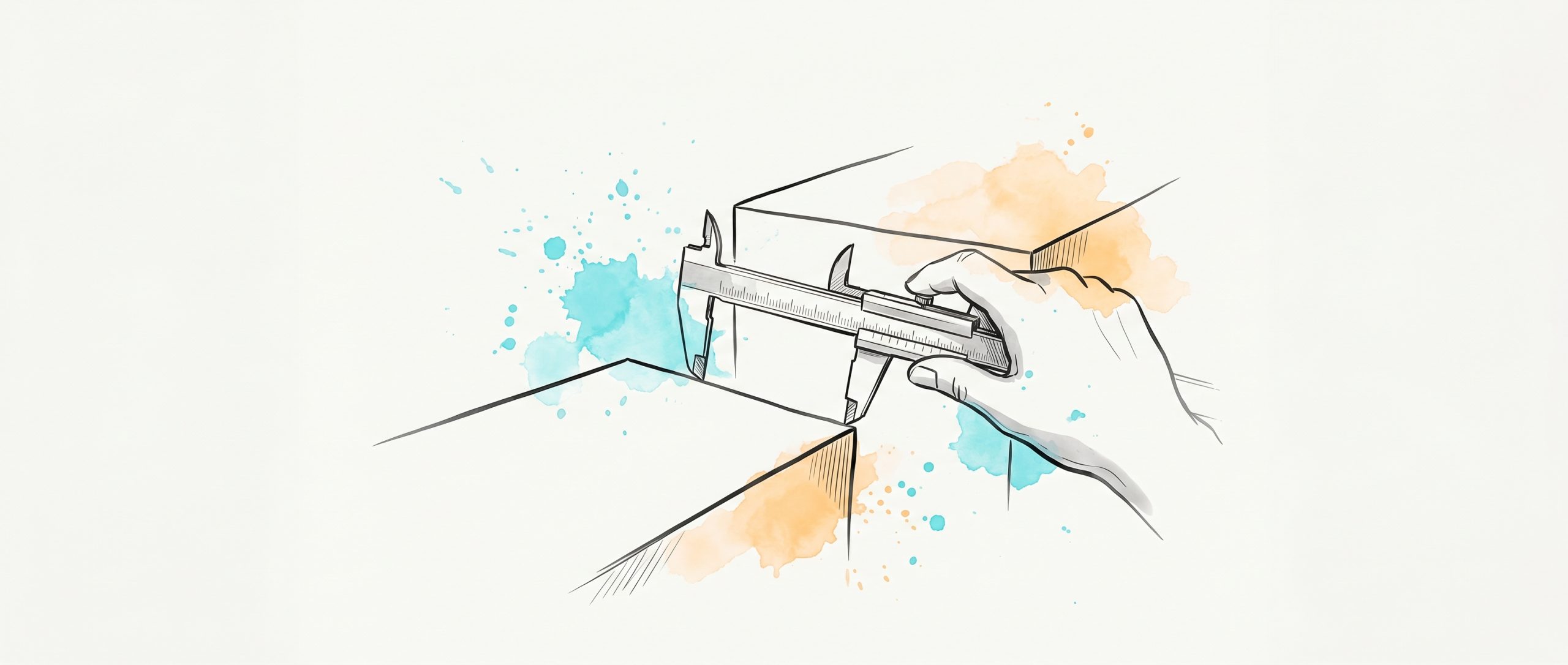
A skill gap is the distance between the skills you have and the skills the work in front of you actually demands. Everyone has them. The professionals who keep growing aren’t the ones without gaps — they’re the ones who can see their own gaps clearly and close the few that matter, before those gaps quietly cap their options.
That second part is harder than it sounds. We are not naturally good at judging our own competence, and the gaps that hold a career back are usually the ones we can’t feel. This guide is about both halves of the problem: how to spot a skill gap honestly, and how to close it so it stays closed.
What a skill gap actually is
Strip away the jargon and a skill gap is simple: there’s something the next stage of your work requires that you can’t yet do reliably. It might be technical (you’ve never built a financial model, run a SQL query, or shipped a feature), or it might be what gets loosely called “soft” — giving difficult feedback, leading a project, presenting to people more senior than you. Soft is a misleading word for skills that are often the hardest to learn and the most decisive at senior levels.
It helps to split gaps into two kinds:
- Visible gaps — the ones you already know about. A job posting lists a tool you’ve never used; a promotion clearly needs a competency you don’t have. These are uncomfortable but easy: you can see them, so you can plan around them.
- Hidden gaps — the ones you can’t feel. These are the dangerous ones. They tend to be skills you think you have, or skills you don’t yet know the next level requires. Hidden gaps don’t announce themselves; they show up as a stalled promotion, vague feedback, or a quiet feeling that you’re working hard and not moving.
Most of the work in this article is about the hidden kind, because the visible ones mostly take care of themselves once you decide to act.
Why closing gaps matters more right now
The ground under most jobs is shifting faster than usual. The World Economic Forum’s Future of Jobs Report 2025 — built on a survey of more than 1,000 large employers representing over 14 million workers across 55 economies — estimates that 39% of workers’ core skills will change or become outdated by 2030. (Worth noting honestly: that’s actually down from the 44% the same survey reported in 2023, partly because more people are training. The pace is high, not accelerating without limit.)
The same report frames it a second way that’s easy to picture. Of every 100 workers, 41 won’t need significant retraining by 2030 — but 59 will need to reskill or upskill. And 63% of employers named skills gaps as the single biggest barrier to transforming their business between now and 2030, the top-ranked obstacle on their list.
You don’t need to memorise the numbers. The takeaway is just this: skill gaps used to be something you addressed every few years. For most knowledge work now, it’s closer to a standing habit. The good news is that the skills employers say are growing fastest aren’t all exotic — the WEF’s top-rising list includes AI and data literacy and cybersecurity, but also analytical thinking, resilience and flexibility, curiosity and lifelong learning, and leadership. Several of those are learnable by anyone willing to be deliberate about it — and they respond better to coaching and honest feedback than to a course catalogue, which is why a growing number of employers now give their whole team access to coaching instead.
Why you’re the last to see your own gaps
Here’s the uncomfortable science. In a now-classic 1999 study, psychologists Justin Kruger and David Dunning found that people who performed worst on tests of logic, grammar, and humour also most overestimated their ability — the bottom-quarter performers scored around the 12th percentile but rated themselves near the 60th (Kruger & Dunning, 1999, Journal of Personality and Social Psychology).
The mechanism is the cruel part: the same knowledge you’d need to do something well is the knowledge you’d need to recognise that you’re doing it badly. If you don’t know what good looks like in a skill, you can’t see the distance between your work and good. (The strong version of this “Dunning-Kruger effect” has been debated by statisticians, but the core finding — that low performers reliably overestimate themselves — has held up well.)
The practical lesson isn’t “you’re probably worse than you think.” It’s that self-assessment alone is an unreliable instrument for finding skill gaps. You can’t introspect your way to your blind spots, because the blind spot is exactly where your judgement is weakest. To find hidden gaps you need to look outside your own head.
How to find your real skill gaps
Four sources will tell you far more than self-reflection alone. None requires special tools.
- Reverse-engineer the role you want, not the one you have. Find three or four real job descriptions or promotion criteria for the level above you and read them as a checklist. The requirements that make you wince — “I could probably figure that out” — are your candidate gaps. “Probably figure it out” is usually code for “can’t do reliably.”
- Ask for specific, behavioural feedback. “How am I doing?” produces reassurance, not information. “What’s one thing that would make me ready for the next level?” or “Where do you see me hesitate?” produces a gap. The more concrete the question, the more useful the answer.
- Look at where work slows down or comes back. The task you keep putting off, the deliverable that always needs a second round of edits, the meeting type you dread — friction is data. It’s often pointing at a skill that isn’t yet automatic.
- Compare your work to genuinely good work, side by side. Find an example of the thing done excellently — a model someone admires, a deck that landed, a piece of code that’s clean — and put it next to yours. The gap that was invisible in the abstract becomes obvious in the comparison. This is also the only reliable cure for the Dunning-Kruger trap: you can’t calibrate against a standard you’ve never seen.
You’ll usually surface more gaps than you can act on. That’s fine — and the next step is deciding which few actually matter.
Don’t close every gap — close the right one or two
A long list of gaps is paralysing and, worse, misleading. Most gaps don’t matter much. The ones worth your time sit where two things overlap: high impact on the direction you’re heading, and genuinely missing (not “rusty”). A quick way to sort the list:
| Ask of each gap… | If yes | If no |
|---|---|---|
| Does this block something I actually want next? | Keep it | Drop it — it’s not your gap, it’s just a thing you can’t do |
| Will it still matter in 2–3 years? | Invest properly | Learn the minimum, move on |
| Is it truly missing, or just under-practised? | Treat as a real gap | You don’t need a course — you need reps |
One or two real gaps, closed well, beat ten half-closed. Depth compounds; breadth scatters.
Closing a gap so it stays closed
This is where most learning plans quietly fail. People watch a course, feel informed, and three weeks later can’t do the thing — because watching isn’t learning, and informed isn’t able. Four well-supported ideas from learning science make the difference between a gap you closed and a gap you only visited.
Practise the specific thing, with feedback — not just hours
The popular idea that 10,000 hours of practice makes an expert is a myth — and not a small one. The “10,000-hour rule” was a journalistic popularisation, not a finding; the researcher whose work it was based on, Anders Ericsson, disputed it. A 2014 meta-analysis of 88 studies found that deliberate practice explained about 26% of performance differences in games, 21% in music, and under 1% in professions — meaningful, but far from “practice is everything” (Macnamara, Hambrick & Oswald, 2014, Psychological Science). A 2019 study that re-ran Ericsson’s original violinist experiment failed to reproduce its headline result (Macnamara & Maitra, 2019, Royal Society Open Science).
So why mention practice at all? Because the part that does hold up is the useful part. What separates practice that builds skill from time that doesn’t is that it’s focused on the specific sub-skill you’re weak at, effortful rather than comfortable, and followed by feedback you can act on. Re-doing what you’re already good at feels productive and teaches you nothing. Working at the edge of what you can do, and finding out quickly whether you got it right, is where skill actually moves.
Space it out — don’t cram
If you try to close a gap in one heroic weekend, most of it will evaporate. A large meta-analysis spanning 317 experiments found that learning spread across multiple sessions reliably beats the same amount of study crammed into one — and the gap between spaced and massed learning grows the longer you need to remember it (Cepeda et al., 2006, Psychological Bulletin). Thirty focused minutes, three times a week, will close a gap that a single ten-hour binge won’t. This is the inverse of how most people approach a new skill, which is part of why so many new skills don’t stick.
Test yourself instead of re-reading
Re-reading notes or re-watching a tutorial feels like learning because it feels easy and familiar. It’s one of the weakest ways to make knowledge durable. Retrieving information from memory — closing the book and trying to do or explain the thing — is dramatically more effective. In one well-known experiment, students who were tested on material remembered substantially more a week later than students who simply restudied it the same number of times, even though restudying looked better on an immediate test (Roediger & Karpicke, 2006, Psychological Science). For a skill, “testing” means using it: build the thing, run the analysis, have the hard conversation. The struggle to retrieve is the learning.
Turn the intention into an if-then plan
Knowing what to practise and actually practising it are different problems. The reliable fix is unglamorous: decide, in advance, exactly when and where you’ll do it. Across 94 studies, people who formed an “implementation intention” — a specific if situation X, then I’ll do Y plan — were significantly more likely to follow through than people who only set a goal, a medium-to-large effect (Gollwitzer & Sheeran, 2006). “I’ll get better at data analysis” fails. “After my Tuesday and Thursday standups, I’ll spend 30 minutes on the SQL course, at my desk” works — because it’s specific, and specific goals beat vague ones (Locke & Latham, 2002, American Psychologist).
Putting it together: a simple loop
None of this needs to be complicated. A workable cycle looks like:
- Find — reverse-engineer the role you want and ask for one piece of specific feedback. Write down the gaps.
- Choose — pick the one or two that actually block where you’re heading. Ignore the rest for now.
- Close — practise the specific weak part with feedback, in short spaced sessions, testing yourself by doing the real thing, anchored to an if-then plan.
- Re-check — every few months, look again. New gaps appear as you grow; that’s a sign of progress, not failure.
If you’re running this loop for a team rather than yourself, the same logic scales — our guide to how to upskill employees walks through it at the organisational level. And if a stalled stretch is starting to feel less like a single gap and more like being stuck in place, building career resilience is the companion skill worth developing alongside.
The aim isn’t to have no gaps. It’s to make finding and closing them a normal, low-drama part of how you work — so that the next gap is just the next thing you handle, not the thing that quietly stops you.
Where a coach — or aidx.ai — fits
The single hardest step above is the honest one: seeing your own gaps and choosing what to ignore. That’s exactly the part it helps to think through with someone (or something) outside your own head, since the whole problem with hidden gaps is that you can’t see them alone. A good coach won’t have the answers about your specific situation, but they’ll ask the questions that surface them — and hold you to the plan once it’s set.
This is some of what aidx.ai is built for: an AI coaching and therapy service you can talk through a real decision with — name the gap you’ve been avoiding, pressure-test whether it’s actually the one that matters, and turn a vague intention into a concrete if-then plan you’ll keep. It won’t close the gap for you, and it isn’t a substitute for a mentor who knows your field. But as a private, judgment-free place to think it through and stay accountable, it can make the deliberate work above a good deal easier to start.
The short version
- A skill gap is the distance between what you can do and what your next step needs. Everyone has them.
- The dangerous gaps are hidden — and you’re the last to see them, because spotting a gap needs the very skill you’re missing (Dunning-Kruger). Look outside your own judgement.
- Find gaps by reverse-engineering the role you want, asking for specific feedback, watching where work snags, and comparing your work to genuinely good work.
- Prioritise ruthlessly — close the one or two gaps that block your direction, ignore the rest.
- Close them with focused, feedback-rich practice in short spaced sessions, testing yourself by doing the real thing, anchored to a specific if-then plan. (The “10,000 hours” version is a myth.)
- Make it a habit, not a project. New gaps appearing is a sign you’re growing.
Last reviewed: June 2026.