
If you’ve searched for how to get unstuck, you probably don’t need convincing that you feel stuck — you need a way to move. The short answer is the part most advice skips: you don’t think your way out of feeling stuck, you act your way out, in steps small enough that you’ll actually take them. Motion comes first; the motivation and clarity you’re waiting for tend to arrive after you start, not before. This is a practical guide to that first push — what to do today, grounded in what the research actually shows.
If you’re still at the stage of naming what you feel — lost, numb, flat, or just off — start with our companion piece on feeling lost, numb, or stuck. This article picks up where that one leaves off: you’ve named it, now here’s how to move.
Why “wait until you feel like it” keeps you stuck
The usual plan is to wait for motivation, energy, or certainty to show up, and then act. When you’re stuck, that plan quietly backfires. Doing less gives you fewer good things to feel good about, your mood drops a little further, and a lower mood makes doing anything feel even heavier. That loop — less doing, lower mood, less doing — is exactly what keeps inertia in place.
The fix is to reverse the order. In behavioural activation, one of the most well-evidenced treatments for low mood, the core idea is deliberately backwards: instead of waiting to feel better so you can do things, you do small things so you can start to feel better. Action comes first, and mood follows it. In a landmark randomised trial, behavioural activation worked about as well as antidepressant medication for adults with major depression, and outperformed cognitive therapy among those who were more severely depressed (Dimidjian et al., 2006, Journal of Consulting and Clinical Psychology). You don’t need to be clinically depressed for the mechanism to apply: when you’re stuck, behaving your way forward is more reliable than thinking your way forward.
Step 1: Shrink the first step until it’s almost too small to refuse
The reason you can’t start usually isn’t laziness — it’s that the step in your head is too big. “Sort out my career” is not a step; it’s a weather system. Your job is to shrink the first action until the part of you that’s stuck can no longer find a reason to say no.
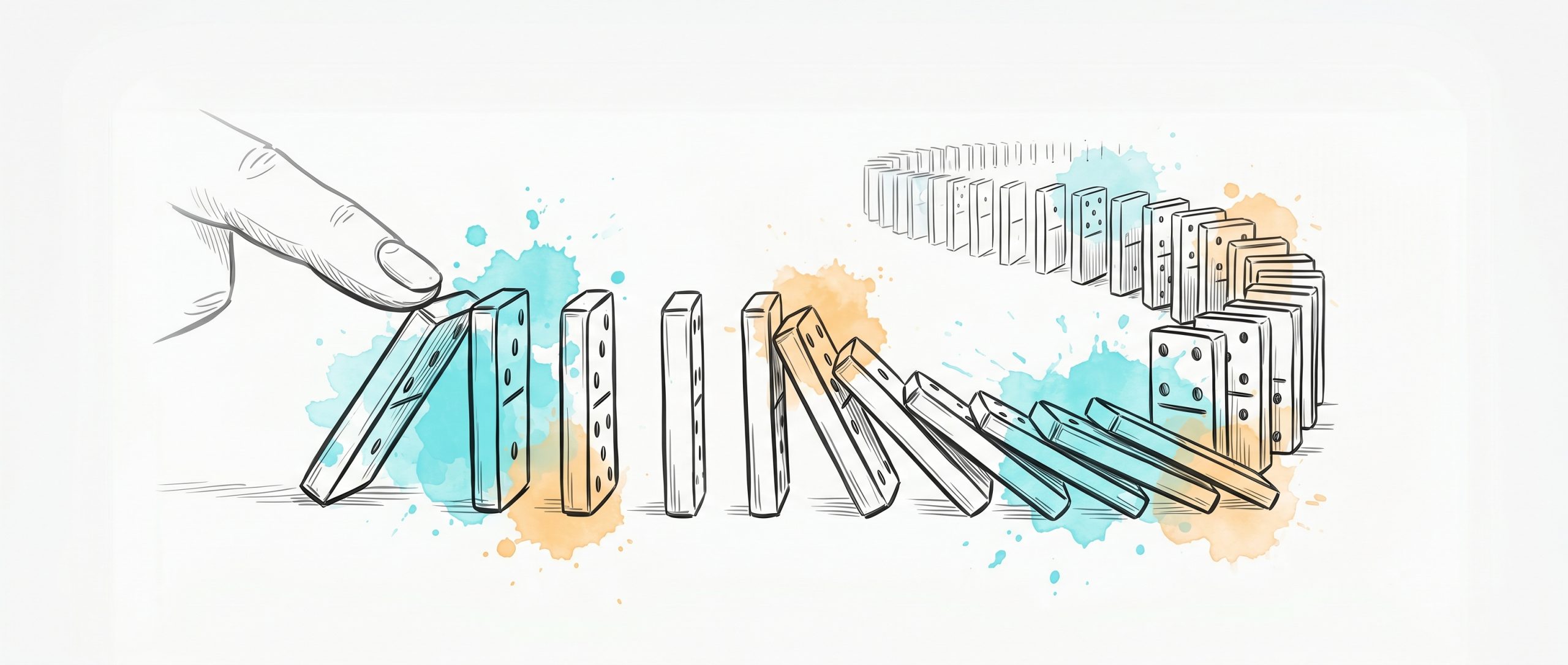
A useful test: if a step still feels like a wall, it’s too big — halve it, then halve it again. “Update my CV” becomes “open the document.” “Get fit” becomes “put my shoes by the door.” “Fix the friendship” becomes “draft one text, don’t send it yet.” These sound almost insultingly small, and that’s the point — small enough to do today, on a bad day, without negotiation. Once you’re moving, the next step is far easier to see than it ever was from a standstill.
Step 2: Make the plan specific — when, where, and how
A stuck mind is a noisy one. Unfinished intentions don’t sit quietly; they nag. Psychologists call this the Zeigarnik effect — the brain keeps an open loop running for anything you’ve started but not closed, like a browser tab you can’t shut.
Here’s the surprising part: you don’t have to finish the task to quiet the loop — you just have to make a concrete plan for it. In a series of studies, Masicampo and Baumeister (2011, Journal of Personality and Social Psychology) found that simply writing down when, where, and how you’d tackle an unfinished goal sharply reduced the intrusive thoughts and mental clutter it had been causing — almost as much as completing it would have. So don’t just decide “I’ll exercise.” Decide: “After coffee tomorrow, I’ll walk around the block once.” A plan that names the moment frees up the mental bandwidth you’ve been spending on dread.
| Vague intention (keeps nagging) | Specific plan (closes the loop) |
|---|---|
| “I should get healthier.” | “After lunch tomorrow, I’ll walk for ten minutes.” |
| “I need to find a new job.” | “Tonight at 8, I’ll open one job listing and read it.” |
| “I should reconnect with people.” | “This evening, I’ll text one friend to say hello.” |
Step 3: Aim the action at what actually matters to you
Small steps stop you stalling, but they need a direction, or you’re just busy. This is where Acceptance and Commitment Therapy (ACT) is useful. ACT’s two-word summary is in its name: accept what’s genuinely outside your control, and commit to action that moves you toward what matters. Rather than restructuring every anxious thought, it asks a simpler question — given how you feel, what’s one small thing you can do today that points toward the kind of life you actually want?
To find that direction, try this: think of a recent moment when you felt genuinely alive, proud, or like yourself. What were you doing, and what did it say you care about — creativity, connection, learning, contribution, freedom? That’s a value, not a goal. A goal can be finished and ticked off; a value is a direction you keep walking in. When you’re stuck, the most useful question isn’t “what’s my five-year plan,” it’s “what’s one small action this week that honours something I care about?” Aim your tiny step there, and even a small move starts to feel like it counts.
Step 4: Expect resistance — and act anyway
Here’s the trap worth naming: even with a small, specific, meaningful step, you probably still won’t feel like doing it. That’s normal, and it’s not a sign the plan is wrong. ACT calls the skill of moving forward while uncomfortable feelings ride along willingness: you don’t have to feel ready, motivated, or confident to take the step. You just have to take it, and let the feelings come along for the walk.
This is the quiet reframe at the heart of getting unstuck: motivation is not the entry ticket for action — it’s often the reward for it. Take the small step first, on borrowed willingness, and the motivation you were waiting for tends to show up a few steps in.
Step 5: Be kind to yourself about the missed days
You will miss days. You’ll plan the ten-minute walk and not take it. The thing that keeps people stuck isn’t the missed day — it’s the spiral of self-criticism that follows, which drains the energy you needed to start again. Talk to yourself the way you’d talk to a friend in the same spot: with honesty, but without contempt. Then do the smallest possible version of the next step. Progress here is a direction, not a clean streak.
A simple sequence to start today
If you take one thing from this, make it this loop:
- Pick one area where you feel most stuck — just one.
- Name a value underneath it — what do you actually care about here?
- Shrink the first step until it’s almost too small to refuse.
- Make it specific — when, where, and how, today or tomorrow.
- Do it before you feel ready, and be kind about the misses.
Repeat that loop and inertia stops being a wall and starts being a series of small, doable doors. You don’t have to overhaul your life this week. You just have to take the next small step — and then the one after that.
A related habit worth breaking, because it’s one of the quietest ways we keep ourselves stuck, is rumination. If your mind tends to circle the same worries without moving, here’s how to stop overthinking.
How aidx.ai can help
Sometimes the hardest part of getting unstuck is having someone to think it through with — to help you find the value under the stuckness, shrink the first step, and stay honest about the missed days without piling on. That’s what aidx.ai is built for: an AI coach and therapist, available whenever you need it, drawing on evidence-based approaches like ACT and behavioural activation to help you turn “I feel stuck” into a small, specific next move. It’s a place to think out loud and plan the step — a companion for the work, not a replacement for human care when you need it. If a fresh perspective would help, you can start a conversation with me, Aidx, any time.
This article is for general information and self-help, and isn’t a substitute for professional diagnosis or treatment. Feeling stuck is common and usually responds well to small, consistent action — but if low mood, hopelessness, or loss of interest has lasted for weeks, or is affecting your daily life, please reach out to a doctor or a licensed mental health professional. If you’re in crisis or thinking about harming yourself, contact your local emergency services now, or in the US call or text 988 (the Suicide and Crisis Lifeline) for free, confidential support, 24/7.
Related reading: Overthinking is one of the quiet things that keeps us stuck — here’s how to stop overthinking.
Related reading: When You Feel Lost, Numb, or Stuck: Making Sense of Hard Emotions