
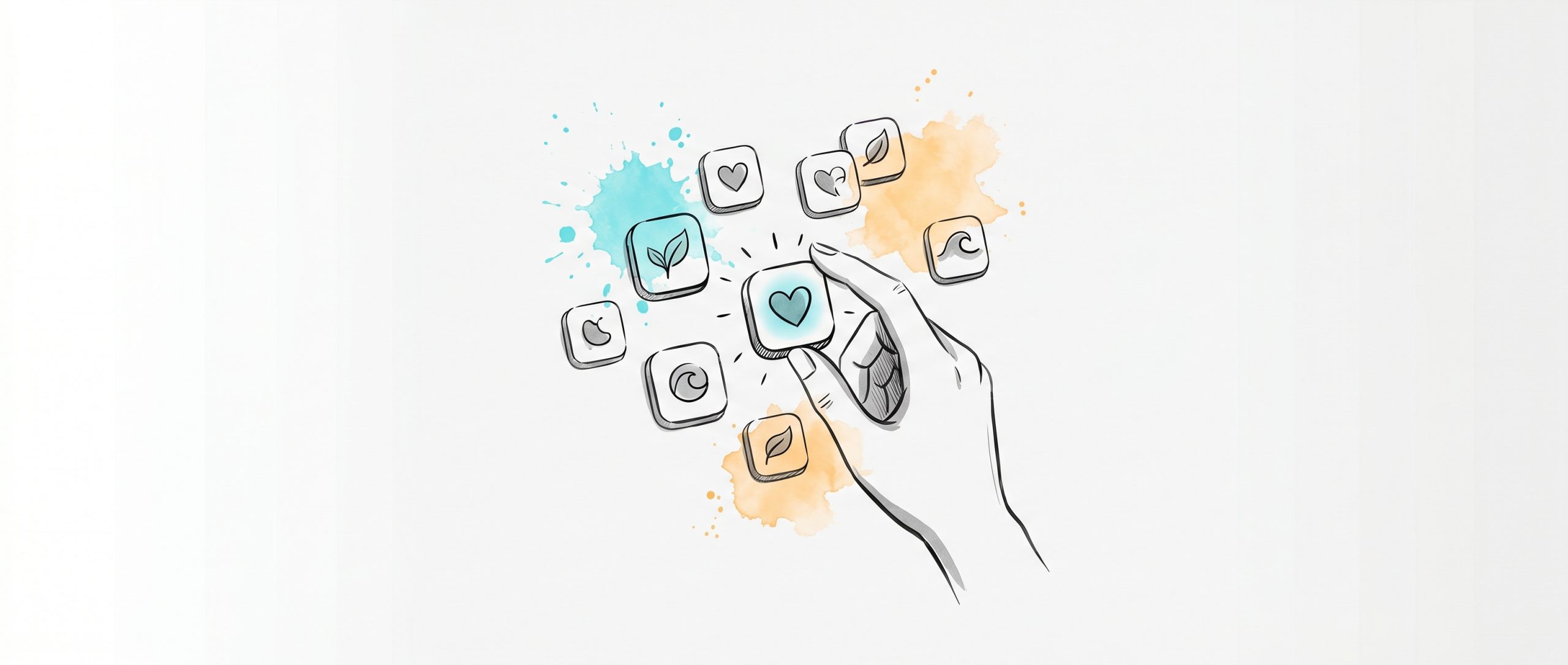
Mental health apps have gone from novelty to mainstream. Open an app store today and you will find thousands promising to lift your mood, calm your anxiety, or coach you through a hard week. Some are genuinely useful. Many are not. And the honest answer to "do they work?" is the most useful thing a guide like this can give you: it depends on the app, the feature, and what you need it for.
This is a plain-spoken guide to the landscape — the main categories of mental health apps, what the research actually supports, where the limits are, and how to choose one without getting lost in marketing claims. No hype, no miracle cures. Just what the evidence says and how to read it.
What a "mental health app" actually is
"Mental health app" is a loose umbrella over very different tools. Lumping them together is where most confusion (and most overselling) starts, so it helps to separate them by what they actually do:
| Category | What it does | Examples of features |
|---|---|---|
| Mood & symptom tracking | Log how you feel over time, spot patterns and triggers | Daily check-ins, emoji ratings, charts, journaling prompts |
| CBT & self-help tools | Guide you through structured exercises drawn from talk-therapy methods | Thought records, cognitive reframing, worry logs, coping cards |
| Meditation & mindfulness | Teach attention, breathing and relaxation skills | Guided meditations, breathing exercises, sleep stories |
| AI chat & coaching | Hold a back-and-forth conversation that adapts to you | Chatbots, voice coaching, personalised reflection |
| Gamified / engagement-first | Wrap any of the above in game mechanics to keep you coming back | Streaks, points, levels, challenges, virtual rewards |
| Teletherapy platforms | Connect you to a licensed human clinician | Video sessions, messaging with a real therapist |
The first five are self-help tools you use on your own. The last is a different thing entirely — a way to reach a human professional. Most of the confusion in this space comes from blurring the line between the two, so we will keep it sharp throughout.
Do mental health apps actually work?
Short version: the best ones can help with mild-to-moderate symptoms, but the effects are usually modest and the quality of evidence varies a lot. Here is what the research shows when you look past the marketing.
A 2025 systematic review in PLOS One examined 38 studies (30 of them randomized controlled trials) covering 35 distinct mental health apps. Every single one of those evidence-based apps was built on cognitive behavioral therapy (CBT) — the well-established talk-therapy method of noticing and reworking unhelpful thought patterns. Most showed improvements in depression and anxiety, but the authors were candid about "significant variability in their effectiveness," and noted that for more serious concerns like suicidal behaviour the evidence is "scant and less definitive" (PLOS One, 2025).
A 2025 systematic review and meta-analysis in The Lancet Digital Health reached a similar, sober conclusion: standalone smartphone apps produced small-to-medium improvements on some outcomes, but the results "must be interpreted cautiously" given considerable variation between studies and only moderate study quality. Its practical takeaway is worth remembering — apps "might be offered for symptoms of depression, anxiety, and sleep problems" especially when an evidence-based first-line treatment is not available (The Lancet Digital Health, 2025).
So apps are a real, useful tool in the toolbox — not a replacement for one. The takeaway is not "apps don’t work"; it’s "a good app, used consistently, can meaningfully support you, and you should keep your expectations honest."
How to choose a mental health app
With thousands of options and very uneven quality, a few simple filters will steer you toward the ones worth your time:
- Look for a named, evidence-based method. The apps with research behind them almost always say what they are built on — CBT, ACT, DBT, mindfulness. If an app can’t tell you why its exercises should help, treat its claims with caution.
- Match the tool to the need. Want to spot what drains your week? A mood tracker. Stuck in anxious loops? A CBT-based app. Wired and can’t wind down? Mindfulness and breathing. Want to talk it through? AI chat or, for clinical needs, a human therapist.
- Read the privacy policy before you pour your heart out. This matters more here than almost anywhere else (see below).
- Be wary of big precise promises. "Reduces anxiety by 50%" and similar round numbers are usually marketing, not science. Real research talks in ranges and caveats.
- Notice whether it fits your actual life. The best app is the one you will still open in three weeks. Simpler is often stickier.
Tracking is one of the most reliable habits any of these apps can help you build — if you want a how-to, see our guide on tracking your mental health progress digitally, which you can start today with or without an app.
The role of gamification: engaging, but not magic
One design trend cuts across every category above: gamification — adding game-like mechanics such as streaks, points, levels, challenges and rewards to keep you coming back. It is everywhere in mental health apps, and it raises a fair question: does turning self-care into a game actually help?
The honest answer is yes for engagement, but not automatically for outcomes. Engagement is the field’s biggest problem: app-based mental health interventions show some of the highest dropout rates in digital health — one analysis put average attrition around 55%, far higher than web-based or telehealth alternatives (Frontiers in Psychiatry, 2022). This tendency for people to drift away before they finish is well documented enough to have a name — the "law of attrition" in eHealth.
Gamification genuinely helps with that. In a large randomized controlled trial, the gamified resilience app eQuoo retained 42% more participants than the control group (JMIR Mental Health, 2023). Keeping people engaged long enough to benefit is no small thing.
But here’s the catch researchers keep flagging — what one 2026 review called the "engagement–efficacy gap." More time in an app does not reliably mean better mental health, and an "uncritical focus on maximising engagement" can even work against genuine progress while introducing ethical risks of its own (Information, MDPI, 2026). A streak is a tool to keep you practising something that helps — not the help itself. The right way to read gamification: a well-designed game layer can carry you over the hump of building a habit, but it’s the underlying exercise (the CBT reframe, the breathing, the reflection) that does the actual work.
Where AI chat and coaching fit in
The newest category is conversational AI — apps you can actually talk to. Instead of tapping through a fixed menu of exercises, you have a back-and-forth that adapts to what you say. Done well, this combines the structure of a CBT app with the responsiveness of a conversation, available at any hour. Done carelessly, it can overpromise.
Researchers see real potential here alongside real caution. The field’s view, summed up by digital-psychiatry researchers, is that conversational AI is promising but still early — useful for support, reflection and skill-building, not a stand-in for clinical care. The most responsible AI tools are explicit about that boundary.
This is the space aidx.ai works in. Its Adaptive Therapeutic Intelligence (ATI) system draws on established, evidence-based methods — Cognitive Behavioral Therapy (CBT), Acceptance and Commitment Therapy (ACT), Dialectical Behavior Therapy (DBT) and Neuro-Linguistic Programming (NLP) — to offer conversational coaching and reflection that adapts to you, by chat or voice, whenever you need it. It is built as evidence-based support for everyday strain — stress, overwhelm, stuck patterns, motivation — not as clinical treatment, diagnosis, or a substitute for a licensed clinician. That distinction is the whole point of using these tools well.
If you want to go deeper on the AI-tool category specifically, two companion guides cover it in detail: our roundup of AI tools for emotional well-being and AI apps for daily positive self-talk.
A word on privacy — read this before you download
Mental health apps ask for some of the most sensitive information you have. Many have handled it badly. Mozilla’s *Privacy Not Included research found that the large majority of popular mental health and prayer apps it reviewed failed basic privacy and security standards — in one review round, 29 of 32 earned a warning label (Mozilla Foundation).
This is not hypothetical. In 2023 the U.S. Federal Trade Commission reached a $7.8 million settlement with teletherapy service BetterHelp over allegations it shared users’ email addresses, IP addresses and health-questionnaire answers with advertisers including Facebook and Snapchat, despite promising not to (HIPAA Journal). Before you trust an app with your inner life, spend two minutes on its privacy policy: what it collects, whether it sells or shares data, and whether you can delete yours.
The honest bottom line
Mental health apps are a genuine, growing part of how people look after themselves — the market is forecast to reach roughly $17.5 billion by 2030 (Grand View Research) — and the best of them, used consistently, can offer real support for everyday stress, low mood and anxious patterns. But they work best as one part of a bigger picture: a tool for building skills and habits, ideally alongside the people and, when needed, the professionals in your life. Choose one that names its method, respects your data, and fits the way you actually live. Then the most important step is the unglamorous one — actually using it.
FAQs
Which type of mental health app is best for me?
Match the tool to the need. For spotting patterns in your mood, a tracking app. For breaking anxious or negative thought loops, a CBT-based app. For winding down and sleep, mindfulness and breathing. For talking something through, AI chat or coaching — and for clinical concerns, a licensed human therapist. The best app is also the one you will keep opening, so favour something simple enough to fit your real routine.
Can a mental health app replace therapy?
No. Apps can be a useful supplement — for building habits, practising skills and supporting everyday stress and mild-to-moderate symptoms — but they are not a substitute for a licensed clinician, especially for moderate-to-severe conditions or crisis situations. The strongest evidence supports apps as an addition to care, not a replacement for it.
Do free mental health apps work as well as paid ones?
Price isn’t the signal that matters — method and evidence are. Some excellent tools are free and some expensive ones are thin. Look for an app that names an evidence-based approach (CBT, ACT, DBT, mindfulness), has a clear privacy policy, and suits what you actually need, regardless of cost.
References
- Systematic review (2025), PLOS One — 38 studies, 30 RCTs, 35 evidence-based apps (all CBT-based; significant variability in effectiveness).
- Systematic review & meta-analysis (2025), The Lancet Digital Health — standalone apps show small-to-medium effects; results to be interpreted cautiously.
- Analysis of attrition in app-based mental-health interventions (2022), Frontiers in Psychiatry — ~55% average attrition.
- RCT of the gamified resilience app eQuoo (2023), JMIR Mental Health — 42% better retention vs. control.
- Review of the “engagement–efficacy gap” (2026), Information (MDPI).
- Mozilla Foundation. *Privacy Not Included: mental health apps (29 of 32 earned a warning label).
- HIPAA Journal. FTC–BetterHelp $7.8M settlement over health-data sharing (2023).
- Grand View Research. Mental Health Apps Market report (market-size forecast).
Last reviewed: June 2026.
A note on scope. This article is general information about mental health apps, not medical advice or a substitute for professional care. Apps and AI coaching tools can support everyday wellbeing, but they cannot diagnose or treat mental health conditions. If you are struggling, consider talking to a doctor or a licensed mental health professional. If you are in crisis or thinking about harming yourself, please reach out for immediate help: in the US, call or text 988 (the Suicide & Crisis Lifeline), available 24/7; elsewhere, contact your local emergency services or a crisis line in your country.