
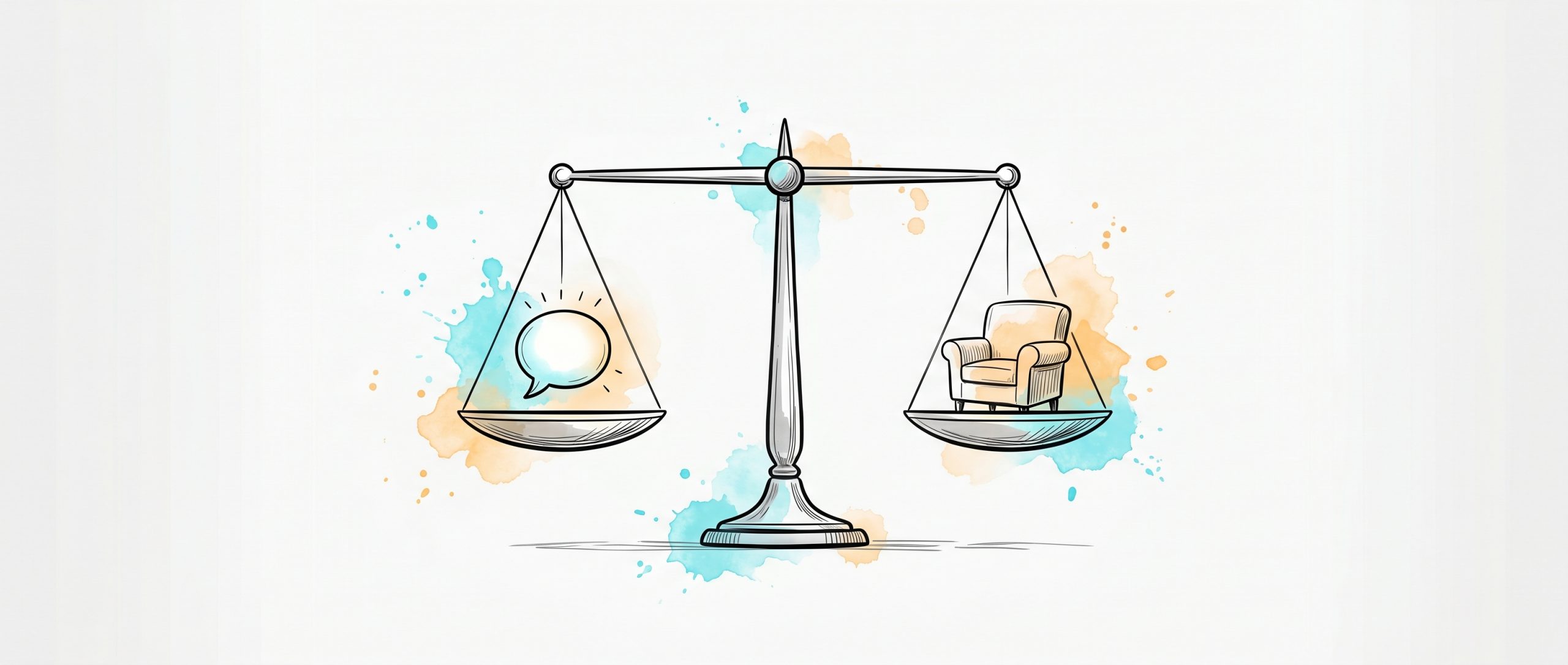
AI therapy uses conversational software, grounded in approaches like CBT, ACT, DBT and mindfulness, to offer mental-health support on demand. Traditional therapy is care delivered by a trained, licensed human. They are not rivals so much as different tools — and the honest answer to “which is better?” is “it depends on what you need.”
The phrase AI therapy covers a lot of ground, from simple symptom-tracking apps to large-language-model chatbots that hold a fluent, back-and-forth conversation. This guide looks at what each option genuinely does best, where AI’s limits are real and worth respecting, the sharp question of whether AI can replace a therapist, and how many people end up using both. For the broad, end-to-end comparison, see our complete guide to traditional therapy vs. AI therapy; here we focus on personalization and “what each does best.”
What each does best, at a glance
Neither approach is a strict upgrade on the other. AI is strongest on access, cost and consistency; human therapy is strongest on depth, judgment and the relationship itself.
| Strength | AI therapy | Traditional therapy |
|---|---|---|
| Availability | On demand, day or night, no waitlist | Scheduled sessions; waitlists common |
| Cost | Low monthly subscription | Often $100–$250 per hour without insurance |
| Consistency | Same method every time; doesn’t tire | Varies with the clinician and the day |
| Depth & judgment | Limited; can miss what’s unsaid | Reads nuance, context and non-verbal cues |
| The relationship | Helpful, but not a human bond | A real therapeutic alliance |
| Acute or complex cases | Not suitable | The right place for serious clinical needs |
The detail behind this table is where the useful decisions live, so let’s take each side in turn.
Where AI therapy genuinely excels
The case for AI support isn’t hype. It comes down to three things human therapy structurally can’t offer at the same scale.
Access, when and where you need it. Demand for mental-health care badly outstrips supply. As of late 2025, about 40% of Americans — roughly 137 million people — lived in a federally designated Mental Health Professional Shortage Area, and only about a quarter of the need in those areas was being met (HRSA). AI support has no waitlist and no catchment area: it’s there at 2 a.m. on a Sunday, which is often exactly when a spiral hits.
Cost. Without insurance, an hour of therapy in the U.S. commonly runs $100–$250, and weekly sessions can mean $400–$800 a month (Project Healthy Minds). A software subscription is a fraction of that. For many people the realistic choice isn’t “AI or a great therapist” — it’s “some support or none.”
Consistency and evidence-based structure. A well-built tool applies the same techniques the same way every time — cognitive behavioral therapy (CBT) for unhelpful thought patterns, acceptance and commitment therapy (ACT) for sitting with difficult feelings, mindfulness for grounding. It doesn’t have an off day. And the early evidence is encouraging: in a 2025 randomized controlled trial of the Dartmouth-built chatbot Therabot, 210 adults with clinically significant symptoms saw roughly a 51% average reduction in depression symptoms, 31% in generalized anxiety, and 19% in eating-disorder concerns over the trial — with users rating their trust in the tool comparably to a human provider (Heinz et al., NEJM AI, 2025). The researchers were clear that this is a promising signal, not a green light for autonomous use.
How AI personalizes support
Personalization is where modern AI tools have moved well past the early “if-this-then-that” chatbots. Because the conversation is continuous, the system can adapt to your wording, your goals and what’s worked for you before. At aidx.ai, for instance, that adaptability shows up as selectable modes for different needs:
| Mode | What it’s for |
|---|---|
| Life (the default) | Life coaching and therapy, blending CBT, DBT, ACT and NLP |
| Business | Coaching focused on professional and work challenges |
| Performance | Optimizing personal and professional performance |
| Rapid Fire | A fast, high-tempo format for quick check-ins |
For sensitive topics, an incognito toggle can be switched on within any mode, so the conversation isn’t stored.
Under the hood, this kind of adaptability is what aidx.ai calls ATI (Adaptive Therapeutic Intelligence) — the in-house architecture that shapes how the conversation adjusts to you across life, business and performance contexts. The point isn’t the branding; it’s that good personalization comes from the conversation adapting to you, not from a fixed script.
Where human therapy is irreplaceable
For all of that, there are things a trained human does that current AI simply can’t — and these aren’t edge cases.
The therapeutic alliance. Across decades of research, the relationship between client and therapist — trust, empathy, the sense of being genuinely understood — is one of the strongest predictors of whether therapy helps at all. AI can simulate warmth convincingly, and people do form attachments to it, but that’s not the same as a reciprocal human bond, and many people can feel the difference.
Reading what isn’t said. A skilled therapist notices the pause, the flat tone, the thing you talk around. They draw on years of training and clinical judgment to interpret cues no text box conveys, and to adjust their approach in real time when something isn’t landing.
Complex, acute and high-risk situations. This is the clearest line. A 2025 Stanford study that tested popular LLM therapy chatbots found they expressed stigma toward certain conditions and, worryingly, mishandled crisis scenarios — in one test, responding to clear signals of suicidal ideation by supplying the requested information instead of recognizing the danger. The chatbots responded inappropriately in roughly one in five cases, and the authors concluded that even with careful prompting, today’s AI can’t safely replace a mental-health provider (Stanford HAI, 2025). For trauma, severe depression, eating disorders, self-harm or suicidality, human clinical care isn’t a nice-to-have — it’s the right and necessary choice.
Can AI replace therapists?
On today’s evidence, no — and that’s the honest answer, not a hedge. AI can deliver structured, evidence-based techniques, be available the instant you need it, and lower the barrier for people who’d otherwise get no support at all. What it cannot do is form a genuine human relationship, exercise clinical judgment, or be trusted to keep someone safe in a crisis.
The more useful framing isn’t “replace” but “extend.” AI widens access to the kind of support — reflection, coping skills, between-session continuity — that helps a lot of people a lot of the time, while licensed clinicians do the deep, complex and high-stakes work that defines real therapy. Both can be true at once.
Using both: AI between sessions, humans for the depth
For many people the practical answer isn’t choosing a side — it’s combining them. AI support can carry the days between appointments: a place to practice a CBT reframe, run a grounding exercise, journal a rough evening, or simply think out loud at an hour when no human is available. Then the human sessions go deeper, with the therapist holding the overall arc of the work.
That blend tends to play to each side’s strengths — the always-on consistency of software, the depth and judgment of a person — without asking either to do a job it isn’t built for. If you’re weighing where to start, our guide to choosing an AI therapy platform walks through what to look for, and how AI-powered coaching supports mental wellness covers the day-to-day side.
How to choose what’s right for you
A few honest questions usually make the decision clear:
- How urgent and how serious is it? Acute distress, a clinical condition, or any thought of self-harm calls for human professional care — start there.
- What’s the barrier? If cost, waitlists, or just not having anyone available right now is what’s stopping you, AI therapy is a real and immediate option.
- What kind of help do you want? For day-to-day coping, structure, reflection and momentum, AI is well suited. For deep relational work, trauma, or untangling something complex, a human therapist is the right fit.
- Could both help? Often, yes — a clinician for the depth, an AI tool to keep the work going in between.
There’s no single right answer, and your needs will shift over time. The goal is simply to get real support, in whatever form actually reaches you.
Last reviewed: June 2026.
This article is general information about mental-health support options, not medical advice or a substitute for professional care. AI tools are not a licensed therapist, doctor, or crisis service. If you’re in crisis or thinking about harming yourself, please reach out to a professional or a crisis line right away — in the U.S. you can call or text 988 (the Suicide and Crisis Lifeline), available 24/7.