
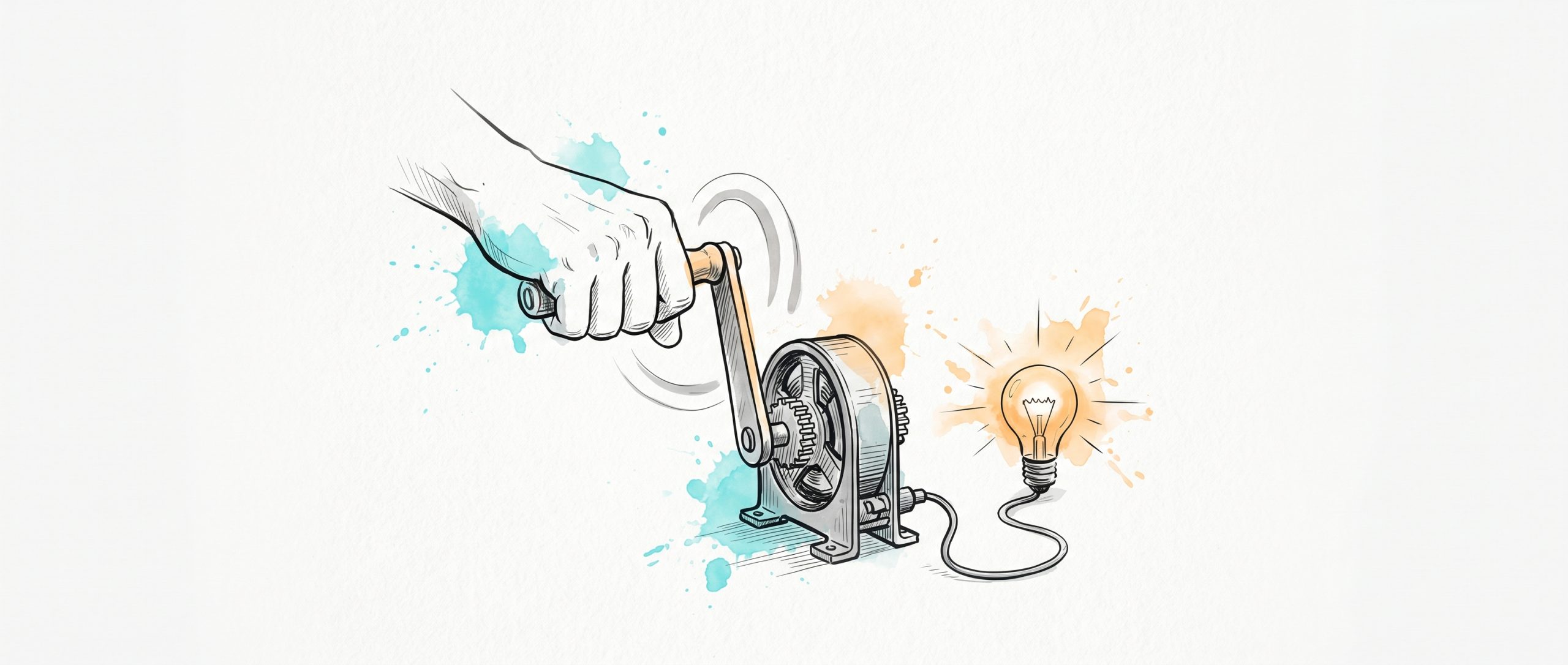
Motivation is not a character trait you either have or lack. It is a state — one that rises and falls with your circumstances, your energy, and the meaning you can find in what you are doing. That is why “just stay motivated” is such useless advice when life gets hard: it treats motivation as a switch you forgot to flip, when really it behaves more like weather. The good news is that decades of psychology research show you can change the weather. Not by gritting your teeth harder, but by understanding what actually drives human effort — and then arranging your goals, your environment, and even your inner voice to work with that grain rather than against it.
This guide pulls together what the evidence genuinely supports about how to stay motivated, especially in the seasons when your drive has quietly drained away. No hacks, no inflated statistics — just the mechanisms that hold up, and concrete things you can do with them today.
Why motivation fades (and why that is normal)
When you can’t summon the motivation to do something you care about, the instinct is to read it as a personal failing. It usually isn’t. Motivation is the output of a system, and when the system is starved of certain inputs, the output drops — predictably, in anyone.
The most useful map of those inputs is Self-Determination Theory, developed by psychologists Edward Deci and Richard Ryan. Their research, synthesised in a landmark American Psychologist paper, found that human motivation thrives when three basic psychological needs are met: autonomy (a sense that your actions are your own choice), competence (a sense that you can actually get better and succeed), and relatedness (a sense of connection to other people).[1] When life gets tough, it tends to attack all three at once. A setback dents your sense of competence. Pressure and obligation erode your autonomy. Stress and isolation cut your relatedness. No wonder the drive disappears — three of its main fuel lines have been pinched shut.
Seen this way, “I’ve lost my motivation” is less a verdict on you and more a signal about your situation. And signals can be answered. The rest of this guide is really about re-opening those fuel lines, one at a time.
Intrinsic vs extrinsic: where durable drive comes from
Self-Determination Theory also draws a distinction that matters enormously when the going is hard: the difference between intrinsic motivation (doing something because it is inherently interesting or meaningful to you) and extrinsic motivation (doing it for an external reward or to avoid a punishment).[1] Both are real, and extrinsic motivation isn’t “bad” — much of adult life runs on it. But intrinsic motivation is the more durable fuel, because the reward is the doing itself; it doesn’t evaporate the moment the external payoff is delayed or removed.
There is a counter-intuitive wrinkle here worth knowing, because it explains why some attempts to “motivate” yourself backfire. In a classic 1973 study, researchers Lepper, Greene and Nisbett watched preschoolers who already loved drawing. One group was promised a reward for drawing; another wasn’t. Afterwards, the children who had been promised a reward spent roughly half as much of their free time drawing as those who hadn’t — the external reward had quietly undermined a pleasure they’d had all along.[2] This is the overjustification effect. A later meta-analysis of 128 studies confirmed the pattern: tangible, expected rewards for something you already find interesting tend to erode your intrinsic interest in it.[3] (It’s a small preschool study at root, so hold the exact figure lightly — but the effect itself is well established.)
The practical takeaway when you’re trying to stay motivated: dangling bigger and bigger external carrots in front of yourself is a fragile strategy. It is worth doing the quieter work of reconnecting a hard task to something you genuinely value.
| Type | Source of drive | How it holds up under adversity |
|---|---|---|
| Intrinsic | The activity is interesting or meaningful in itself | Durable — survives delayed or absent external rewards |
| Extrinsic | An external reward or the avoidance of a penalty | Useful short-term, but fragile when the reward is removed or distant |
Action comes before motivation, not after
Here is the single most liberating idea in this whole field, and it runs against everything our culture tells us. We wait to feel motivated before we act. But often it works the other way round: action generates motivation, not the reverse.
The strongest evidence for this comes from the treatment of low mood and depression — the conditions in which motivation is most thoroughly flattened. A therapeutic approach called behavioural activation is built entirely on the principle of acting before you feel like it: you schedule small, valued activities and do them regardless of whether the desire has shown up yet, on the understanding that the feeling tends to follow the doing. A meta-analysis of 34 randomised studies covering more than 2,000 people found behavioural activation to be a large, effective treatment for depression — comparable to cognitive therapy.[4] It is recommended in major clinical guidance precisely because it works.
You don’t need to be depressed to borrow the principle. When motivation is gone, stop waiting for it. Pick the smallest possible version of a valued action — open the document, lace the shoes, send the one email — and do that. Motivation is far more likely to arrive once you’re already moving than while you’re sitting still trying to manufacture it.
Set goals the way the evidence says works
If you’re going to act, it helps enormously to know what you’re aiming at. Some of the most replicated findings in all of motivational psychology come from goal-setting theory, developed over decades by Edwin Locke and Gary Latham. Their core, reliably reproduced finding: specific and challenging goals lead to better performance than vague “do your best” intentions.[5] “Find a new job” is a wish. “Apply to three roles this week” is a goal — and the difference in follow-through is large. (If goal-setting itself is where you get stuck, our guide on how to set goals walks through the mechanics.) Specific goals work because they direct your attention, mobilise effort, sustain persistence, and prompt you to actually develop a strategy.
Two caveats keep this honest. A challenging goal only helps if you’re genuinely committed to it and getting feedback on your progress — a hard goal you don’t believe in just produces disengagement. And when you’re depleted, the “challenging” part should be calibrated kindly: the aim is a goal that stretches you a little, not one that crushes you.
Turn the goal into an if-then plan
Knowing your goal is not the same as doing it — the gap between intention and action is where most motivation dies. The most robust tool for closing that gap is the implementation intention, a concept from psychologist Peter Gollwitzer. Instead of a vague “I’ll exercise more,” you form a concrete if-then plan: “If it’s 7am on a weekday, then I put on my running shoes and walk out the door.” A meta-analysis of 94 studies found this simple format had a medium-to-large effect on actually attaining goals (d = 0.65) over and above merely setting the goal.[6] The reason it works is mechanical: by deciding in advance exactly when and where you’ll act, you no longer have to win the motivation argument in the moment.
Let small wins do the heavy lifting
Big goals are motivating to set and demoralising to face, because the finish line is so far off that daily effort feels like nothing. The fix is to make progress visible at a small scale. In a study of nearly 12,000 daily diary entries from people doing real work, Harvard researchers Teresa Amabile and Steven Kramer found that the single most powerful booster of people’s motivation and mood on any given day was simply making progress in meaningful work — even small progress.[7] Tellingly, small setbacks dragged people down even more than small wins lifted them up, which is exactly why protecting a sense of forward motion matters so much when things are already hard.
Practically: break the mountain into stones small enough that you can finish one and feel it. Crossing off “wrote one paragraph” is not trivial — it’s the precise input the research says feeds your motivation tomorrow.
Work with your emotions, not against them
When you’re under strain, a wave of frustration, anxiety or dread can swamp whatever drive you’d mustered. The instinct is to suppress it. There’s a gentler, better-supported move.
It’s sometimes called “name it to tame it.” In a UCLA neuroimaging study, simply putting a feeling into words — choosing the label for an emotion — was associated with reduced activity in the amygdala, the brain’s threat-response centre, and increased activity in prefrontal regions linked to regulation.[8] (It was a small study, so treat it as suggestive rather than settled — but the practice is low-cost and the broader evidence is supportive.) Next time motivation collapses under a wave of feeling, try naming it plainly: “I notice I’m feeling overwhelmed and a bit hopeless about this.” The naming itself can take some of the charge out of the emotion, leaving you a little more room to choose your next small action.
Be on your own side
The harshest force working against motivation in tough times is often your own inner critic. We tell ourselves that self-criticism is what keeps us sharp — that easing up would mean giving up. The evidence points the other way. Research by Juliana Breines and Serena Chen found that people who responded to a personal failure with self-compassion — treating themselves with the kindness they’d offer a friend — were subsequently more motivated to improve and make amends than those who were self-critical.[9] Self-compassion, pioneered as a field of study by psychologist Kristin Neff, doesn’t make you complacent; it makes failure survivable enough that you’re willing to step back into the arena.[10] If you want to stay motivated through a hard stretch, talk to yourself like someone you’re trying to keep in the game — not someone you’re trying to punish out of it.
One quick word on a popular tip you can safely ignore: striking a two-minute “power pose” to feel more driven. The original 2010 finding has failed to replicate in larger studies, and one of its own authors later wrote that she no longer believes the effects are real.[11] Your time is better spent on the practices above.
A simple sequence for when your drive is gone
Pulling the threads together, here is a short, repeatable sequence for the moments when motivation has genuinely drained away:
- Name the feeling. “I’m feeling flat and discouraged.” Naming it loosens its grip and gets you out of fight-or-flight.[8]
- Drop the standard for now. Meet yourself with kindness, not contempt. You’ll re-engage faster from self-compassion than from self-attack.[9]
- Reconnect to the why. Ask what about this actually matters to you (autonomy and meaning), rather than what you “should” do.[1]
- Shrink the goal until it’s almost laughably small, and make it specific. Not “be productive” but “write one sentence.”[5]
- Make an if-then plan for the very next step, so you don’t have to re-decide in the moment.[6]
- Act first — then let the motivation catch up. Do the tiny thing before you feel ready, and notice the small win when it’s done.[4]
Run that loop enough times and something shifts. You stop waiting on a feeling and start trusting a process. As Viktor Frankl, the psychiatrist who survived the Nazi concentration camps and wrote Man’s Search for Meaning, put it: “Between stimulus and response there is a space. In that space is our power to choose our response. In our response lies our growth and our freedom.” Motivation, in the end, lives in that space — in the small, repeated choice to take the next step anyway.
When low motivation is something more
Most dips in drive are a normal response to a hard stretch, and the strategies above are designed for them. But it’s worth knowing the difference between low motivation and something that needs more support. A persistent loss of interest or pleasure in things you used to enjoy, lasting most of the day for two weeks or more, alongside changes in sleep, appetite, or a sense of hopelessness, can be a sign of depression rather than a passing slump — and that deserves care from a real professional, not just a productivity tweak.
If you’re thinking about staying motivated alongside the broader work of building drive, you may also find our guides on how to get unstuck and building self-discipline that doesn’t rely on willpower useful. And if it helps to think things through with something available at any hour, aidx.ai offers AI coaching and therapy you can talk to when motivation runs low — a place to name what’s going on and find your next small step.
This article is for general information and is not a substitute for professional medical or mental-health advice. If low mood, hopelessness, or loss of motivation persists or worsens, please speak with a qualified health professional. If you are in crisis or thinking about harming yourself, contact your local emergency services or a crisis line immediately — in the US, call or text 988 (Suicide & Crisis Lifeline); in the UK, call Samaritans on 116 123; elsewhere, find your local helpline at findahelpline.com.
Last reviewed: June 2026.
References
- Ryan, R. M., & Deci, E. L. (2000). Self-Determination Theory and the Facilitation of Intrinsic Motivation, Social Development, and Well-Being. American Psychologist, 55(1), 68–78.
- Lepper, M. R., Greene, D., & Nisbett, R. E. (1973). Undermining children’s intrinsic interest with extrinsic reward. Journal of Personality and Social Psychology, 28(1), 129–137.
- Deci, E. L., Koestner, R., & Ryan, R. M. (1999). A meta-analytic review of experiments examining the effects of extrinsic rewards on intrinsic motivation. Psychological Bulletin, 125(6), 627–668.
- Mazzucchelli, T., Kane, R., & Rees, C. (2009). Behavioral activation treatments for depression in adults: A meta-analysis and review. Clinical Psychology: Science and Practice, 16(4), 383–411.
- Locke, E. A., & Latham, G. P. (2002). Building a practically useful theory of goal setting and task motivation. American Psychologist, 57(9), 705–717.
- Gollwitzer, P. M., & Sheeran, P. (2006). Implementation intentions and goal achievement: A meta-analysis of effects and processes. Advances in Experimental Social Psychology, 38, 69–119.
- Amabile, T., & Kramer, S. (2011). The Power of Small Wins. Harvard Business Review.
- Lieberman, M. D., et al. (2007). Putting Feelings Into Words: Affect Labeling Disrupts Amygdala Activity in Response to Affective Stimuli. Psychological Science, 18(5), 421–428.
- Breines, J. G., & Chen, S. (2012). Self-Compassion Increases Self-Improvement Motivation. Personality and Social Psychology Bulletin, 38(9), 1133–1143.
- Neff, K. D. (2023). Self-Compassion: Theory, Method, Research, and Intervention. Annual Review of Psychology, 74, 193–218.
- Carney, D. R. (2016). My position on “power poses.” (Author statement disavowing the original findings.)