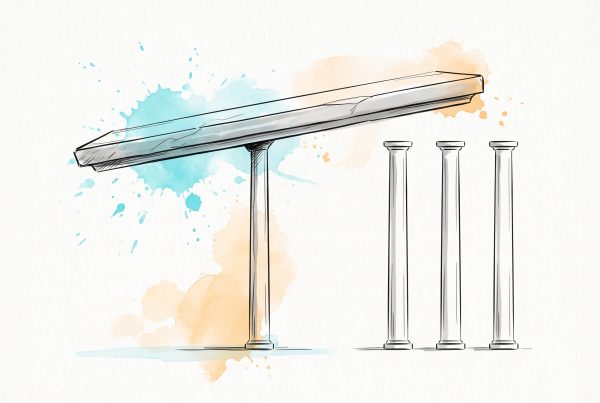


Self-discipline is the ability to act on what matters to you instead of on how you feel in the moment — and despite what most advice implies, it’s a skill you build, not a trait you’re born with or a reserve of grit you grind your way through. The most disciplined people aren’t the ones with the strongest willpower. They’re the ones who’ve quietly arranged their lives so they need less of it.
That single idea — that discipline is mostly design, not force — is the best-supported finding in the whole science of self-control, and it’s the thread running through this guide. Below: what self-discipline actually is, how it differs from willpower and motivation, why it feels so hard (sometimes for reasons that aren’t a character flaw at all), and a practical, evidence-based system for building it that doesn’t depend on you white-knuckling your way through every day.
What is self-discipline?
Merriam-Webster defines self-discipline as the “correction or regulation of oneself for the sake of improvement.” In plainer terms: it’s the capacity to do what you’ve decided to do, even when the feeling to do it has gone — to act on your long-term intentions rather than your present mood.
A useful way to hold it: motivation is the feeling that makes starting easy, and self-discipline is what carries you when that feeling is gone. Motivation gets a lot of credit it doesn’t deserve, because it’s unreliable by nature — it comes and goes with your energy, your sleep, the weather, and a hundred things you don’t control. Self-discipline is what fills the gap on the days motivation doesn’t show up. And crucially, it’s learnable. You are not born with a fixed amount of it.
Self-discipline vs. willpower vs. motivation
These three get used interchangeably, but separating them is the first practical step, because each calls for a different strategy.
| Concept | What it is | How reliable |
|---|---|---|
| Motivation | The feeling or drive to act | Low — it fluctuates and can’t be summoned on demand |
| Willpower | The in-the-moment effort to resist an impulse or push through | Limited — works in bursts, tiring to rely on |
| Self-discipline | The structure and skill — habits, systems, and environment — that let you act consistently | High, because it doesn’t depend on how you feel |
The mistake almost everyone makes is to treat discipline as more willpower — to assume that if they could just want it badly enough or try hard enough, they’d follow through. As we’ll see, that’s the opposite of how disciplined people actually operate.
Is self-discipline a skill or a trait?
It’s a skill. People differ in their starting point — temperament, upbringing, and even attention and mood conditions all play a role (more on that below) — but self-discipline is built through practice and structure, not handed out at birth. The research on habit formation, goal-setting, and environment design all points the same way: these are trainable mechanisms, and getting better at them is what “becoming more disciplined” actually means.
The willpower myth: why “just try harder” fails
For years, the dominant scientific story was that willpower works like a muscle that fatigues — a finite resource that gets used up over the course of a day, a phenomenon called “ego depletion.” It’s an intuitive idea, and it shaped a lot of popular advice.
It also largely failed to hold up. When researchers ran a preregistered replication across 23 separate labs with 2,141 participants, the ego-depletion effect came out essentially at zero (Hagger et al., 2016). A later, even larger preregistered test across 36 labs and 3,531 participants found the same thing — no meaningful effect (Vohs et al., 2021). The “willpower is a fuel tank that empties” model is, at best, far weaker than it was sold as.
This matters because the fuel-tank story quietly encourages exactly the wrong strategy: hoard your willpower, then spend it all resisting temptation in the moment. The evidence suggests a better approach — design your days so you face fewer moments that demand willpower in the first place.
What disciplined people actually do (the research)
Here’s the finding that should change how you think about this. In a week-long study where 205 adults reported on their desires and temptations in real time — nearly 8,000 reports in total — people who scored high in self-control didn’t report resisting temptation more often. They reported experiencing fewer and weaker temptations to begin with (Hofmann et al., 2012). They weren’t winning the fight against impulse. They’d arranged their lives so the fight rarely started.
A second line of research nails down why. Across six studies with 2,274 people, the link between self-control and good outcomes — better grades, sleep, exercise, healthier eating — ran mostly through beneficial habits, not through effortful self-restraint. The authors put it directly: “beneficial habits — perhaps more so than effortful inhibition — are an important factor linking self-control with positive life outcomes” (Galla & Duckworth, 2015). People with high self-control had simply automated the right behaviors, so they spent less willpower, not more.
The takeaway is freeing: you don’t need to become someone with superhuman willpower. You need to build a few good habits and remove a few sources of friction and temptation. That’s the whole game, and it’s far more achievable than “try harder forever.”
Why self-discipline feels so hard for you
Before the how-to, it’s worth naming why discipline genuinely is harder for some people, in some seasons. Treating every lapse as a moral failure is both inaccurate and counterproductive. Common, real reasons it feels impossible:
- No clear, specific goal. “Get healthier” gives your brain nothing to act on. Vague goals are nearly impossible to be disciplined toward — you can’t follow through on a fog.
- You’re relying on willpower alone. If every healthy choice is a fresh act of resistance, you’ll lose eventually. That’s a design problem, not a willpower deficit.
- Exhaustion and poor sleep. Discipline is far harder on an empty tank. Sometimes the most disciplined move is to fix your sleep first.
- Perfectionism and all-or-nothing thinking. One missed day becomes “I’ve blown it,” and the whole effort collapses. The streak mindset is fragile by design. (And not all delay is failure — sometimes putting a task off is the right call; see productive procrastination.)
- Underlying conditions. Attention, mood, and anxiety conditions genuinely affect self-regulation — ADHD, depression, and chronic anxiety can make sustained follow-through much harder, through no fault of effort or willingness. If this is you, the answer isn’t more shame; it’s the right support, and often a professional’s help. Struggling here is not a character flaw.
Naming the real reason matters, because the fix is different for each. Someone exhausted needs rest, not a stricter regimen. Someone with no clear goal needs a target, not more grit.
How to build self-discipline: a practical system
This is a system built on what actually works — design and habit, with willpower as the backup, not the engine.
1. Set one specific, slightly hard goal
Decades of research on goal-setting are remarkably consistent: specific, challenging goals reliably produce better performance than vague “do your best” goals (Locke & Latham, 2002). “Do your best” gives you nowhere to aim. “Walk 30 minutes after lunch, Monday through Friday” does. Pick one goal, make it concrete, and make it a notch harder than easy — but no more than one at a time to start.
2. Make “if-then” plans
One of the most powerful and underused tools in all of behavior science is the implementation intention — a simple plan in the form “If situation X happens, then I will do Y.” A meta-analysis of 94 studies found a medium-to-large effect (d = 0.65) on goal achievement from forming these plans, over and above simply holding the goal (Gollwitzer & Sheeran, 2006).
So instead of “I’ll exercise more,” you decide in advance: “If it’s 7am on a weekday, then I put on my shoes and walk before coffee.” You’ve pre-made the decision, so the moment doesn’t require deliberation or willpower. This single technique does a lot of quiet heavy lifting.
3. Design your environment to remove friction
This is the lever disciplined people lean on hardest. Make the good choice easy and the bad choice annoying:
- Put the thing you want to do in the way (gym clothes laid out the night before; the book on your pillow).
- Put the temptation out of reach (phone in another room; junk food not in the house). Remember the research: you don’t want to be resisting it all day — you want to not encounter it.
- Reduce the steps between you and the right action. Every bit of friction you remove is willpower you don’t have to spend.
4. Build the habit, and be patient with it
Habits work because, once formed, they run automatically — and automatic behavior costs almost no willpower. (If you want to go deeper on this, see our guide to building better habits, faster.) But forming one takes longer than the popular “21 days” myth suggests. In a study tracking real people building real habits, automaticity took a median of about 66 days to plateau — with a wide individual range from 18 to 254 days depending on the person and the behavior (Lally et al., 2010). Reassuringly, that same study found that missing a single day didn’t derail the process. Consistency over time matters; perfection doesn’t.
Start absurdly small. “Two minutes of stretching” that you actually do beats “an hour at the gym” that you skip. Small repeated actions become automatic; big intermittent efforts don’t.
5. Bundle the boring with the pleasant
If a habit is a chore, pair it with something you enjoy. In one field experiment, letting people listen to addictive audiobooks only at the gym increased gym visits early on — and 61% chose to keep the arrangement (Milkman, Minson & Volpp, 2014). The effect faded over time, so it’s not magic, but “temptation bundling” is a clever way to borrow motivation from something you already love. Save the podcast for the walk; the show for the treadmill.
The mindset layer: be kind to yourself (it works better)
There’s a stubborn belief that the path to discipline is to be hard on yourself — that self-criticism keeps you in line and self-kindness makes you soft. The evidence says the reverse.
In a series of experiments, people who were guided to respond to a personal failure with self-compassion rather than self-judgment actually showed more motivation to improve, spent more time studying after a failure, and were more determined to make amends (Breines & Chen, 2012). Harsh self-criticism, by contrast, tends to trigger defensiveness and the very avoidance that derails goals. Self-compassion frees up the mental energy you’d otherwise spend on shame.
Practically: when you slip — and you will — skip the spiral. Note what happened, ask what made it hard, adjust the plan, and continue. A missed day is data, not a verdict. The all-or-nothing mindset is the single most common reason people abandon an effort that was actually working.
It also helps to handle the urge itself differently. When a craving or impulse hits, you don’t have to obey it or fight it — you can watch it. Urges rise, peak, and pass, usually within minutes. Noticing “here’s the impulse to quit” without acting on it, and letting it crest and fall, is a skill that gets easier with practice — and it’s far less exhausting than gritted-teeth resistance. A regular mindfulness practice strengthens exactly this capacity; we cover the link in how meditation improves self-discipline.
When to get support
Building discipline is genuinely easier with a structure outside your own head — a clear goal written down, a plan for the moments you’re likely to slip, and something that keeps you honest without shaming you. That’s exactly what good coaching provides, and it’s part of why accountability and external structure consistently help people follow through.
This is also where an AI coaching and therapy tool like aidx.ai can fit naturally, as an AI performance coach to build consistency with: it’s available the moment the impulse to quit shows up — late at night, mid-week, whenever willpower dips — and it works from the same evidence-based methods (CBT, ACT, and related approaches) this guide draws on, helping you set specific goals, make if-then plans, notice your patterns, and respond to slips with the kind of steadying, non-judgmental support that actually keeps people going. It’s a complement to your own effort and, where needed, to professional care — not a replacement for either.
Frequently asked questions
What causes a lack of self-discipline?
Usually one or more of: a goal that’s too vague to act on, relying on raw willpower instead of habits and environment, exhaustion or poor sleep, perfectionism that collapses after one slip, or an underlying condition like ADHD, depression, or anxiety that genuinely affects self-regulation. It’s rarely a simple matter of “not wanting it enough” — and identifying the real cause points you to the right fix.
Is self-discipline a skill or a trait?
A skill. People start from different places, but self-discipline is built through specific goals, habit formation, and environment design — all of which are trainable. You’re not stuck with the amount you have now.
Is discipline better than motivation?
They work together, but discipline is more dependable. Motivation is the feeling that makes starting easy; it’s unreliable and can’t be summoned on demand. Discipline — your habits, systems, and environment — is what carries you on the days motivation doesn’t show up. Build for the days you don’t feel like it.
How can I improve my self-discipline fast?
Start with one specific goal, not five. Make an “if-then” plan for when you’ll act. Remove one major source of temptation from your environment so you’re not resisting it all day. Start the habit absurdly small so you actually do it. And when you slip, adjust and continue rather than quitting. These are the highest-leverage moves, and you can put all of them in place today.
How long does it take to build self-discipline?
A single new habit takes a median of around 66 days to become automatic, with a wide range — some people get there in under three weeks, others take several months (Lally et al., 2010). The “21 days” figure is a myth. Consistency matters far more than speed, and missing the occasional day won’t set you back.
References
- Breines, J. G., & Chen, S. (2012). Self-compassion increases self-improvement motivation. Personality and Social Psychology Bulletin, 38(9), 1133–1143. Link
- Galla, B. M., & Duckworth, A. L. (2015). More than resisting temptation: Beneficial habits mediate the relationship between self-control and positive life outcomes. Journal of Personality and Social Psychology, 109(3), 508–525. Link
- Gollwitzer, P. M., & Sheeran, P. (2006). Implementation intentions and goal achievement: A meta-analysis of effects and processes. Advances in Experimental Social Psychology, 38, 69–119. Link
- Hagger, M. S., et al. (2016). A multilab preregistered replication of the ego-depletion effect. Perspectives on Psychological Science, 11(4), 546–573. Link
- Hofmann, W., Baumeister, R. F., Förster, G., & Vohs, K. D. (2012). Everyday temptations: An experience sampling study of desire, conflict, and self-control. Journal of Personality and Social Psychology, 102(6), 1318–1335. Link
- Lally, P., van Jaarsveld, C. H. M., Potts, H. W. W., & Wardle, J. (2010). How are habits formed: Modelling habit formation in the real world. European Journal of Social Psychology, 40(6), 998–1009. Link
- Locke, E. A., & Latham, G. P. (2002). Building a practically useful theory of goal setting and task motivation. American Psychologist, 57(9), 705–717. Link
- Milkman, K. L., Minson, J. A., & Volpp, K. G. M. (2014). Holding the Hunger Games hostage at the gym: An evaluation of temptation bundling. Management Science, 60(2), 283–299. Link
- Vohs, K. D., et al. (2021). A multisite preregistered paradigmatic test of the ego-depletion effect. Psychological Science, 32(10), 1566–1581. Link
Last reviewed: June 2026. This article is general educational information about building self-discipline, not medical or psychological advice. If a persistent inability to follow through is affecting your work, health, or wellbeing — or if it accompanies low mood, anxiety, or attention difficulties — consider speaking with a qualified mental-health professional.