

Personalized AI coaching is reshaping how people achieve their goals by combining AI-driven insights with evidence-based techniques. Unlike traditional coaching, it offers unlimited, 24/7 access, adapts to your communication style, and uses methods like CBT, ACT, DBT, and NLP to help you grow. Studies show that AI coaches can match human coaches in effectiveness, with users achieving up to 78% more goals.
Key benefits include:
- Round-the-clock availability for immediate support.
- Tailored strategies based on your emotional patterns and goals.
- Real-time progress tracking and alerts for burnout or stress.
- Affordable pricing (e.g., $29.99/month vs. $1,000+ for human coaching).
Platforms like Aidx.ai lead the way, offering secure, personalized experiences for personal, professional, and performance growth. While AI can’t replicate human empathy, it excels in providing consistent, data-driven support for lasting change.
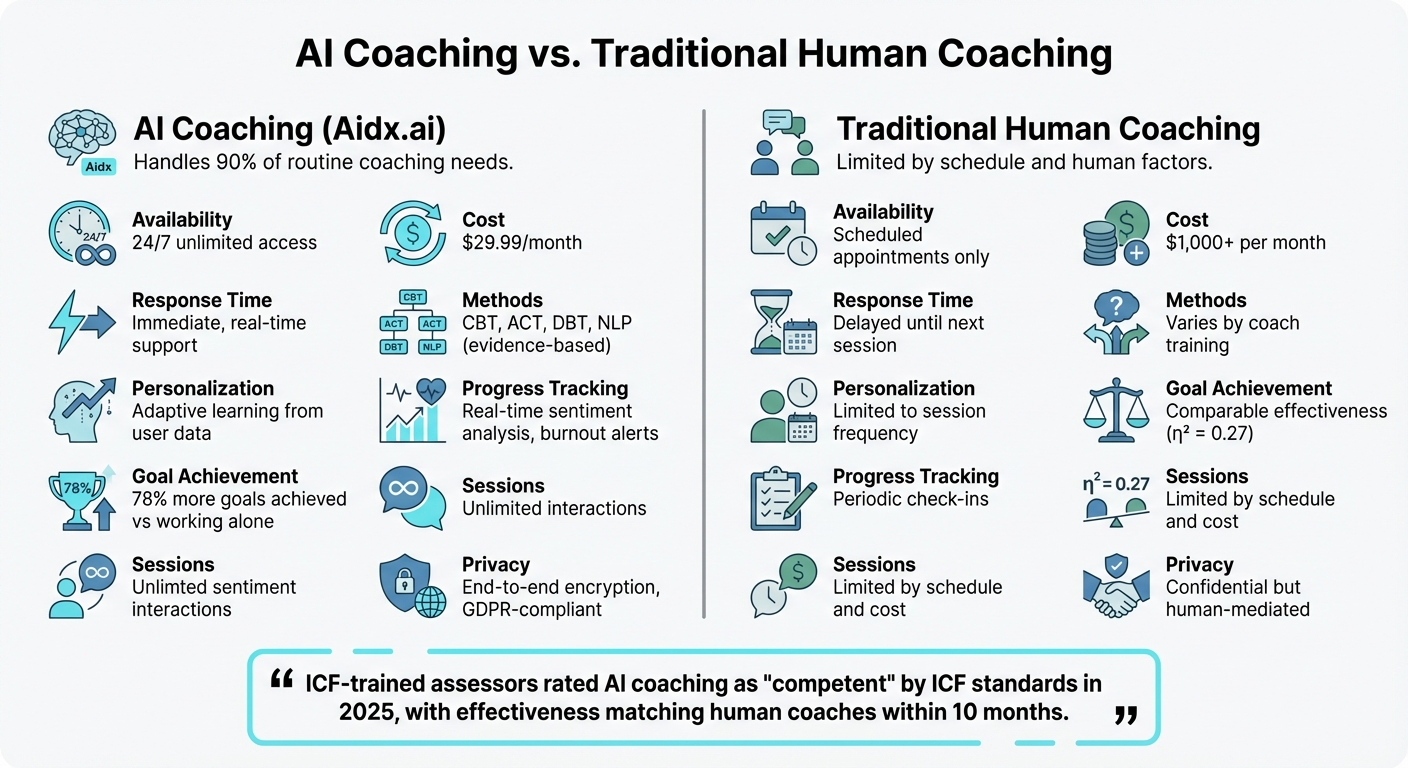
AI Coaching vs Traditional Human Coaching: Key Benefits Comparison
Digital and AI Coaching: What Coaches Need to Know
sbb-itb-d5e73b4
How Personalized AI Coaching Works
Personalized AI coaching begins by gathering and analyzing various user data to create a tailored experience. Through an initial assessment – usually involving interactive questions – the system evaluates your skill level, strengths, weaknesses, and specific goals. Beyond this, it continuously monitors your communication style, sentiment, and even non-verbal cues like voice or facial expressions. By doing so, it adjusts its responses to provide guidance that feels relevant and specific to you. This data-driven approach forms the backbone of a dynamic coaching process that evolves with your progress.
Research highlights that AI coaching is most effective when grounded in established frameworks like goal attainment theory or the PRACTICE coaching model. Platforms such as Aidx.ai incorporate evidence-based therapeutic methods, including CBT, DBT, ACT, and NLP, to tailor strategies that align with your unique thought patterns [2][7]. Essentially, the AI doesn’t just react – it learns and adapts, fine-tuning its methods to suit what works best for you.
Analyzing User Data for Personalization
AI systems use data to identify patterns in your preferences and challenges, allowing them to offer real-time, personalized feedback [2]. For instance, if you repeatedly struggle with decision-making under pressure, the system can recognize this trend and adjust its coaching approach. It may focus on refining your language patterns during communication training or suggest exercises to build confidence in high-stakes situations. These insights enable the AI to continuously refine your goals and strategies, ensuring the coaching remains aligned with your evolving needs.
Learning and Adapting Over Time
The system doesn’t just collect data – it grows with it. Frequent interactions help refine the coaching process, making goal achievement more attainable [2]. Take Aidx.ai’s Adaptive Therapeutic Intelligence (ATI) System™ as an example: it learns your communication style, emotional tendencies, and preferences, combining this understanding with evidence-based techniques. By gradually adjusting challenge levels, the system identifies what motivates meaningful change for you. Over time, this iterative process creates a coaching experience that not only adapts to your current needs but also supports your long-term growth journey.
Evidence-Based Methods in AI Coaching
AI coaching systems are built on psychological frameworks that have been refined through years of clinical research. Platforms like Aidx.ai use methods such as Cognitive Behavioral Therapy (CBT), Dialectical Behavior Therapy (DBT), Acceptance and Commitment Therapy (ACT), and Neuro-Linguistic Programming (NLP) to go beyond surface-level interactions. These approaches provide a structured way for the AI to identify patterns, challenge unhelpful thinking, and guide users toward meaningful and lasting change.
What makes these frameworks stand out in AI coaching is how they are applied. For example, CBT enables the system to detect cognitive distortions – like catastrophizing or black-and-white thinking – and offer exercises to reframe those thoughts in real time. ACT focuses on helping users align their actions with their core values by incorporating mindfulness and commitment strategies, fostering psychological flexibility. DBT introduces tools for managing emotions and tolerating distress, which can be especially helpful during high-stress moments. Meanwhile, NLP enhances communication by mirroring the user’s style and suggesting techniques to anchor positive mental states. Together, these methods create a dynamic and evolving coaching experience, continuously refined through adaptive learning.
Using CBT, ACT, DBT, and NLP
In a study conducted by Terblanche et al. (2022), the AI coach Vici demonstrated the effectiveness of these evidence-based methods. Participants working with Vici achieved results comparable to those coached by humans. The standout difference? Vici provided unlimited, 24/7 access, while human coaching was restricted to occasional sessions. The increased availability of AI coaching led to more frequent interactions, which directly correlated with better outcomes [2].
Aidx.ai’s Adaptive Therapeutic Intelligence (ATI) System™ takes this even further. It learns each user’s unique communication patterns and emotional tendencies, tailoring interventions to meet immediate needs. For instance, it applies CBT and ACT in Life Mode to enhance personal wellness, uses these frameworks for leadership growth in Business Mode, and focuses on performance optimization in Performance Mode. This flexibility allows the system to adapt seamlessly to different contexts.
Goal Setting and Progress Tracking
AI coaching doesn’t just focus on emotional and cognitive interventions – it also emphasizes structured goal setting and tracking to make progress measurable. By turning vague aspirations into actionable plans, it creates a clear path toward achieving results.
The process begins with an initial assessment that pinpoints your starting point and objectives. From there, the AI helps you break down your goals into SMART goals – specific, measurable, achievable, relevant, and time-bound. Progress is tracked continuously, with the AI monitoring your sentiment, behavior, and goal completion in real time. It even provides visual feedback to keep you motivated. Aidx.ai takes this a step further by tracking emotional wellbeing, stress levels, and burnout risk, offering timely alerts when intervention might be needed. This combination of structured planning and real-time monitoring transforms insights into meaningful, sustained action.
What Makes AI Coaching Effective
AI coaching stands out by combining constant availability with highly tailored interactions. Unlike human coaches, who are bound by schedules and limited availability, AI provides a flexible, always-on experience that fits seamlessly into the fast-paced lives of modern users.
24/7 Access and Unlimited Sessions
Traditional coaching often revolves around scheduled appointments, which can create delays and disrupt progress. AI coaching flips this model entirely. With on-demand access, you can tackle challenges as they arise – whether it’s late at night before a major presentation or during a quiet evening when stress levels spike.
Studies show that unlimited, on-demand coaching leads to greater success in achieving goals compared to the traditional, appointment-based model. For instance, a review of the "1440" AI life coach revealed that users reported higher satisfaction, better goal attainment, and stronger perceived support compared to human coaching sessions. These findings highlight the power of scalable, repeated engagement[4].
Imagine receiving guidance on a stressful email within minutes or resolving a tough decision immediately. AI systems can handle up to 90% of routine coaching needs[5], freeing human coaches to focus on more complex challenges. This real-time, context-aware support not only addresses immediate concerns but also helps users maintain momentum and reduce anxiety.
Building Trust Through Personalized Interaction
While availability is key, the quality of interaction is just as important. Research shows that AI coaching can build trust through personalized, context-aware communication. A mixed-methods study comparing AI with human coaching revealed that users rated the relationship with their AI coach similarly to human coaches. The AI’s ability to provide tailored, non-generic responses aligned with individual communication styles made users feel supported[3].
In fact, in 2025, International Coaching Federation (ICF)-trained assessors evaluated AI coaching agents as "competent" by ICF standards during real client sessions. This demonstrates that AI coaching can deliver results on par with human coaches[7].
"Aidx has been surprisingly human in identifying problems & asking the right questions. But faster! I got sucked into the conversation like I was talking to an educated & empathetic therapist." – Hali Holeszowski, Mobility Coach & Founder[1]
Trust is further strengthened by the platform’s transparency and security measures. For example, Aidx.ai operates with a privacy-first design, offering end-to-end encryption, GDPR-compliant safeguards, and a strict "no humans see what you write" policy. This commitment to confidentiality creates a safe space for users to engage in vulnerable conversations, enabling meaningful behavioral changes.
Aidx.ai: A Case Study in Personalized AI Coaching
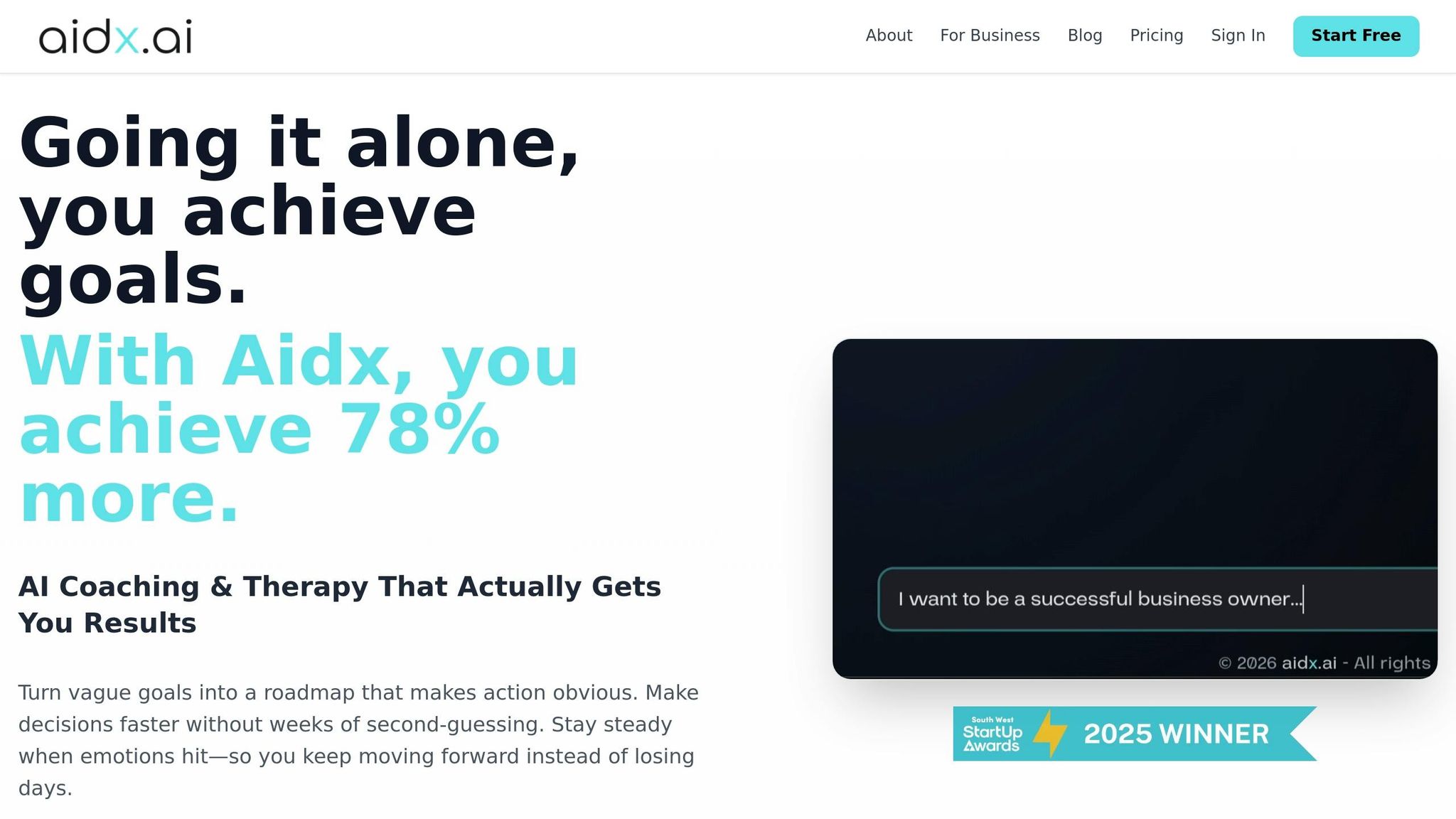
Aidx.ai brings the concept of personalized AI coaching to life, blending 24/7 availability, evidence-based techniques, and adaptive learning into a platform that has earned accolades, including being a two-time UK Startup Award winner (2024 & 2025).
What makes Aidx.ai stand out is its Adaptive Therapeutic Intelligence (ATI) System™. Unlike rigid systems that rely on pre-set user profiles, ATI evolves dynamically. It learns individual behaviors over time, tests various strategies, and fine-tunes its approach based on what resonates with each user. The result? Coaching that’s more effective and tailored to the person.
How Aidx.ai’s ATI System™ Drives Behavioral Change
The ATI System™ goes beyond surface-level interactions. It tracks user preferences, emotional patterns, and communication styles to deliver responses that feel personal and relevant. Instead of doling out generic advice, it asks targeted questions and employs techniques that align with the user’s unique needs.
This system draws from proven methods like CBT (Cognitive Behavioral Therapy), DBT (Dialectical Behavior Therapy), ACT (Acceptance and Commitment Therapy), and NLP (Neuro-Linguistic Programming). For example, some users might thrive with CBT’s cognitive reframing, while others respond better to ACT’s focus on mindfulness and acceptance. The platform adapts continuously, refining its feedback to match each user’s style.
But Aidx.ai doesn’t stop at insights – it bridges the gap between understanding and action. With tools like visual roadmaps, goal reminders, and metrics tracking stress, motivation, and burnout risk, users are empowered to stay on track. This approach has led to users achieving 78% more goals compared to working alone [1]. The system even monitors conversational sentiment, identifying potential red flags before they escalate into bigger issues.
This dynamic adaptability makes Aidx.ai an effective tool across various aspects of life and work.
Applications Across Life, Business, and Performance
The ATI System™ powers specialized coaching modes tailored to personal, professional, and performance-focused needs.
Life Mode is all about personal growth and emotional well-being. It helps users navigate intense emotions, manage stress, and monitor overall wellness. By incorporating ACT techniques for mindfulness and personalized goal tracking, it supports lasting change.
Business Mode focuses on professional growth and leadership. Professional trader Sarid Harper shared his experience:
"I have been using Aidx to help me overcome mental blocks in relation to increasing the size of my positions. Aidx helped me build a framework from which to work that empowered me during times of difficulty."
This mode provides real-time decision feedback, uncovers blind spots, and tracks progress toward career goals, enabling users to grow confidently in their roles.
Performance Mode is designed for those aiming to excel at peak levels. It keeps a close eye on burnout, energy, and motivation, sharpening focus and enabling faster, more informed decision-making. Psychologist Vera Martins highlighted the system’s practical approach, noting its ability to address "specificities of the issue" with "practical tips and actionable steps."
Across all modes, Aidx.ai prioritizes user privacy. It employs GDPR-compliant encryption, offers an optional incognito mode, and strictly ensures that no human ever sees user conversations. This secure environment fosters trust, encouraging open dialogue – a key factor in driving meaningful change.
Measuring the Effectiveness of AI Coaching
The effectiveness of AI coaching comes down to measurable results. These platforms rely on clear metrics to track whether users are meeting their goals and changing behaviors. Unlike traditional coaching, which often depends on subjective feedback and scheduled sessions, AI tools continuously gather data to reveal patterns and trends over time.
Tracking Goal Achievement and Behavioral Change
Studies indicate that frequent interactions with AI coaches lead to significantly higher success rates in achieving goals compared to limited access[2]. With round-the-clock availability, users can engage more often than they would in occasional human-led sessions. This increased usage directly ties to better outcomes[2].
AI platforms also evaluate behavioral changes by analyzing communication patterns. Metrics such as the number of open-ended questions asked, talk-to-listen ratios, and interruption frequency help assess both the quality of coaching and how users are evolving in their interactions[6]. According to research from the Conference Board, 89% of participants reported that AI coaching provided actionable next steps, showing clear progress toward their objectives[8]. This ability to measure progress extends naturally to tracking emotional health.
Monitoring Wellbeing and Preventing Burnout
AI coaching platforms are also equipped to monitor emotional health, aiming to catch early signs of burnout. Using tools like sentiment analysis and emotional detection, these systems can assess emotional states in real-time, identifying shifts based on text or voice cues[2]. In corporate settings, these platforms track metrics such as stress levels, energy, motivation, and burnout risk, offering a comprehensive view of employee wellbeing[6]. Early detection of negative trends allows for timely interventions, often preventing more serious issues down the line[2].
For example, Aidx.ai employs its Insights feature to track emotional wellbeing, stress, energy, and burnout risk throughout coaching sessions. By analyzing conversations over time, it flags subtle warning signs that users might overlook. This proactive monitoring ensures issues are addressed early, reinforcing the personalized and responsive nature of AI coaching.
Limitations and Ethical Considerations
Personalized AI coaching brings many benefits, but it’s important to address its ethical and practical boundaries to ensure its responsible use. While the technology is advanced, it still falls short of replicating human judgment and deeply nuanced empathy.
Empathy Limitations and Algorithmic Bias
AI’s ability to simulate empathy is impressive, but it’s not the same as truly understanding human emotions – especially during moments of intense personal crisis. As Mindliftly points out:
"Human empathy can never be fully replicated by AI. Coaches need to ensure that clients realize that AI is a tool, but not a substitute for human judgment" [10].
Another challenge is algorithmic bias. Since AI systems are trained on historical data, they may unintentionally reflect biases related to race, gender, or other factors. This can lead to inaccuracies in the early stages of coaching. Aidx.ai explains:
"Aidx doesn’t know you on day one. It learns your patterns, tests what works, adjusts as you go" [1].
To reduce these risks, AI coaching platforms should base their recommendations on evidence-based approaches like Cognitive Behavioral Therapy (CBT), Dialectical Behavior Therapy (DBT), and Acceptance and Commitment Therapy (ACT). Regular audits of AI models are also essential to avoid reinforcing stereotypes and to ensure outputs remain reliable [10].
Privacy and Data Security Standards
Protecting user privacy is a cornerstone of effective AI coaching. Users often share highly sensitive information – ranging from emotional challenges to professional struggles – that must be kept secure. Leading platforms prioritize strong measures like end-to-end encryption and compliance with GDPR standards.
One effective approach is a zero-human access policy. For example, Aidx.ai, co-founded by cybersecurity expert Nicklas Wolff, incorporates data protection into the platform’s design rather than treating it as an afterthought.
Despite these efforts, fewer than 10% of organizations have robust frameworks to manage AI-related risks [9]. Michael Impink, an AI Ethics in Business instructor at Harvard DCE, highlights the stakes:
"If people begin to feel that AI algorithms are making life-altering decisions in ways even experts can’t explain, they’re likely to lose trust in those institutions and tools" [11].
For AI systems to maintain user trust, transparency is key. Clear communication about how algorithms function and accountability for their outcomes are critical. These challenges emphasize the ongoing need to refine AI systems and ensure they operate with fairness and openness.
Conclusion: The Impact of Personalized AI Coaching
AI coaching, rooted in personalized strategies and ongoing feedback, is showing impressive results. Research from randomized trials indicates that AI coaches can match the effectiveness of human coaches within a 10-month period, with both achieving effect sizes around η² = 0.27 (p < .001) – a significant improvement over control groups [2][12].
The success of AI coaching stems from three key elements: adaptive personalization, evidence-based methods, and constant availability. By analyzing user data to deliver tailored feedback, monitoring progress with real-time sentiment analysis, and employing proven therapeutic techniques, AI coaching offers consistent and meaningful support. This approach addresses challenges that traditional monthly sessions often fall short of, like maintaining self-awareness and driving long-term behavioral change.
Take Aidx.ai as an example. Its Adaptive Therapeutic Intelligence (ATI) System™ adapts to each user’s unique communication style and emotional tendencies. By combining goal-setting, progress tracking, and timely notifications with evidence-based therapeutic practices, Aidx turns insights into actionable steps. Users report achieving 78% more goals compared to working alone [1]. The platform’s flexibility, with modes tailored for Life, Business, and Performance, further amplifies its effectiveness.
Privacy is another critical factor. Strong privacy measures foster trust and encourage open, frequent interactions – key for creating deeply personalized experiences. This secure framework enables scalable solutions that deliver measurable benefits, such as reducing burnout, improving work-life balance, and enhancing employee retention in corporate environments.
Perhaps the most transformative aspect of AI coaching is its accessibility. At just $29.99 per month, it provides expert-level support at a fraction of the cost of human coaches, who typically charge over $1,000 monthly. A 2025 assessment using ICF standards confirmed that AI-based coaches can demonstrate coaching behaviors that positively impact well-being, achieving results comparable to human coaches [7]. This isn’t about replacing human connection; it’s about making effective tools for behavioral change available to more people, whenever and wherever they need them.
FAQs
What data does an AI coach use to personalize coaching?
AI coaching takes personalization to a new level by analyzing what users share – whether through text or voice. It identifies emotional patterns, tracks behaviors, and monitors progress over time. By adjusting strategies to match each person’s communication style and preferences, systems like the ATI System™ provide tailored guidance that grows and adapts alongside the user.
How quickly does AI coaching adapt to my communication style?
AI coaching platforms, such as Aidx.ai, adjust to your communication style as you interact with them. They analyze your emotional patterns and adapt their responses over time, creating a more personalized and dynamic support experience that grows alongside you.
When should I use a human therapist instead of AI coaching?
When dealing with complex mental health issues – like trauma, severe depression, or anxiety – it’s crucial to work with a human therapist. These professionals bring a level of deep empathy, nuanced understanding, and the ability to manage crises that AI simply can’t replicate. Their ability to interpret emotional cues and build trust creates a foundation for meaningful healing.
On the other hand, AI coaching platforms, such as Aidx.ai, can be a great fit for addressing mild to moderate challenges, fostering behavior change, and supporting ongoing self-monitoring. AI tools provide accessibility and rely on evidence-based techniques, making them a helpful resource for many. However, for situations that demand personalized care and a deeper connection, human therapists remain unmatched.