
A perfectionist is not simply someone with high standards. Plenty of people hold high standards and sleep well. The defining feature, in the clinical research, is narrower and more painful than that: your sense of your own worth has become dependent on meeting those standards — and it stays dependent even when meeting them is costing you.
That distinction matters more than any list of traits, because it points at the part that can actually change. Nobody is going to ask you to care less. The problem was never the standard. It is what the standard is holding up.
What follows is what perfectionism actually is, how to recognise it, what it costs — including the awkward question of whether it makes you any good at your job — and what the evidence shows can shift it.
What a perfectionist actually is
The most influential definition comes from Roz Shafran, Zafra Cooper and Christopher Fairburn, who in 2002 proposed the term clinical perfectionism for the version that causes harm. Their definition is worth reading slowly, because every clause is doing work[1]:
“the overdependence of self-evaluation on the determined pursuit (and achievement) of self-imposed personally demanding standards of performance in at least one salient domain, despite the occurrence of adverse consequences.”
Unpacked: the standards are your own, nobody imposed them; they apply in at least one area that matters to you, not necessarily all of them; your self-evaluation depends on hitting them; and you keep going even when it is demonstrably hurting you.
The same paper describes the machinery that keeps it running, and this is the part most people recognise instantly. When you fall short of a standard, you respond with self-criticism. When you meet it, the standard gets quietly re-evaluated as having been insufficiently demanding[1]. Failure proves you are not good enough. Success proves the bar was too low. It is a system with no exit, which is why effort alone never resolves it.
One thing to be clear about early: perfectionism is not a diagnosis. It appears in no diagnostic manual. Researchers describe it as a transdiagnostic process — a pattern that shows up across many different difficulties rather than constituting one of its own. That is a genuinely reassuring fact, and it is also the reason the research on it is more hopeful than you might expect.
The two halves — and why only one of them hurts
Perfectionism research consistently separates two components, and almost everything interesting follows from the split:
| Perfectionistic strivings | Perfectionistic concerns | |
|---|---|---|
| What it is | Setting high standards; caring about doing things well | Fear of mistakes, doubt about your actions, the gap between who you are and who you should be |
| Sounds like | “I want this to be really good.” | “If this isn’t right, that says something about me.” |
| Generally linked to | Conscientiousness, achievement, engagement | Anxiety, depression, burnout, avoidance |
In a major review of this literature, Joachim Stoeber and Kathleen Otto concluded that self-oriented perfectionistic strivings appear positive — with an explicit condition attached — “if perfectionists are not overly concerned about mistakes and negative evaluations by others”[2]. The if is the whole ballgame. Standards on their own are largely fine. Standards fused to your worth are not.
In fairness, this is contested. Gordon Flett and Paul Hewitt have argued at length against the idea that there is a “normal” or “healthy” perfectionism at all, suggesting that so-called positive perfectionism is partly motivated by fear of failure, and that defining it has blurred the line between perfectionism and ordinary conscientiousness[3][4]. It is a live disagreement among serious people, and you should know that before anyone sells you “healthy perfectionism” as settled science.
Signs of perfectionism
The pattern shows up in behaviour long before it shows up in a mood:
- The 6% problem. A 94% registers as the six marks you dropped. Praise slides off; a single criticism lodges for a week.
- Re-reading things you have already sent — emails, messages, submitted work — auditing them for the mistake.
- Not starting. You put off the things you care about most, because a thing not begun cannot be done badly.
- All-or-nothing thinking. One missed day and the whole effort is contaminated, so it gets abandoned rather than resumed.
- Checking and re-checking, or refusing to delegate, because someone else might do it to a lower standard.
- The moving bar. Achievements deflate on contact. Whatever you just did was, on reflection, not that hard.
- “Never good enough” as a background hum rather than an occasional thought.
Notice how many of those are about avoidance rather than effort. That surprises people. Perfectionism is popularly imagined as relentless productivity; in practice it very often looks like a person who cannot begin.
The uncomfortable question: does it actually make you better?
This is the belief that keeps the whole thing in place — that your standards are the engine of everything good in your life, and that loosening them would mean losing what makes you effective. It is the reason advice to “just lower the bar” feels both threatening and useless.
So it is worth knowing what the evidence says, because it does not say what you would expect.
A meta-analysis of perfectionism in the workplace, covering the organisational research literature, found perfectionism to have “sizable and consistent relationships with several organizationally relevant factors” but an equivocal overall relationship with job performance[5]. Equivocal. After all of it — the late nights, the re-reading, the not-sleeping — the link to actually performing better at work is unclear.
In education the picture is sharper, and it splits exactly along the two halves above. A meta-analysis of 67 studies and 378 effect sizes found that the subscales measuring standards were positively related to academic performance and to helpful academic outcomes. Meanwhile two of the four subscales measuring concerns — Discrepancy and Doubts about Actions — were negatively related to academic performance, and every concerns subscale was positively associated with unhelpful outcomes[6].
Read that carefully, because it is the most useful finding in this article. The half you are frightened of losing — high standards — is the half associated with doing well. The half that is making you miserable is, if anything, making you worse. You are not being asked to trade performance for peace. Those are not the terms.
What it actually costs
Burnout. A meta-analysis of 43 studies covering 9,838 people found that perfectionistic strivings had small negative or non-significant relationships with burnout, while perfectionistic concerns showed medium-to-large positive relationships with it. Once the overlap between the two was statistically controlled, “pure” strivings looked more protective still[7]. Again: it is not the caring that burns you out.
Mental health more broadly. The largest synthesis of this question retrieved 284 studies yielding 2,047 effect sizes, and concluded that perfectionism functions as a transdiagnostic factor — both dimensions showed associations with a range of difficulties including depression, anxiety, obsessive-compulsive disorder and eating disorders[8]. The eating-disorder link is real and long-established in this literature, and it deserves a sentence rather than a scare: perfectionism is one recognised contributing process among several, not a cause and not a prediction. If food, eating or body image is where your standards have settled, that is worth raising with a doctor or therapist rather than reading about.
Procrastination and avoidance. The delay is not laziness; it is a rational response to a rule that says an imperfect attempt would be evidence about you. That is also why the usual productivity advice bounces off — it treats a self-worth problem as a scheduling problem. If that is the shape of it for you, our guide to why you procrastinate and what actually helps goes further, and the piece on building self-discipline without willpower covers the all-or-nothing collapse that ends most streaks.
“Never good enough”, and the atelophobia question
A lot of people arrive at this subject through the word atelophobia — usually defined online as a fear of imperfection. It is worth being straight about what that word is.
Atelophobia is not a diagnosis. It does not appear in the DSM-5-TR or the ICD-11, and it has essentially no presence in the clinical research literature: a search of PubMed, the US National Library of Medicine’s index of biomedical research, returns zero results for the term. The DSM does not catalogue individually named phobias at all; specific phobia is classified into five broad groups — animal, natural environment, blood-injection-injury, situational, and other — and requires that the fear be out of proportion to the actual danger, persist for six months or more, and cause significant distress or impairment[9].
None of which means the feeling is imaginary. It means the internet gave a real experience a clinical-sounding name it never had. What you are describing is far better captured by the perfectionism research above — which has the considerable advantage of coming with evidence about what helps.
Perfectionist or impostor? They are not the same thing
These two get conflated constantly, and separating them tells you where to aim.
| Perfectionism | Impostor feelings | |
|---|---|---|
| The core belief | “My worth depends on this being flawless.” | “I am not as capable as people think, and I will be found out.” |
| Trigger | A standard you might miss | Evidence of your own competence |
| Response to success | Raise the bar | Attribute it to luck or timing |
They travel together often enough that perfectionism is one of the patterns that reliably shows up alongside impostor feelings — but they are different beliefs and they need different answers. If the “I’ll be found out” thread is the louder one for you, that is covered separately in how to overcome impostor syndrome.
Is perfectionism really rising? Yes — carefully
You will have seen the headline that perfectionism has risen 33% among young people. That claim comes from one real study, and it is worth stating accurately, because the popular version overstates it.
Thomas Curran and Andrew Hill analysed 164 samples of 41,641 American, Canadian and British college students who completed the same perfectionism scale between 1989 and 2016. All three dimensions rose over the 28 years. The largest increase was in socially prescribed perfectionism — the sense that other people demand perfection of you — which moved from a predicted 3.35 to 3.71 on the scale, an increase of 0.40 standard deviations. Self-oriented perfectionism rose 0.12 SD and other-oriented 0.19 SD[10].
So where does “33%” come from? The authors translated those shifts into percentiles: the average student in 2017 sat at the 66th percentile of the 1989 distribution, meaning roughly two-thirds of 2017 students scored above the 1989 average, up from half. They express that as a 32% increase — a 32% change in the proportion of students above the old average, not a 32% rise in perfectionism itself. The underlying shift is 0.40 SD: real, the largest of the three, and modest.
The genuinely interesting part is which dimension moved most. It was not that young people became more demanding of themselves. It was that they increasingly feel others demand perfection of them. If your perfectionism feels like something being done to you rather than something you chose, the data quietly agrees.
What actually changes it
Here is where this subject differs from almost everything else in mental health writing, and it is the reason this article is worth finishing.
A systematic review and meta-analysis by Ricky Galloway, Hunna Watson, Danyelle Greene, Roz Shafran and Sarah Egan pooled 15 randomised controlled trials of CBT for perfectionism, covering 912 participants. Across all delivery formats, the effects were large for concern over mistakes (g = 0.89) and clinical perfectionism (g = 0.87), medium for personal standards (g = 0.57), and medium for the symptoms that travel with it — depression (g = 0.60), eating-disorder symptoms (g = 0.61) and anxiety (g = 0.42). No publication bias was detected, and average study quality was rated 82%[11].
Now the unusual bit. Twelve of the interventions — three-quarters of them — used self-help formats, a book or an online programme rather than a therapist’s office, and the authors analysed those separately. Self-help delivery produced g = 0.91 for clinical perfectionism, 0.83 for concern over mistakes, 0.56 for personal standards, 0.61 for eating-disorder symptoms, 0.48 for depression and 0.43 for anxiety. Whether the self-help was guided by a person or worked through alone did not significantly affect the result on the three outcomes where that could be tested[11].
In most areas of mental health, the strong evidence is for treatment delivered by a clinician and the self-directed version is a weaker second best. In perfectionism, working through a structured programme on your own held up. That is genuinely good news for anyone who is not currently in therapy.
Three honest caveats, which the authors state themselves and you should carry with the number. There were few trials. Most compared CBT against a waiting list rather than against another active treatment — so g ≈ 0.9 is not “better than therapy,” it is “better than nothing while you wait,” and waitlist comparisons inflate effect sizes. And on the guided-versus-unguided question, the authors write plainly that the analysis “was based on limited studies, and thus no strong conclusions can be drawn.” The participants were also mostly young (average age 23) and mostly women, largely recruited in Australia. Promising is the right word. Proven is not.
What that actually looks like in practice
The trials above are not mysterious. They mostly do a small number of specific things, and you can start most of them today.
- Run the experiment instead of arguing with yourself. This is the core move of CBT for perfectionism. Pick one standard, deliberately drop it a notch — send the email after one read, leave the report at “good”, arrive with the ordinary cake — and write down beforehand what you predict will happen. Then check. The prediction is usually wrong, and the value is cumulative: you are gathering evidence about the accuracy of your own alarms.
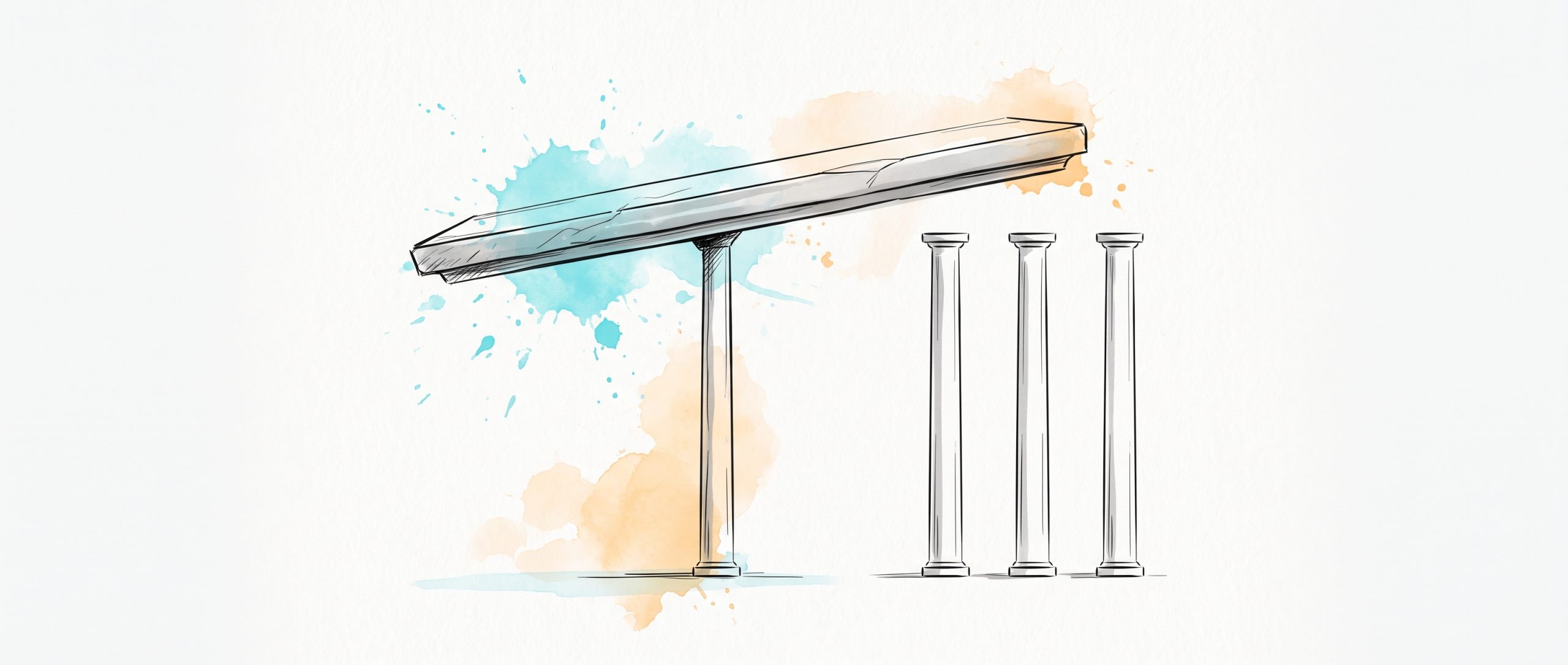
- Widen the base your self-worth rests on. Shafran’s model describes worth balanced on one or two domains[1]. The work is not lowering that pillar; it is adding others, so that a bad day at one becomes a bad day rather than a verdict. Our guide to building self-esteem on something steadier is essentially this task.
- Catch the re-evaluation. When you hit a target and immediately conclude it was easy, name that out loud. It is the specific mechanism keeping the system closed, and it operates almost invisibly.
- Replace all-or-nothing with degrees. “Ruined” and “perfect” are the only two options the pattern offers. Asking “how good is this, on a scale?” is a small, standard cognitive reframing move, and it is remarkably hard the first few times.
- Change how you speak to yourself after a miss. Self-criticism is not the engine of your standards; it is the tax on them. The shame spiral after a mistake is the part that makes the next attempt more frightening, and quieting that inner critic is reasonable work in its own right.
- Ask the workability question. Not “is this standard high?” but “is this standard serving what I actually care about?” A rule can be admirable and still be costing you the thing it was meant to protect.
A brief, honest word about tools, ours included. Having somewhere to write the prediction down before you send the email, and somewhere to go afterwards when the self-criticism starts, is genuinely useful — it is part of what aidx.ai is built for, as AI coaching and therapy drawing on CBT and ACT. What we will not claim is that the trials above tested us. They tested structured self-help programmes, which is a closer cousin to a tool like this than most self-help evidence gets — but it is a cousin, not the same thing, and we would rather say so.
When to bring in a professional
Structured self-help held up well in the trials, and it is a reasonable place to start. It is not the right place to start if perfectionism has tipped into territory that deserves a qualified human: if it is centred on food, eating, weight or body image; if checking and re-checking has become compulsive; if you are persistently low, not sleeping, or withdrawing from people; or if your standards are the reason your life has narrowed. None of that is a failure of effort, and a therapist is the option with the strongest evidence behind it. If you are having thoughts of harming yourself, please treat that as urgent and contact emergency services or a crisis line now.
The thing worth carrying out of here is the smallest and the most load-bearing: your standards are not the problem, and you are not being asked to give them up. What is worth putting down is the arrangement whereby you only get to be a worthwhile person on the days you meet them. Those two things were always separate. They can be separated again.
Last reviewed: August 2026
This article is general information about psychology and emotional wellbeing. It is not medical or psychological advice, and it cannot diagnose or treat any condition. If perfectionism is seriously affecting your mood, your health, your eating, or your ability to work, consider speaking with a doctor, therapist or counsellor. If you are in crisis or thinking about harming yourself, please contact your local emergency services or a crisis line right away — in the US, call or text 988 (Suicide & Crisis Lifeline); in the UK, call 116 123 (Samaritans). For eating-disorder support, in the US the National Alliance for Eating Disorders helpline is 1-866-662-1235; in the UK, Beat’s helpline is 0808 801 0677.
References
- Shafran, R., Cooper, Z., & Fairburn, C. G. (2002). Clinical perfectionism: A cognitive–behavioural analysis. Behaviour Research and Therapy, 40(7), 773–791.
- Stoeber, J., & Otto, K. (2006). Positive conceptions of perfectionism: Approaches, evidence, challenges. Personality and Social Psychology Review, 10(4), 295–319.
- Flett, G. L., & Hewitt, P. L. (2006). Positive versus negative perfectionism in psychopathology: A comment on Slade and Owens’s dual process model. Behavior Modification, 30(4), 472–495.
- Hewitt, P. L., Flett, G. L., Besser, A., Sherry, S. B., & McGee, B. (2003). Perfectionism is multidimensional: A reply to Shafran, Cooper and Fairburn (2002). Behaviour Research and Therapy, 41(10), 1221–1236.
- Harari, D., Swider, B. W., Steed, L. B., & Breidenthal, A. P. (2018). Is perfect good? A meta-analysis of perfectionism in the workplace. Journal of Applied Psychology, 103(10), 1121–1144.
- Osenk, I., Williamson, P., & Wade, T. D. (2020). Does perfectionism or pursuit of excellence contribute to successful learning? A meta-analytic review. Psychological Assessment, 32(10), 972–983. (67 studies, 378 effect sizes.)
- Hill, A. P., & Curran, T. (2016). Multidimensional perfectionism and burnout: A meta-analysis. Personality and Social Psychology Review, 20(3), 269–288. (43 studies, N = 9,838.)
- Limburg, K., Watson, H. J., Hagger, M. S., & Egan, S. J. (2017). The relationship between perfectionism and psychopathology: A meta-analysis. Journal of Clinical Psychology, 73(10), 1301–1326. (284 studies, 2,047 effect sizes.)
- Samra, C. K., Torrico, T. J., & Abdijadid, S. Specific phobia. StatPearls (NCBI Bookshelf, National Library of Medicine).
- Curran, T., & Hill, A. P. (2019). Perfectionism is increasing over time: A meta-analysis of birth cohort differences from 1989 to 2016. Psychological Bulletin, 145(4), 410–429. (164 samples, N = 41,641.)
- Galloway, R., Watson, H., Greene, D., Shafran, R., & Egan, S. J. (2022). The efficacy of randomised controlled trials of cognitive behaviour therapy for perfectionism: A systematic review and meta-analysis. Cognitive Behaviour Therapy, 51(2), 170–184. (15 RCTs, N = 912.)