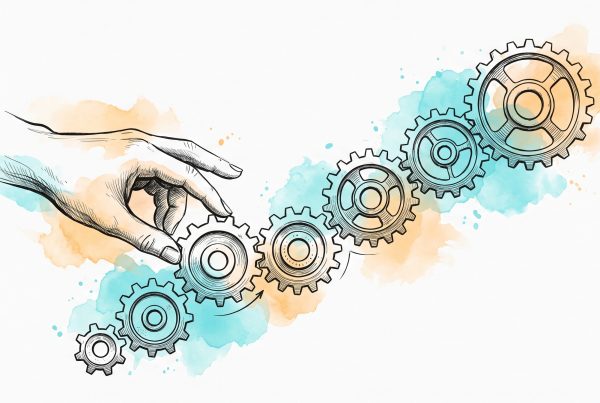


Mindfulness at work means bringing steady, non-judgmental attention to whatever you’re actually doing — one email, one conversation, one breath at a time — instead of running on autopilot while your mind drifts somewhere else. It’s a simple idea with a real evidence base, and also one that’s been wildly oversold. This guide separates the two: what the research genuinely supports, where it’s weaker than the headlines suggest, and a handful of practices you can use today without rearranging your whole day.
The honest short version: in controlled studies, mindfulness training produces small-to-moderate improvements in self-reported stress, anxiety, and focus. It is not a cure for a crushing workload, and the largest real-world study to date found that individual wellbeing programs, on their own, often deliver no measurable benefit. Mindfulness is a useful personal skill — not a substitute for a humane workplace.
Why attention is the real problem at work
Start with a number that explains a lot about the modern workday. In a landmark 2010 study published in Science, Harvard researchers Matthew Killingsworth and Daniel Gilbert sampled the in-the-moment thoughts of around 2,250 adults and found that people’s minds were wandering — thinking about something other than what they were doing — for 46.9% of their waking hours. Nearly half the day, spent somewhere other than the task in front of us. The same study found that a wandering mind tended to be a less happy one, and that the mind-wandering generally came first (Killingsworth & Gilbert, 2010).
That’s the core problem mindfulness is actually good at addressing. Not stress in the abstract, but the quiet, constant leak of attention away from the present — the half-read message you reply to anyway, the meeting you attend while mentally drafting the next one. Mindfulness is, at heart, attention training: noticing when your mind has drifted and gently bringing it back, over and over. Done regularly, that “bringing it back” is the rep that strengthens the muscle.
What the evidence actually shows
Wellness marketing tends to promise the moon. The research is more measured — and more trustworthy for it. Here’s where the strongest evidence sits, and where it doesn’t.
Focus and mind-wandering: the best-supported benefit
In a 2013 randomized trial, psychologists at UC Santa Barbara gave 48 undergraduates either a two-week mindfulness course or a nutrition class as an active control. The mindfulness group showed reduced mind-wandering, improved working memory capacity, and higher GRE reading-comprehension scores — and the gains were largest in people who were the most distractible to begin with (Mrazek et al., 2013). A separate line of research with high-pressure military cohorts found that mindfulness training helped protect working memory from the degrading effect of intense stress — but only for those who actually put in the practice time; participants who did little practice saw no protection (Jha et al., 2010).
That last detail matters. The benefit isn’t magic; it tracks how much you practice. Mindfulness behaves like training, not like a pill.
Stress and emotional regulation: real, but modest
The most cited workplace pressure point is stress, and it’s widespread: in the American Psychological Association’s 2023 Work in America survey of over 2,500 US employees, 77% reported experiencing work-related stress in the previous month, and 57% reported stress-related effects like emotional exhaustion (APA, 2023).
Does mindfulness help? The most rigorous evidence says: a little. A meta-analysis of 23 randomized controlled trials of workplace mindfulness programs found beneficial effects on perceived stress, anxiety, and psychological distress, with effect sizes in the small-to-moderate range (Hedges’ g ≈ 0.45–0.69) (Bartlett et al., 2019). Notably, those same authors found the evidence too thin to draw conclusions about burnout, depression, or work performance — so the common claim that mindfulness “boosts productivity” is not something this body of research can back up.
The single most important study to keep in mind is the most skeptical one. An AHRQ-commissioned meta-analysis of 47 trials and 3,515 participants, published in JAMA Internal Medicine, concluded that meditation programs produced small improvements in anxiety, depression, and pain (effect sizes around d = 0.3) — but found no evidence they worked better than active alternatives like exercise or other therapies, and only low or insufficient evidence for boosting positive mood or attention (Goyal et al., 2014). In plain terms: mindfulness genuinely helps some people with stress and low mood, but a daily walk or a good conversation might help about as much.
Creativity and the brain: intriguing, not proven
You’ll often see mindfulness sold as a creativity hack. Be cautious here. The most-cited study found that open-monitoring meditation (broad, receptive awareness) was associated with better divergent thinking — generating many ideas — while focused-attention meditation suited convergent, single-answer problems (Colzato et al., 2012). It’s a genuinely interesting finding, but it’s one small experiment, not a settled result. Treat the creativity claim as suggestive, not established.
The neuroscience is similar: promising, preliminary (for the fuller, honest picture, see how mindfulness changes the brain). Small MRI studies have found that after an eight-week mindfulness course, reductions in perceived stress correlated with structural changes in the amygdala, the brain’s threat-detection center (Hölzel et al., 2010). It’s an early, indirect signal of the brain adapting — not proof of a workplace superpower. The honest read across all of it: real effects, modest size, often overstated.
Practical mindfulness techniques for a real workday
None of this requires an hour on a cushion. The most useful workplace mindfulness fits into the gaps you already have. A few that map directly onto the research above — most of which is about reclaiming attention:
| Practice | How to do it | When it helps most |
|---|---|---|
| Three-breath reset | Before opening your inbox or starting a hard task, take three slow breaths, feeling each one fully. | Transitions between tasks; before reacting to a stressful message. |
| Single-tasking | Give one task your whole attention until a natural stopping point. Close the other tabs. | Deep work; anything where mistakes are costly. |
| Body scan | Spend 60 seconds noticing tension from head to shoulders to jaw, and consciously letting it go. | Between back-to-back meetings; mid-afternoon slump. |
| Mindful listening | In a conversation, give full attention and pause before you respond, instead of pre-loading your reply. | One-on-ones, difficult conversations, negotiations. |
| Mindful walking | On a short break or commute, attend to the feeling of your feet and your breath rather than your phone. | Resetting after a draining stretch; the work-to-home shift. |
The unglamorous truth is that consistency beats intensity. A genuine 60 seconds, several times a day, will do more than an ambitious 30-minute session you abandon by Thursday. And every time you notice your mind has wandered and bring it back — that is the practice working, not a sign you’re failing at it.
The honest caveat: mindfulness can’t fix a broken workplace
Here’s the part most wellness content leaves out. In 2024, an Oxford researcher analyzed wellbeing data from over 46,000 workers across 233 UK organizations and found that employees who took part in individual-level interventions — mindfulness, resilience training, stress-management courses, wellbeing apps — were, on average, no better off than those who didn’t. The one exception was volunteering (Fleming, 2024).
That finding isn’t a reason to abandon mindfulness; it’s a reason to be clear-eyed about what it’s for. Individual practices help you meet the demands of your job with a steadier mind. They cannot, on their own, undo an unmanageable workload, chronic understaffing, or a culture of always-on availability. When mindfulness is offered as a substitute for fixing those structural problems — “have you tried meditating?” in place of reasonable hours — it can even feel like the burden being shifted onto the person under strain.
The research points to a both/and answer: personal mindfulness and genuine organizational change — sane workloads, better job design, and a culture of psychological safety — are what actually move the needle. If you manage people, that second half is the bigger lever. If you’re an individual, mindfulness is a real tool you control directly, and worth using — with realistic expectations. For the wider picture on pressure at work, our guide to managing workplace stress goes deeper, and if you’ve ever felt under-challenged rather than overloaded, boreout is the quieter, less-discussed cousin of burnout.
Making it stick
The hardest part of mindfulness at work isn’t the technique — it’s remembering to do it at all, in the rush of a normal day. A few things help it stick:
- Anchor it to something you already do. Tie a three-breath reset to opening your laptop, joining a call, or returning from lunch. The existing habit becomes the reminder.
- Start absurdly small. One breath. One mindful sip of coffee. The goal early on is consistency, not duration — you can always grow it later.
- Drop the self-criticism. A wandering mind isn’t a failure; noticing the wander is the entire skill. Bring it back without the commentary.
- Pick what fits you. If sitting still feels impossible, walk. If breathing feels boring, try mindful listening. There’s no single correct form.
If you’d like a structured nudge, this is one place an AI companion can genuinely help. aidx.ai is an AI coaching and therapy service (chat and voice, with an AI performance coach for focus and energy at work) that draws on evidence-based approaches like CBT and ACT; it can prompt you toward a short reset at the moments you most need one, help you stay consistent, and talk through what’s actually driving the pressure — not as a replacement for a human therapist or for fixing an overloaded job, but as steady, private support that fits into a working day.
Frequently asked questions
Does mindfulness really improve performance at work?
It improves some of the things that underlie performance — chiefly focus and self-reported stress — with small-to-moderate effects in controlled studies. But the direct claim that it “boosts productivity” isn’t well supported; the leading workplace meta-analysis found the evidence on work performance too thin to draw a conclusion (Bartlett et al., 2019). Expect a steadier mind, not a productivity miracle.
How much do I need to practice to see a benefit?
More than you might hope, but less than you might fear. The research consistently shows benefits track with practice time — people who practiced more saw the gains, those who barely practiced often saw none (Jha et al., 2010). A realistic target is a few minutes, several times a day, woven into existing routines, sustained over weeks.
Is mindfulness a substitute for addressing a stressful job?
No, and it’s important to be honest about this. The largest real-world study found individual wellbeing programs, on their own, delivered no measurable benefit (Fleming, 2024). Mindfulness helps you cope with workplace demands; it doesn’t fix unreasonable ones. Both individual practice and genuine organizational change matter — and the structural side is usually the bigger lever.
Last reviewed: June 2026. This article is general information about mindfulness and wellbeing, not medical or psychological advice. If work stress is seriously affecting your health, or you’re experiencing persistent anxiety or depression, please consult a qualified professional. If you’re in crisis or thinking about harming yourself, contact your local emergency services or a crisis line right away.
References
- American Psychological Association. (2023). 2023 Work in America Survey.
- Bartlett, L., et al. (2019). A systematic review and meta-analysis of workplace mindfulness training randomized controlled trials. Journal of Occupational Health Psychology.
- Colzato, L. S., et al. (2012). Meditate to Create. Frontiers in Psychology.
- Fleming, W. J. (2024). Employee well-being outcomes from individual-level mental health interventions. Industrial Relations Journal.
- Goyal, M., et al. (2014). Meditation Programs for Psychological Stress and Well-being. JAMA Internal Medicine.
- Hölzel, B. K., et al. (2010). Stress reduction correlates with structural changes in the amygdala. Social Cognitive and Affective Neuroscience.
- Jha, A. P., et al. (2010). Examining the protective effects of mindfulness training on working memory capacity. Emotion.
- Killingsworth, M. A., & Gilbert, D. T. (2010). A Wandering Mind Is an Unhappy Mind. Science.
- Mrazek, M. D., et al. (2013). Mindfulness Training Improves Working Memory Capacity and GRE Performance While Reducing Mind Wandering. Psychological Science.