
Switching careers is no longer a guessing game. AI tools now offer data-driven insights to help you identify transferable skills, research growing industries, and create personalized learning plans. Here’s why it matters:
- 45% of professionals discovered new career paths using AI tools.
- Job seekers using AI report 38% higher placement rates.
- AI-powered platforms cost $10–$100/month, compared to $100–$300 per coaching session.
AI tools analyze millions of job postings, match your profile to hiring trends, and guide you step-by-step. Whether it’s assessing your skills, developing a targeted upskilling plan, or refining your resume, AI ensures you stay competitive in a rapidly changing job market.
The process is simple:
- Evaluate your skills: Identify strengths and gaps using AI analysis.
- Research industries: Use AI to find sectors aligned with your expertise.
- Upskill efficiently: Build a learning plan with measurable milestones.
- Update your profile: Optimize your resume and LinkedIn for your new direction.
- Leverage AI support: Stay on track with tools for networking, interviews, and planning.
AI tools like Aidx.ai make career transitions accessible, actionable, and affordable. Start planning your next move with confidence.
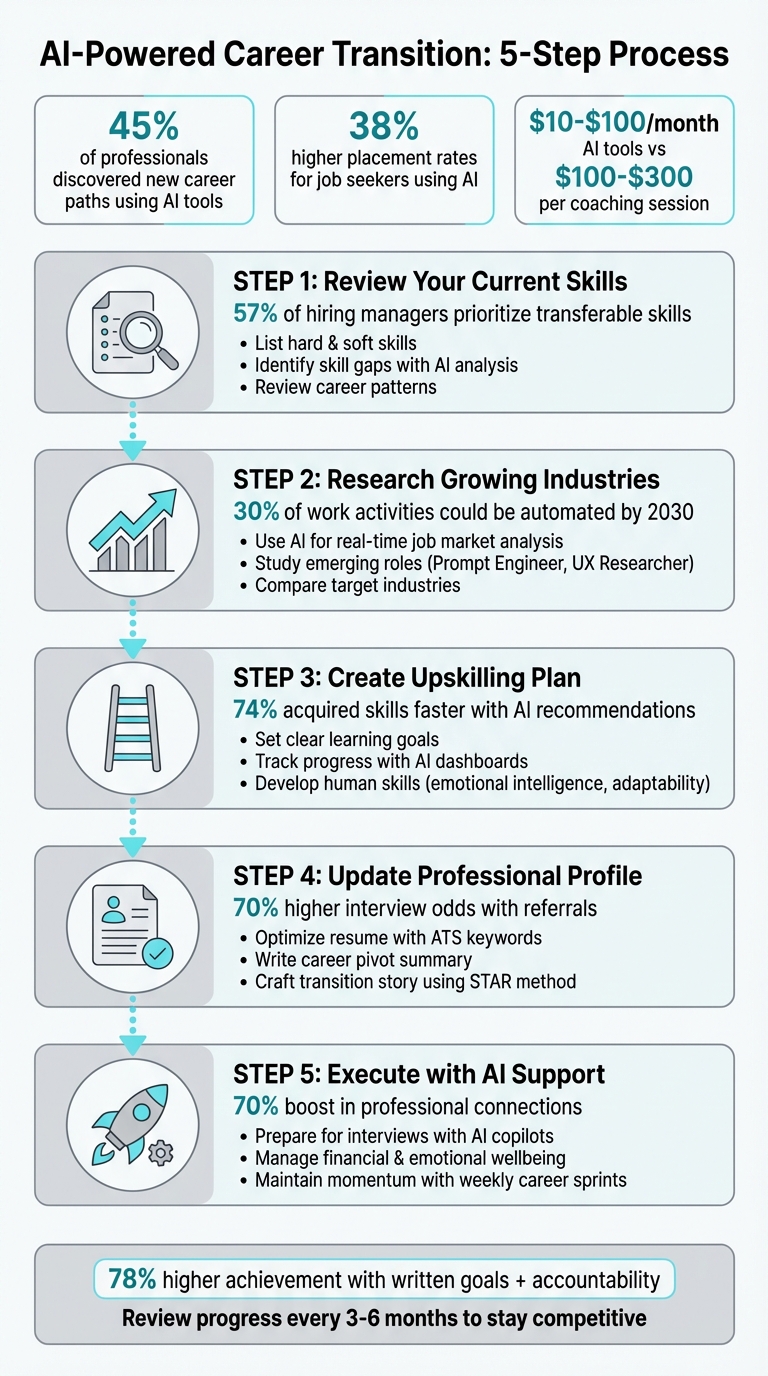
5-Step AI-Powered Career Transition Process with Key Statistics
How to Use AI as Your Career Coach | Build Confidence, Upskill & Advance Your Career
sbb-itb-d5e73b4
Step 1: Review Your Current Skills and Find Transferable Strengths
Taking stock of your existing skills is the first step toward discovering opportunities in a new industry. Did you know that 57% of hiring managers prioritize transferable skills when evaluating candidates for a career switch? [2] Your experience already holds more potential than you might realize – it’s all about identifying the parts that can cross over.
List Your Skills
Start by gathering your resume, LinkedIn profile, and any work samples. These documents are a treasure trove of information about your hard skills (like Python or SQL) and soft skills (like problem-solving or stakeholder communication). If you’re unsure how to pinpoint these, tools like Aidx.ai’s Life Mode can help. This feature walks you through identifying strengths you might overlook – such as how a construction manager’s knack for coordination can seamlessly translate to managing tech projects.
When listing your skills, focus on the actual work you’ve done rather than just job titles. For instance, instead of saying "managed a team", try "led cross-functional stakeholder coordination." This kind of language speaks to a broader range of industries and roles.
Find Skill Gaps
Once you’ve outlined your strengths, it’s time to see how they stack up against your target industry. AI tools can analyze thousands of job postings to create a "skill blueprint", showing you where your abilities align and where there’s room to grow. For example, Aidx.ai’s Insights tracking highlights both the skills you need most (like AI literacy or digital tools) and the ones you can realistically develop within a reasonable timeframe [1].
By focusing on high-demand, learnable skills, you can prioritize the gaps that will make the biggest impact. At the same time, revisiting your past roles can help you identify areas where you’ve already excelled, giving you a clearer picture of what you bring to the table.
Review Career Patterns
Take a moment to reflect on your career history. Where have you felt the most fulfilled? Which roles played to your strengths? Tools like Aidx.ai’s Roadmap feature can help you map out these patterns, shedding light on the environments and responsibilities where you thrive. This isn’t just about technical skills – it’s about understanding whether you excel in analytical tasks, creative problem-solving, or leadership roles.
Mapping your past successes can also help you predict where you’re likely to succeed in the future. For added clarity, AI-powered personality assessments can validate these findings, ensuring your next career step aligns with both your abilities and what motivates you [3].
Step 2: Research Growing Industries and Trends
Once you’ve identified your skills, the next step is to focus on industries where those abilities can thrive. This is where AI can be a game-changer, offering real-time insights into emerging sectors that align with your expertise.
Use AI for Industry Research
AI tools can analyze millions of job postings in real time, uncovering trends that might slip through traditional research methods. For instance, platforms like Aidx.ai provide up-to-the-minute insights on disruptions, new roles, and in-demand skills across dynamic sectors like Fintech, Health Tech, SaaS, Manufacturing, and Creative fields [4]. Instead of relying on outdated industry reports, you can quickly identify current market trends, including emerging roles like "Prompt Engineer" or "UX Researcher" [4][6].
One key area to explore is "AI-augmented roles." These positions leverage automation to handle routine tasks, allowing professionals to focus on strategic or creative responsibilities. In industries like Fintech and Health Tech, predictive analytics and advanced data management are fueling demand for specialized expertise [4].
Study Job Market Trends
After identifying a few promising industries, dig deeper into their specifics. Aidx.ai’s Business Mode can simplify this process by offering detailed, data-driven insights. You can evaluate factors like industry growth rates, median salaries by role and location, required skill sets, and potential entry barriers such as certifications or technical knowledge.
Here’s a thought to consider: by 2030, up to 30% of current work activities could be automated [4]. Using an AI disruption index can help you pinpoint roles with long-term stability versus those at risk [3][4].
Compare Target Industries
To make an informed choice, compare your top industry options side by side. A simple table can help you assess factors like growth potential, skill requirements, salary expectations, and the time needed to upskill. This visual comparison can clarify which industries best align with your abilities and long-term goals.
| Industry | Growth Driver | Key Emerging Roles | Entry Barriers |
|---|---|---|---|
| Fintech | Predictive analytics, automated reporting | Data Scientist, Financial Analyst (AI-focused) | Python, SQL, financial modeling |
| Health Tech | AI-enabled decision making, patient data management | Health Data Analyst, Product Manager | Healthcare expertise, data privacy |
| SaaS | Process automation, AI-driven customer success | UX Researcher, Prompt Engineer, Customer Success Lead | User research methods, AI literacy |
| Manufacturing | Automation of routine activities, supply chain AI | Process Automation Specialist, Project Manager | Lean/Six Sigma, technical project management |
This structured approach ensures you’re not just chasing trends but aligning your career path with industries that offer both immediate and long-term growth opportunities.
Step 3: Create an AI-Powered Upskilling Plan
Once you’ve pinpointed your target industry and identified the skills to focus on, the next step is creating a solid plan to bridge those gaps. AI tools can help transform general goals into actionable steps with measurable milestones.
Set Clear Learning Goals
Start by using an AI-powered skills gap analyzer to compare your resume against a target job description. These tools evaluate your current abilities against industry standards, highlighting the most critical skills you need to develop. They even rank these gaps based on factors like demand (how sought-after the skill is) and feasibility (how quickly you can learn it) [1]. For example, in 2025, Maya, a 27-year-old junior financial analyst, used this method to transition into Data Science. The analyzer identified Python, SQL, and Machine Learning as her top priorities. Maya then mapped out her learning plan, scheduling a 12-week Python course and a 6-week Machine Learning specialization using an AI Career Clock [1].
For a more structured approach, tools like Aidx.ai’s Roadmap feature can turn these goals into detailed, visual plans. Instead of vaguely aiming to "learn prompt engineering", you could break it down into weekly tasks – like completing a Coursera course in weeks 1–2, starting a side project in weeks 3–4, and practicing mock interviews in weeks 5–6 [3]. Research shows that writing down goals and outlining steps increases success rates by 78% [3]. With clear milestones in place, you’re ready to track progress and ensure steady growth.
Track Progress and Stay Accountable
Knowing what to learn is just the start – keeping yourself on track is where the real challenge lies. AI dashboards can help by integrating with your learning platforms to monitor your progress in real time. Many of these tools also provide a "Job Match" score, which updates as you complete courses, offering a visual indicator of your readiness for your target role [3]. In 2025, Shannon used Career Compass AI to transition from digital marketing to UX design in just 10 months. The platform helped her identify roles like UX Researcher, which aligned with her existing research skills, and she successfully secured a full-time position [6].
Aidx.ai’s Planner and Accountability tools take this a step further. You can set weekly milestones and share automated progress reports with friends or family every Monday – no account required on their end. This added layer of accountability makes it easier to stay committed to your goals. Dedicate 30 minutes every Friday for a "career sprint" to review dashboard metrics, adjust your schedule based on AI insights, and complete surveys to identify areas for improvement [3].
Develop Human Skills
While technical expertise is crucial, don’t overlook the importance of human-centric skills. Abilities like emotional intelligence, adaptability, and storytelling are becoming even more valuable as automation reshapes the workplace. AI mock interview tools can help you refine these skills by offering real-time feedback on your tone, confidence, and communication style [4][5]. Aisha Patel, a consultant at Deloitte, shared:
"The AI tools for career changers, like the Interview Copilot, gave me the confidence I needed to tackle tough questions" [7].
Aidx.ai’s Performance Mode is designed to strengthen these human skills, helping you improve self-awareness, manage emotional responses, and focus on key priorities. By balancing technical and human-centric skills, you can build a well-rounded profile that stands out in competitive fields. And with 74% of professionals reporting that AI-powered recommendations helped them acquire relevant skills faster [3], there’s no better time to embrace these tools for your career growth.
Step 4: Update Your Professional Profile
Now that you’ve reviewed your skills, researched your industry, and developed an upskilling plan, it’s time to refine your professional image. This step is all about translating your experience into a market-ready narrative that resonates with hiring managers and passes through ATS filters. Your resume and LinkedIn profile should reflect your transition plan and highlight your evolving expertise.
Update Your Resume and LinkedIn
Start with your resume and LinkedIn profile by replacing generic objectives with a career pivot summary. For example, instead of saying, "Experienced professional seeking new opportunities", try something like, "Financial analyst transitioning to data science with proven project management skills and newly acquired Python and SQL proficiencies" [4].
Use AI tools to identify gaps between your current resume and the language used in target job descriptions. These tools can highlight missing keywords – like "machine learning pipeline" or "agile sprint planning" – that could make the difference between being filtered out or landing an interview [4][7].
Reframe your experience to emphasize transferable wins. For instance, if you managed marketing campaigns, you could reword that to "drove data-driven feature prioritization" for a product management role. Similarly, if you coordinated construction projects, highlight "cross-functional stakeholder management" for roles in tech. Always aim to quantify your achievements; for example, "increased reporting efficiency by 40%" is far more impactful than vague phrases like "improved processes" [2][4].
Add a Technical Proficiencies section to your resume and update your LinkedIn headline with industry-specific terms that showcase your upskilling efforts. Use the "About" section on LinkedIn to craft a cohesive narrative about your career transition [2][1][7]. Interestingly, professionals who use AI tools in their job search have reported up to a 38% increase in job placements compared to those who don’t [5].
Write Strong Applications
When pivoting careers, generic cover letters won’t cut it. You’ll need to clearly explain why you’re making the shift. Structure your cover letter to open with your motivation, highlight a measurable transferable win, mention your proactive upskilling efforts, and tie your background to the needs of the role [4].
AI writing assistants can help you draft compelling elevator pitches tailored to specific roles. However, make sure the final version reflects your authentic voice. Every claim you make should be backed by a real-world example. For instance, a marketing analyst transitioning to product management might reframe their experience to focus on "driving feature prioritization" instead of "campaign ROI analysis." This approach helped one professional secure three interviews and land a junior product manager role within six weeks [2].
Tools like Aidx.ai offer coaching methods grounded in evidence-based practices (CBT, ACT, NLP) to help you refine your messaging and build confidence. Their Business Mode is designed to support professional growth, helping you craft compelling narratives that resonate with hiring managers while staying true to your story.
Tell Your Career Transition Story
Your ability to tell a clear, compelling story about your career transition can set you apart. Highlight how your unique background positions you for success in the new role. For instance, mentioning that AI-driven changes inspired you to manage your career proactively can demonstrate forward-thinking and adaptability [4].
Identify at least five transferable skills from your current role that align with your target industry. Use the STAR method (Situation, Task, Action, Result) to craft interview stories that demonstrate how your past successes translate into future potential. For example, one professional transitioned from digital marketing to UX design in under a year by leveraging her research skills. With AI-driven feedback, she refined her story and secured a full-time UX position [6].
Where possible, include links to portfolio projects, GitHub repositories, or certifications in your LinkedIn profile. These concrete examples provide proof of your new skills and show that you’re actively building the expertise needed for your career shift. Referrals can significantly boost your chances – statistics show they increase interview odds by 70% [4]. Share your updated profile with your network and ask for introductions to roles that align with your new direction.
With your resume polished, your LinkedIn updated, and your story ready to tell, you’re well-positioned to move forward with the next step in your career transition.
Step 5: Execute Your Transition with AI Support
With your skills assessment, industry research, and upskilling plan in place, it’s time to put everything into action. AI tools can now shift gears, moving from preparation to execution. These tools can help you stay focused as you navigate interviews, financial planning, and the ongoing steps of your career transition.
Prepare for Networking and Interviews
Breaking into a new industry often means mastering unfamiliar technical terms and concepts. Networking and interviewing can feel daunting when you’re still learning the ropes, but AI tools can make this process smoother. For instance, you can use these tools to simulate interview scenarios, like practicing prioritization frameworks for product management or running through SQL drills for data analysis [5]. This lets you refine your responses in a low-pressure environment.
Interview Copilots are another game-changer. They provide real-time guidance during interviews, helping you craft effective responses. Aisha Patel, a consultant at Deloitte, shared her experience:
"The AI tools for career changers, like the Interview Copilot, gave me the confidence I needed to tackle tough questions" [7].
These tools can also assist in generating thoughtful questions to ask hiring managers, using company-specific data to showcase strategic thinking – even in industries you’re just entering [5].
AI can also help you personalize LinkedIn messages and identify potential connections, making your outreach more impactful. Engaging with AI for career transitions has been shown to boost meaningful professional connections by 70% [7]. Platforms like Aidx.ai’s Business Mode even incorporate evidence-based coaching techniques such as CBT, ACT, and NLP, helping you build confidence and prepare mentally for high-stakes conversations.
With these tools, you’ll be better equipped to navigate networking and interviews, setting the stage for a smoother transition.
Manage Financial and Emotional Wellbeing
Career transitions can be emotionally taxing, with uncertainty, financial stress, and imposter syndrome often weighing heavily. AI tools provide round-the-clock support to help you manage these challenges [5][6]. Unlike human coaches, AI offers objective, unbiased feedback based on broad market data, helping you make informed decisions [5].
For instance, AI can help you identify "bridge roles" that align with your current skills while offering a stepping stone toward your target career. If you’re moving from marketing to UX design, a user research role might be a great fit, leveraging your analytics experience while easing the financial strain of the transition.
Platforms like Aidx.ai also offer self-monitoring tools to track stress levels, burnout risk, and emotional wellbeing. Weekly AI surveys provide insights into what’s working and what’s causing stress, allowing you to address issues early. The platform’s Insights feature even monitors patterns in your conversations, flagging potential concerns before they escalate. Additionally, integrated financial planning tools let you set goals and track progress, ensuring both your budget and mental health stay on track.
By addressing both practical and emotional aspects, these tools can help you stay grounded and focused during your career pivot.
Keep Momentum with Regular Planning
Consistency is key to a successful career transition. AI-powered trackers can help you stay on top of job applications, monitor interview stages, and follow up on leads automatically [3][1]. This ensures you don’t miss opportunities and keeps you accountable to your goals. Tools like "Job Match" continuously update your profile’s readiness score as you gain new skills, helping you stay competitive [3][1].
To maintain momentum, consider setting aside 30 minutes every Friday for "Career Sprints." During this time, review your progress and adjust your learning plan as needed [3]. AI can generate custom 6- or 12-week growth plans with clear, actionable steps. For example:
- Week 1: Complete a Python basics course
- Week 2: Build your first portfolio project
- Week 3: Apply to five junior data analyst roles
This structured approach turns broad goals into manageable tasks, making it easier to stay on track.
Platforms like Aidx.ai support this process with tools such as the Roadmap tool, which transforms vague goals into visual, trackable steps. The Follow-ups feature ensures consistent progress by sending automatic reminders, while the Accountability feature emails weekly updates to friends or family – no account required for them. Research from Dominican University shows that written goals combined with accountability can lead to 78% higher achievement (Dr. Gail Matthews). With 83% of workers reporting that AI tools improve their overall work experience [7], incorporating these tools into your routine can help you achieve your transition goals faster and more efficiently.
Step 6: Monitor Progress and Adjust to Industry Changes
Once you’ve implemented your AI-supported career transition plan, it’s crucial to keep an eye on your progress and adapt as the job market evolves. Career transitions aren’t a one-time event – they’re a continuous journey. As industries shift and new trends emerge, your skills and strategies need to evolve too. Think of your career plan as a "living document" – something you revisit and refine every 3–6 months to stay aligned with the latest market demands and your personal growth trajectory [3][2]. Regular reassessment, supported by AI tools, ensures you remain on track and competitive.
Review Progress Regularly
Set aside time each week to review your progress using AI-powered dashboards. These tools provide insights into metrics like skill scores, application statuses, and how well your profile matches current job postings. For example, platforms like Job Match can automatically update your readiness score as you complete training or certifications [3]. If you’re using Aidx.ai, the Insights feature can analyze conversation patterns to flag potential stress or burnout risks, while weekly pulse surveys highlight areas of success and pinpoint obstacles [6].
On a quarterly basis, take a deeper dive. Update your resume and run it through AI tools to identify any new skill gaps [1][3]. Track key metrics such as the number of applications sent, interviews secured, and offers received to evaluate the effectiveness of your career pivot strategy [4]. Interestingly, 74% of professionals have found that AI-driven learning recommendations helped them acquire relevant skills more quickly [3].
Stay Flexible and Open to Changes
Flexibility is key when navigating the ever-changing job market. Skills that are in high demand today might become less relevant in a matter of months. In fact, 45% of professionals report that AI tools helped them uncover entirely new career paths by adapting their strategies based on emerging trends [1]. Tools like Aidx.ai offer voice-enabled sessions for real-time reassessment of your goals. The platform’s Roadmap feature allows you to easily tweak your objectives – whether it’s setting a new goal after closing a skill gap or adding fresh challenges to your learning schedule [3]. To keep things on track, the Follow-ups feature provides proactive reminders and check-ins.
If you notice a drop in your application-to-interview conversion rate, it could indicate shifting job requirements. In such cases, rerun your skills gap analysis and validate AI recommendations with insights from industry mentors [1][5]. By combining real-time data from AI with advice from experienced professionals, you can pivot your strategy confidently and effectively.
Conclusion
Making a career change doesn’t have to feel overwhelming, especially when AI tools are in your corner. Platforms like Aidx.ai take static career plans and turn them into dynamic, evolving roadmaps that grow with you and the job market. By tapping into data from millions of real-time job postings, these tools shift the focus from guesswork to actionable insights based on hard data [3].
The stats tell a compelling story: 74% of professionals say AI-powered learning recommendations helped them acquire relevant skills faster [3], and users of these platforms report up to 38% higher placement rates [5]. Beyond the numbers, these tools also provide 24/7 support to help navigate the emotional hurdles of career pivots, tackling challenges like imposter syndrome and decision fatigue [5].
What truly sets AI-driven career planning apart is its ability to adapt. As you close skill gaps and industries evolve, your roadmap adjusts automatically. Tools like Roadmap and Follow-ups help you set goals, track your progress, and pivot when needed. This "living document" approach is critical in a world where up to 30% of current work activities could be automated by 2030 [4].
Success in today’s fast-changing job market isn’t just about having a plan – it’s about having a plan that evolves. Regular reviews, focusing on the most impactful skill gaps, and staying open to new opportunities keep you competitive. AI doesn’t replace human judgment or mentorship; instead, it makes high-level career planning more accessible, with costs ranging from $10–$100 per month compared to $100–$300 per traditional coaching session [5].
Whether you’re moving from finance to data science or marketing to UX design, AI tools can provide the clarity and confidence you need to make data-driven decisions. They ensure your career evolves alongside industry demands, keeping you prepared for every step forward. The workplace is changing fast, but with AI by your side, you can stay ahead and build a career that grows as quickly as you do.
FAQs
Which career should I pivot to?
Choosing a new career path can feel overwhelming, but AI tools can make the process more manageable. These tools are great for self-assessment, identifying skill gaps, and exploring market trends. Start by evaluating your strengths and transferable skills – what are you good at, and how can those abilities apply to different roles? Once you have a clear picture, look into industries with high demand for talent. AI-driven platforms can take your background and match it with emerging opportunities, helping you find a career that not only fits your skill set but also offers room for growth in today’s fast-changing job market.
What skills should I learn first?
The skills you should focus on will depend on where you want your career to go. However, starting with transferable skills like communication, problem-solving, and flexibility is a smart move. These are valuable in nearly any field. You can also use AI tools to evaluate your current skill set, spot areas for improvement, and identify technical skills that are in demand in your desired industry. This way, you’re not only strengthening your overall skill base but also targeting the specific needs of the field you’re aiming to enter.
How do I know I’m job-ready?
You’re ready to dive into the job market when your skills, experience, and personal branding align with the roles you’re targeting. AI tools can play a big role in this process by evaluating your skill set, spotting areas for improvement, and comparing your qualifications to what’s currently in demand. For example, you can use AI to review your resume, fine-tune your LinkedIn profile, and perform skill-gap analyses. Once your profile aligns with the requirements of your desired roles and you’ve addressed any gaps, you’ll be in a strong position to confidently pursue new opportunities.