
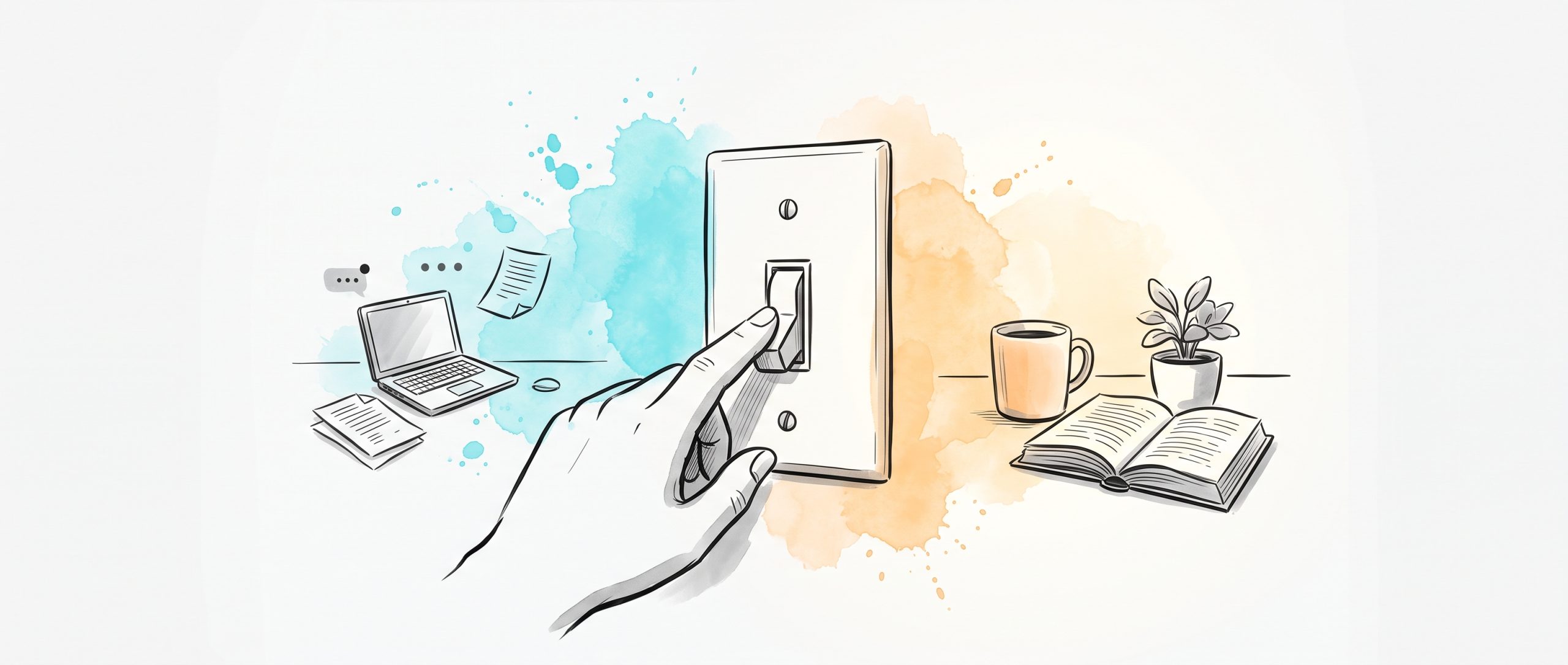
Remote work gave us back the commute, the lunch we actually eat at home, the flexibility to start a wash between meetings. What it quietly took away is the edge — the clear line where work stops and life begins. When the office is a corner of the bedroom, “logging off” becomes a decision you have to make on purpose, not a door you walk through. That single missing boundary is where most remote work-life balance problems begin.
AI tools can help — not because software has discovered some secret, but because the right tool removes friction from the habits that already work: protecting focus, defending your evenings, and noticing when stress is building before it becomes burnout. This guide separates the categories that genuinely help from the hype, grounds the advice in real research, and shows where an AI coach fits when the problem isn’t your calendar but your capacity to switch off.
Why remote work blurs the work-life line
Remote and hybrid work is now a permanent feature of working life, not a pandemic hangover. In early 2024, the U.S. Bureau of Labor Statistics found that 22.9% of people at work teleworked at least some of the time, rising to 43.6% among workers with advanced degrees (BLS, 2024). Stanford’s ongoing survey of working arrangements puts it another way: roughly a quarter of all paid workdays in the US are now done from home (WFH Research / SWAA, 2024–25).
The flexibility is real, and most people don’t want to give it back. But the same arrangement that hands you autonomy can also erase the natural transitions that used to protect your time. Microsoft’s analysis of anonymised work patterns across 31 markets found that the workday has stretched at both ends: meetings starting after 8pm rose 16% year over year, around 29% of workers are back in their inbox by 10pm, and during core hours people are interrupted roughly every two minutes by a meeting, email, or message (Microsoft Work Trend Index, 2025). They call it the “infinite workday.” Most remote workers just call it Tuesday.
It’s worth being honest about the evidence, though, because the headlines oversimplify it. Remote work is not automatically worse for wellbeing. The American Psychological Association’s 2024 survey found that overwork wasn’t unique to remote staff at all — 52% of hybrid workers said they had to work more hours than they wanted, versus 38% of fully remote workers (APA, 2024). What mattered most for wellbeing wasn’t where people worked but whether they were in the arrangement they actually preferred, and whether they could protect their boundaries. That’s the real lever — and it’s the one good tools and good habits can move.
The three problems AI can actually help with
Skip the brochure language for a moment. AI tools don’t “create balance.” They reduce the friction on three specific problems that erode remote work-life balance. Here’s what each one looks like and which category of tool addresses it.
| The problem | What it feels like | How AI helps |
|---|---|---|
| The day has no shape | Constant context-switching; deep work never happens; the to-do list outlives the week | AI scheduling assistants auto-block focus time and reschedule around conflicts |
| Work never switches off | Pings at dinner; “quick” evening replies; a brain that won’t power down | AI notification and inbox tools triage what’s truly urgent and protect off-hours |
| Stress builds unnoticed | Running on empty for weeks before admitting it; balance feels impossible, not just hard | An AI coach helps you spot patterns, set boundaries, and recover before burnout |
The first two are logistics. The third is the one most people underestimate — and the one a calendar app can’t touch.
Problem 1: The day has no shape
Without the structure of an office, time leaks. Meetings expand, focus fragments, and the work that actually matters gets squeezed into the cracks. This is where AI scheduling assistants earn their place. Tools in this category — Reclaim.ai and Motion among them — plug into your Google or Outlook calendar and do something a shared calendar never could: they actively defend your time. They auto-block focus periods, schedule tasks by priority and deadline, and quietly reshuffle everything when a meeting lands on top of your deep-work hour.
It’s worth knowing the category is still maturing — Clockwise, one of the early focus-time schedulers, is being sunset in 2026 — so choose a tool with momentum behind it. And remember what you’re really buying: automation of a habit that already works. Owl Labs found that most knowledge workers already block focus time manually; AI just removes the daily tax of doing it by hand (Owl Labs, 2024). A tool that protects two uninterrupted hours a day is doing more for your balance than any productivity hack.
Problem 2: Work never switches off
This is the boundary problem, and it’s the heart of remote work-life balance. The research here is unusually clear about what helps. Across hundreds of studies, the single most reliable predictor of recovery and wellbeing is psychological detachment — the ability to mentally disconnect from work during off-hours, not just physically close the laptop. A meta-analysis of 316 studies covering nearly 100,000 people found that detachment consistently reduces exhaustion and work-family conflict (Bennett et al., 2018). Crucially, detachment is trainable.
AI tools support this on the logistics side: notification managers and smart inbox tools can hold non-urgent messages until morning, surface only what’s genuinely time-sensitive, and auto-reply during your off-hours so you’re not the bottleneck at 9pm. The principle is the same one now being written into law — France’s “right to disconnect” has required employers to define after-hours boundaries since 2017, and Australia introduced its own version in 2024 (Fair Work Ombudsman, 2024). You don’t have to wait for legislation to give yourself the same protection.
The harder part isn’t the inbox — it’s your head. Closing the laptop doesn’t close the open loops. Building a deliberate “shutdown ritual” (a short walk that stands in for the old commute, a quick note of tomorrow’s first task, a literal phrase like “work is done”) trains the detachment the research points to. If you struggle to switch off, our guide on how to set boundaries goes deeper on making them stick.
Problem 3: Stress builds unnoticed
The most damaging thing about remote burnout is how quietly it arrives. Without colleagues to read your face or a manager who notices you’ve gone quiet, the warning signs go unwitnessed — including by you. By the time “I’ll rest when this is done” stops working, you’re already depleted.
It helps to be precise about what burnout actually is. The World Health Organization defines it as an occupational phenomenon — a syndrome resulting from chronic workplace stress that hasn’t been managed, with three dimensions: energy depletion, mental distance or cynicism toward your work, and reduced effectiveness. Notably, the WHO is explicit that burnout is not a medical condition (WHO, 2019). It’s a response to your circumstances — which means it responds to changing them. And it’s common: Gallup found that 41% of employees worldwide experience a lot of daily stress (Gallup, 2024).
This is the gap a scheduling app can’t fill, and it’s where an AI coach is genuinely useful — not to diagnose you, but to give you a regular, private space to check in, notice the patterns, and act on them early. (If you’re already past “running low,” our guide to recovering from burnout and restoring energy is the place to start.)
Where an AI coach fits — and what the evidence says
“AI coaching” deserves a calibrated, honest look rather than hype. The evidence for conversational, AI-based mental-health support is genuinely positive but still early. Pooled analyses of randomised trials show statistically significant, modest reductions in symptoms of depression and anxiety from mental-health chatbots, with larger effects in people already under strain (npj Digital Medicine, 2023). The effects are real; they’re also typically short-term, and the research is young. The honest summary: AI coaching is a powerful, accessible support for everyday stress, boundaries, and motivation — and not a replacement for a clinician when something serious is going on.
That honesty is exactly the frame to use when choosing a tool for the wellbeing side of remote balance. A scheduling app optimises your calendar. A coach works on the thing underneath it — your relationship with work, the guilt around logging off, the boundary you keep meaning to set. This is the niche aidx.ai is built for: AI coaching and therapy, drawing on evidence-based methods like CBT and ACT, available by chat and voice, 24/7, wherever you are.
A few things make it a natural fit for remote and hybrid workers specifically:
- It’s there at the exact moment you need it. Stress doesn’t keep office hours, and neither does Aidx — the 10pm “why can’t I switch off?” spiral is precisely when a coach is most useful.
- It builds boundaries with you, not for you. Rather than just blocking notifications, Aidx helps you work out why the boundary keeps slipping and rehearse the conversation or the habit that makes it hold.
- It fits the mode to the moment. Life, Business, and Performance modes mean you can switch from “help me set a work boundary” to “help me prep for a hard conversation with my manager” without starting over.
- It plans and follows up. A built-in planner and proactive check-ins mean the boundary you set on Monday is one Aidx actually circles back to — closing the gap between good intentions and a Thursday that looks different.
- It’s private by design. No human reads your conversations, everything is encrypted, and an incognito toggle lets you keep any conversation from being stored at all — which matters when work and the device you vent about it on are the same one.
Under the hood, Aidx runs on a proprietary AI system (ATI) that adapts to how you communicate. Aidx is also award-winning AI coaching — recognised at the UK Startup Awards in 2024 and 2025 — but the part that matters for remote balance is simpler: it’s a calm, capable second perspective you can reach the instant the line between work and life starts to blur.
A realistic toolkit for remote work-life balance
You don’t need ten apps. You need to cover the three problems above and then get out of your own way. A realistic stack looks like this:
- One AI scheduling assistant to give your day a shape and protect focus time automatically.
- One notification or inbox tool set up to defend your off-hours, so detachment is the default rather than a daily act of willpower.
- One ritual — non-negotiable — that marks the end of the workday. The research on psychological detachment says this matters more than any app.
- An AI coach for the part underneath the logistics: noticing stress early, holding boundaries, and recovering before you hit the wall.
The tools handle the friction. The boundary is still yours to set. But you don’t have to figure out where to draw it — or how to make it hold — alone.
Common questions
Can AI tools really improve remote work-life balance?
Indirectly, yes. AI tools don’t create balance on their own, but they remove friction from the habits that do — protecting focus time, defending off-hours, and helping you notice rising stress early. The boundary is still yours to set; good tools just make it far easier to hold.
What’s the difference between an AI scheduling tool and an AI coach?
A scheduling assistant (like Reclaim or Motion) optimises your calendar — when you work. An AI coach like aidx.ai works on your relationship with work — why you can’t switch off, how to set a boundary that sticks, and how to recover when you’re depleted. Most remote workers benefit from both: one for logistics, one for capacity.
Is remote work actually worse for mental health?
Not inherently. The evidence is mixed: remote work boosts autonomy, which supports wellbeing, but can blur boundaries and increase isolation. The APA found wellbeing depended less on where people worked than on whether they were in their preferred arrangement and could protect their time. Managed well, remote work can be better for balance — not worse.
Can an AI coach replace therapy?
No, and it shouldn’t claim to. The evidence shows AI coaching offers real, modest help with everyday stress, boundaries, and motivation, and the support is private and available any time. But for acute or serious mental-health concerns, professional or crisis care is essential — an AI coach is a complement to that, never a substitute.
This article is general information about work, wellbeing, and the tools that support them — not medical or professional advice. If work-related stress is seriously affecting your health, or you’re in crisis, please speak with a qualified professional or your local emergency services.
Last reviewed: June 2026.