
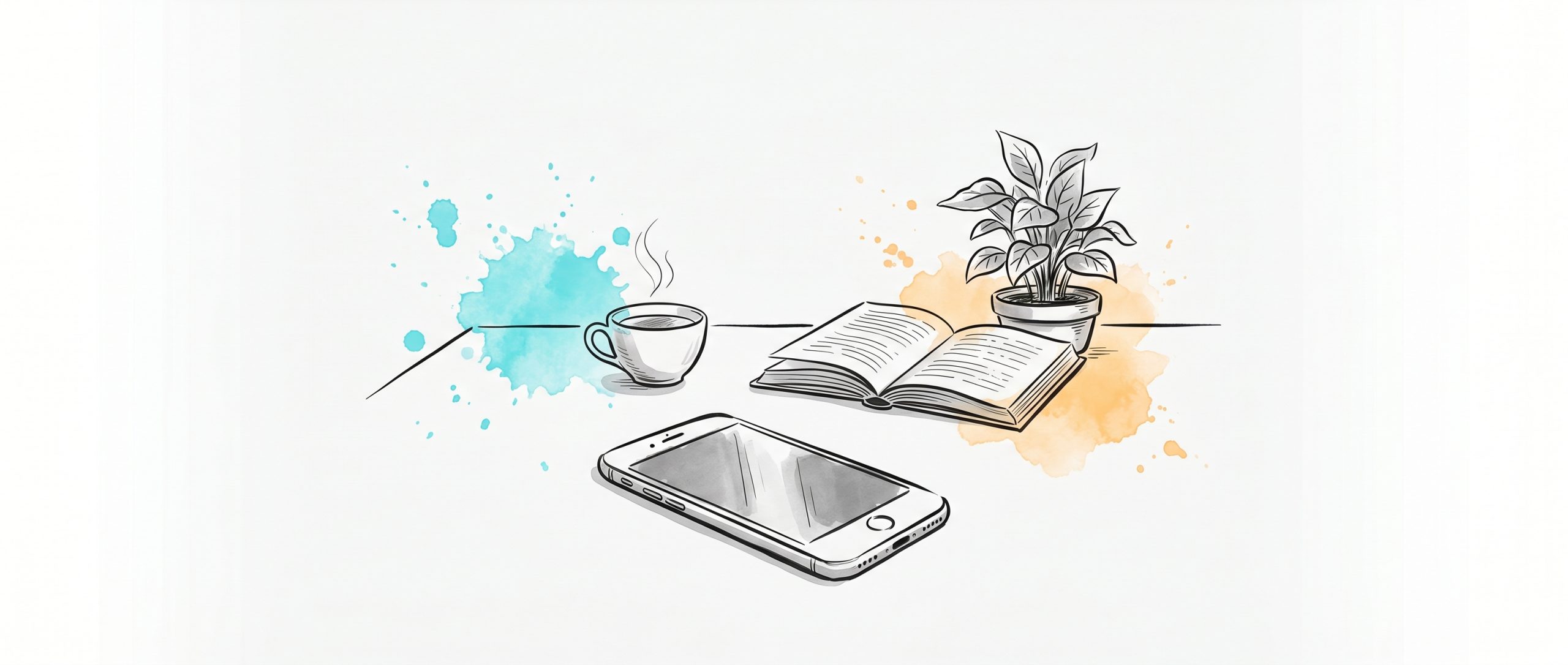
A digital detox doesn’t mean throwing your phone in a lake and moving to a cabin. The version that actually works is smaller, calmer, and far more practical: a deliberate, time-boxed reduction in how much you use the devices and apps that have quietly taken over your attention — followed by a few changes you keep. The good news is that you don’t need to quit anything cold turkey. The research is fairly clear that reducing use, not abstaining from it, is usually enough to feel better.
Here’s how to do a digital detox that sticks — what to change, in what order, and what the evidence actually says works (and what’s just popular advice).
First, a quick gut-check: do you need one?
You don’t need a clinical reason to take a break from screens. But a few signs suggest your tech habits are costing you more than they’re giving back:
- You reach for your phone without deciding to. You unlock it, then forget why — the checking is automatic, not chosen.
- Your focus is fragmented. You reread the same paragraph, bounce between tasks, and can’t settle into anything deep.
- Sleep suffers. You scroll in bed, then lie awake; mornings feel foggy.
- You feel worse after scrolling, not better — flatter, more comparing, more restless — yet you keep going.
- Real life competes with the screen and loses. Conversations, meals, and downtime get half your attention.
If a few of those land, a detox is worth a try. The point isn’t guilt — it’s reclaiming time and attention you’d rather spend elsewhere. One large randomised study that paid people to deactivate Facebook for four weeks found it freed up about an hour a day, which participants put back into offline socialising and relaxing, and produced a small but real improvement in wellbeing (about 0.09 of a standard deviation).1 Modest, but reliable — and an hour a day is an hour a day.
How to do a digital detox, step by step
Skip the all-or-nothing reset. Work through these in order; each one is small enough to actually do, and most are backed by real evidence.
1. Measure before you cut
You can’t manage what you don’t see, and most of us badly underestimate our own use. When researchers installed tracking software on people’s phones, the average user touched their phone — tapped, swiped, typed — about 2,617 times a day across roughly 76 separate sessions; the heaviest tenth topped 5,400.2 (That was a small 2016 study, not a national survey, so treat it as a vivid illustration rather than a precise law.) Open your phone’s built-in dashboard — Screen Time on iOS, Digital Wellbeing on Android — and look at the real number for a few days before you change anything. It’s usually a useful shock. (If you like data, the same approach — tracking the thing you want to change — works for mood and focus too.)
2. Reduce, don’t abstain — pick one realistic target
This is the most important and most reassuring finding in the whole field: you don’t have to quit. In a German experiment with 503 people, simply cutting daily smartphone use by one hour for two weeks increased physical activity and reduced symptoms of depression and anxiety — and the effects were still visible at follow-up. Crucially, partial reduction worked as well as going cold turkey.3 So set a specific, modest target: “social apps to 30 minutes a day,” or “an hour less, total.” A famous study limiting students to about 30 minutes of social media a day (10 minutes each across three apps) for three weeks found significant drops in loneliness and depression versus a group that carried on as usual.4
3. Turn off non-human notifications
Notifications are the engine of compulsive checking, and switching them off is one of the best-supported tactics there is. In one within-person experiment, a week of keeping notifications on and the phone within reach left people reporting more inattention and hyperactivity — ADHD-like symptoms — than a week with alerts off and the phone out of reach.5 A simple rule: kill every notification that isn’t a real person trying to reach you. Keep calls and messages from humans; silence the badges, banners, and “someone you may know” pings from everything else. (If your real problem is a mind that won’t stop, the phone is often the symptom rather than the cause — here’s how to stop overthinking.)
4. Batch the checking instead of trickling it
Constant interruption is expensive even after the interruption ends. Research on “attention residue” shows that when you switch away from a task before finishing it, part of your mind stays stuck on the old task and your performance on the next one drops — the cost lingers after you put the phone down.6 The fix is batching: handle email and messages in a few set windows rather than all day long. When people were asked to check email just three times a day instead of whenever, their daily stress went down.7
5. Put physical distance between you and the phone
Distance does quiet work that willpower can’t. In a clever pair of experiments, people performed best on memory and reasoning tasks when their phone was in another room — better than face-down on the desk, and better than in a pocket — even though the phone was silent and switched off. Just knowing it was nearby seemed to drain a little attention.8 The honest caveat: a later analysis of many such studies found this “brain drain” effect is real but small.9 Still, it’s free. During focused work, leave the phone in another room rather than face-down beside you. (It’s one of the simplest ways to lower the low-grade stress of a workday built on constant interruption.)
6. Get the phone out of the bedroom
The single highest-value habit for most people is making the bedroom screen-free. Sleep authorities recommend stopping screen use 30 to 60 minutes before bed and keeping devices out of the room.10 In a controlled study, reading from a glowing screen for a few hours before bed delayed the body’s melatonin release and internal clock by around an hour and a half, made people take longer to fall asleep, and left them groggier the next morning compared with reading a printed book.11 Part of the harm is the light; a big part is simply that the device keeps your mind engaged and steals time you’d otherwise be asleep. A cheap alarm clock and a charger left in the kitchen do more than any app.
7. Add friction, and replace the habit
Make the pull-to-scroll loop slightly harder, and give the freed-up time somewhere to go. A few small frictions have light evidence behind them — switching your screen to grayscale made the apps less rewarding and cut total screen time by roughly 20 to 38 minutes a day in a couple of small studies.12 Others (deleting the worst app off your home screen, setting app timers, a weekly “screen-free evening”) are sensible and plausible but not yet proven in rigorous trials — worth trying, just don’t expect magic. The part that is well-supported: have a replacement ready. In that German study, the people who cut screen time naturally moved more — the freed hour wants filling. Decide in advance what it’s for: a walk, a book, a call, an actual conversation.
A simple plan to follow
| Step | What to do | Why it works |
|---|---|---|
| Measure | Check Screen Time / Digital Wellbeing for 3 days | You underestimate your own use |
| Set a target | One hour less, or social apps to 30 min/day | Reducing beats abstaining — and it’s enough |
| Notifications | Off for everything that isn’t a real person | Cuts the compulsive-checking trigger |
| Batch | Email and messages in set windows | Avoids the lingering cost of interruption |
| Distance | Phone in another room while you focus | Nearby phones quietly tax attention |
| Bedroom | Charge it outside the bedroom; screens off 30–60 min before bed | Protects sleep timing and quality |
| Friction + replace | Grayscale, app off the home screen, a planned alternative | Less reward to scroll; somewhere for the time to go |
How long should a digital detox last?
You don’t need a dramatic week off-grid — in fact, most of the studies that found benefits ran for just two to four weeks of reduced use, not total abstinence. A practical rhythm: run the steps above for two weeks as an experiment, notice what changed (sleep, focus, mood, the hour you got back), then keep the two or three habits that helped and let the rest go. Some people like a recurring “screen-light” evening or one offline day a week; that’s a fine maintenance routine, though it’s more tradition than tested science.
One honest note: the benefits of a digital detox are real but generally modest — reviews of these interventions find small, reliable improvements in wellbeing rather than transformation.13 A detox is a useful reset, not a cure-all. And a few people feel a flicker of anxiety or “phantom buzz” when they first cut back; that usually fades within days. If your relationship with screens feels genuinely out of control — not just a bad habit, but something that’s harming your work, sleep, or relationships and won’t shift — that’s worth talking through with a professional.
Making the change stick
The reason most detoxes fail isn’t willpower — it’s that the moment of reaching for the phone is faster than the decision not to. So the trick is to change the environment, not just the intention: distance, grayscale, notifications off, the charger in another room. Those quiet structural changes do the work for you, so you’re not fighting the same battle every hour.
It also helps to have something to think with when you’re untangling a habit. Talking it through — what the scrolling is really doing for you, what you want the time back for, where you keep getting pulled in — often surfaces more than another app timer. That’s part of what aidx.ai is for: an award-winning AI coaching and therapy service you can talk to in chat or by voice, drawing on evidence-based methods like CBT to help you notice your patterns and design changes that actually fit your life. It’s a supportive tool to think things through, not a replacement for a human professional.
Start small. Measure for three days, pick one hour to cut, and get the phone out of the bedroom tonight. That alone is a real digital detox — and it’s the kind you can keep.
This article is for general information and isn’t a substitute for professional medical or mental-health advice. If screen use, sleep problems, or low mood are seriously affecting your life, please speak with a qualified professional. If you’re in crisis, contact your local emergency services or a crisis line such as the 988 Suicide & Crisis Lifeline (US) or the Samaritans (UK, 116 123).
Last reviewed: June 2026.
References
- Allcott, H., Braghieri, L., Eichmeyer, S., & Gentzkow, M. (2020). The Welfare Effects of Social Media. American Economic Review, 110(3), 629–676. aeaweb.org
- dscout (2016). Mobile Touches: Putting a Finger on Our Phone Obsession (behavioural tracking of 94 users over 5 days). dscout.com
- Brailovskaia, J., et al. (2022). Finding the “sweet spot” of smartphone use: Reduction or abstinence to increase well-being and physical activity? Journal of Public Health. PMC
- Hunt, M. G., Marx, R., Lipson, C., & Young, J. (2018). No More FOMO: Limiting Social Media Decreases Loneliness and Depression. Journal of Social and Clinical Psychology, 37(10), 751–768. guilfordjournals.com
- Kushlev, K., Proulx, J., & Dunn, E. W. (2016). “Silence Your Phones”: Smartphone Notifications Increase Inattention and Hyperactivity Symptoms. Proceedings of CHI 2016. ACM Digital Library
- Leroy, S. (2009). Why is it so hard to do my work? The challenge of attention residue when switching between work tasks. Organizational Behavior and Human Decision Processes, 109(2), 168–181. ScienceDirect
- Kushlev, K., & Dunn, E. W. (2015). Checking email less frequently reduces stress. Computers in Human Behavior, 43, 220–228. summary
- Ward, A. F., Duke, K., Gneezy, A., & Bos, M. W. (2017). Brain Drain: The Mere Presence of One’s Own Smartphone Reduces Available Cognitive Capacity. Journal of the Association for Consumer Research, 2(2), 140–154. journals.uchicago.edu
- Ruiz Pardo, A. C., & Minda, J. P. (2023). Reexamining the “brain drain” effect: A meta-analysis. (Pooled effect small, g ≈ −0.14.) PMC
- American Academy of Sleep Medicine. Guidance on screens before bed and devices in the bedroom. aasm.org · Sleep Foundation, How Electronics Affect Sleep
- Chang, A.-M., Aeschbach, D., Duffy, J. F., & Czeisler, C. A. (2015). Evening use of light-emitting eReaders negatively affects sleep, circadian timing, and next-morning alertness. PNAS, 112(4), 1232–1237. pnas.org
- Holte, A. J., & Ferraro, F. R. (2021). Grayscale and screen time. The Social Science Journal. Taylor & Francis · Dekker, C. A., & Baumgartner, S. E. (2024). Grayscale displays and smartphone use. Mobile Media & Communication. SAGE
- Ansari, S., et al. (2024). Digital detox interventions and well-being: a meta-analysis (small effect sizes, SMD ≈ 0.21–0.27). Cyberpsychology, Behavior, and Social Networking. SAGE