
Social media boundaries are the small, deliberate rules you set so the apps work for you instead of the other way around — a time limit, a tidier feed, a phone-free hour before bed. They matter because the problem is rarely social media itself; it’s the way endless, frictionless scrolling quietly crowds out sleep, attention, and the offline moments that actually fill you up. The good news from the research is encouraging: you don’t have to quit. Modest, well-chosen limits are enough to shift how you feel.
Here’s the short version, before we get into the why and how:
- You don’t need to delete your accounts. In a University of Pennsylvania experiment, students who capped their use at about 30 minutes a day felt less lonely and less depressed within three weeks — without quitting.
- What you watch matters more than how long you watch. The sharpest lever isn’t raw screen time; it’s who and what you give your attention to — close friends over strangers, supportive content over the highlight reels that trigger comparison.
- A few simple boundaries do most of the work: a daily time cap, a feed you’ve actively pruned, notifications off, and phone-free zones around sleep and meals.
- Boundaries are a practice, not a one-off. You’ll slip. The point isn’t a perfect streak — it’s noticing when old habits creep back and gently course-correcting.
What social media boundaries actually are
A boundary is just a line you draw on purpose: this much, here, and not there. With social media, that might mean half an hour a day rather than “whenever I reach for my phone,” following people who leave you feeling steady rather than scrolling whatever the algorithm serves, or keeping the bedroom a screen-free space. None of this is about willpower or shame. It’s about removing friction from the choices you want to make and adding a little friction to the ones you don’t.
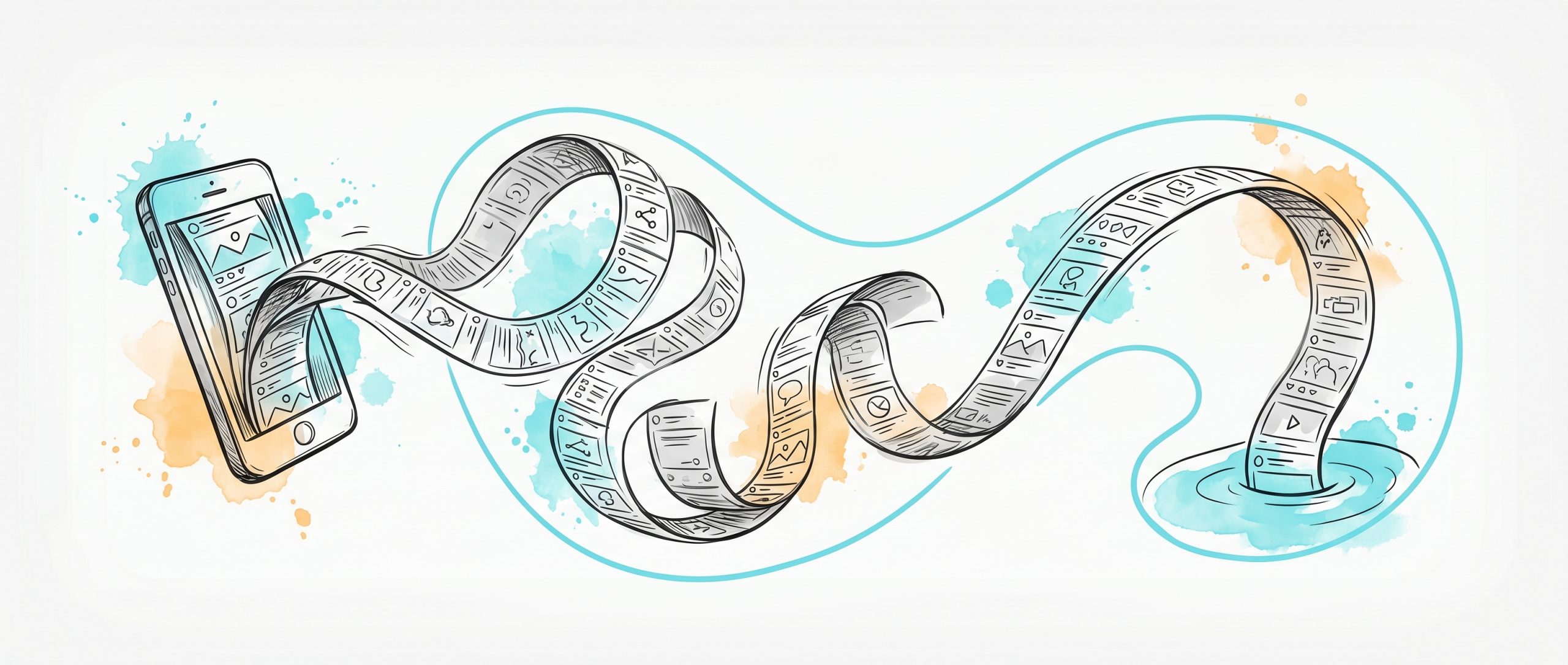
The reason this works is that most problematic scrolling isn’t really a choice at all — it’s a default. The apps are engineered to be frictionless and open-ended, so “just checking” becomes forty minutes you never decided to spend. A boundary reintroduces the decision. That’s the whole game.
How social media affects your wellbeing — honestly
Used well, social media is genuinely good for you. It keeps relationships alive across distance, offers community to people who feel isolated, and can be a real source of support and information. The evidence on this is solid: the most reliable positive signal in a large 2024 meta-analysis of 141 studies was the link between actively using social media — messaging, posting, reaching out — and feeling socially supported [1]. Connection is the point of these tools, and for a lot of people they deliver it.
The trouble starts with how easily that same design pulls you somewhere less nourishing: passively scrolling other people’s highlight reels, measuring your ordinary day against everyone else’s curated best. That upward comparison is the mechanism most consistently linked to feeling worse after a session — the quiet sense that everyone is doing better, looking better, living more [2].
It’s tempting to reduce this to “passive bad, active good,” but the honest picture is more nuanced. That same 2024 meta-analysis found the passive-versus-active distinction is weaker than it was once thought to be — neither neatly predicts how you’ll feel [1]. The more dependable lever turns out to be who and what you engage with, not whether your thumb is moving. Following close friends tends to track with less loneliness; following strangers tends to track with more [3]. That single insight quietly reshapes how you set boundaries: the goal isn’t just less time — it’s better time.
Quantity still counts, though. In a nationally representative study of 1,787 US adults aged 19 to 32, those spreading their attention across 7 to 11 platforms had roughly three times the odds of depression and anxiety symptoms compared with people using two or fewer — even after accounting for total time spent [4]. Worth a caveat: this is a snapshot, so it shows an association, not proof that more platforms cause distress — it’s entirely possible that anxious or low people spread themselves wider. Still, the pattern is a useful nudge: fewer platforms, more presence.
Signs you might need some boundaries
You don’t need a problem to benefit from a boundary, but a few patterns are worth paying attention to. None of these is a diagnosis — read them as gentle prompts.
- You reach for your phone on autopilot — first thing on waking, in every queue, the moment a conversation pauses.
- You feel a low hum of anxiety when you can’t check, or genuinely restless when you’re offline.
- Scrolling reliably leaves you feeling worse — flatter, more inadequate, more irritable — than before you started.
- It’s eating into sleep, focus, or time you’d rather spend with people in the room.
- You catch yourself measuring your life against the feed, or leaning on likes for a hit of reassurance.
If a few of these land, that’s information, not failure. And the encouraging finding is how little it takes to shift things. When Penn researchers asked students to cap social media at about 30 minutes a day for three weeks, the group that did it reported significantly less loneliness and depression than the group that scrolled as usual — a real, measured improvement from a modest change [5].
How to set social media boundaries that actually hold
Boundaries stick when they’re concrete and a little easier to keep than to break. Here are the ones with the most going for them, roughly in order of impact.
| Boundary | What it looks like | Why it helps |
|---|---|---|
| Curate who you follow | Mute or unfollow accounts that trigger comparison; keep close friends and supportive voices. | The strongest lever — better time beats less time. Friends track with less loneliness, strangers with more. |
| Set a daily cap | Use your phone’s built-in limits to draw a line at ~30–60 minutes. | Modest caps measurably reduced loneliness and depression in a controlled study. |
| Add friction | Turn off notifications; log out; move apps off the home screen. | Makes use a decision rather than a reflex — it feels more intentional. |
| Protect sleep & meals | No phones in the bedroom or at the table; a wind-down hour before bed. | Guards the offline moments that restore you most. |
Start with your feed, not the clock
Because what you watch matters as much as how long, the highest-value move is also the quickest: prune your feed. Spend ten minutes muting or unfollowing the accounts that reliably leave you feeling smaller — the curated-perfection influencers, the rage-bait, the people whose lives you measure yours against. Then deliberately follow voices that leave you steadier or more curious. One Penn study found that muting strangers and dropping a platform people scrolled passively measurably reduced both FOMO and social comparison, on top of any time limit [6]. Treat it as ongoing gardening: every so often, notice how a post makes you feel, and weed accordingly.
Set a time limit you can actually keep
Once your feed is friendlier, draw a line on the clock. Both iPhone and Android have this built in — Apple’s Screen Time and Android’s Digital Wellbeing both let you see where the minutes go and set a daily cap that nudges you when you hit it. Around 30 minutes a day is the figure the research leans on, but the exact number matters less than choosing one on purpose. In the Penn experiment, even people who occasionally overshot their limit still felt better than the unrestricted group [5] — proof that this is about direction, not perfection.
Make the apps a decision, not a reflex
Most compulsive checking is a habit loop: a flicker of boredom, an automatic reach, a hit of novelty. You break the loop by adding small frictions. Turning off non-essential notifications is the classic move — and it’s genuinely worth doing, though be clear-eyed about what it does. A 2024 preregistered trial found that switching notifications off didn’t, on its own, cut people’s overall screen time, but it did make their use feel more intentional and less compulsive [7]. So treat notifications-off as a way to reclaim the decision, paired with the time cap that handles the hours. Logging out after each session, and tucking the apps into a folder off your home screen, add just enough friction to interrupt the autopilot reach.
Protect sleep and meals with phone-free zones
Some moments are worth fencing off entirely. The two with the biggest payoff are sleep and meals.
For sleep, keep the phone out of the bedroom and aim for a screen-free wind-down before bed. The usual explanation is blue light suppressing melatonin, and there’s something to that — but the honest version is more layered. The blue-light effect is real mainly under prolonged, bright exposure, far stronger than a glance at your phone [8]; reviews find the impact on sleep is inconsistent and depends heavily on intensity and timing [9]. What reliably keeps you up isn’t just the wavelength — it’s the arousal: the news, the argument, the doom-scroll that fires up your mind right when it should be powering down. So the boundary that matters is a calm hour without activating content, not just a blue-light filter. A traditional alarm clock makes leaving the phone in another room easy.
For meals, device-free tables tend to make conversations better and reconnect you with the people you’re actually sitting with. A shared charging station in a common area — where everyone parks their phone during off-hours — turns an abstract rule into a visible, shared habit. That visibility helps, especially in a household. Tech-free times and zones like these are exactly the practical boundaries the US Surgeon General’s 2023 advisory on social media recommends families adopt [10].
Rebalancing online and offline life
Cutting back only sticks if something better fills the space. The minutes you reclaim from scrolling are an opportunity, not a void — and the activities that reward you most are usually the ones the feed was crowding out.
Movement is one of the surest mood-lifters going; even a brisk twenty-minute walk leaves a longer afterglow than an hour of scrolling. Creative hobbies — cooking, drawing, an instrument, the garden — give your attention something to build rather than just consume. Journaling turns you from a passive watcher of other people’s lives into an active reflector on your own. And nothing online quite replaces unhurried, face-to-face time with people you love; that’s the antidote to the low-grade isolation heavy scrolling can breed.
You don’t have to schedule your day like a spreadsheet, but a loose rhythm helps: a screen-free morning before the day’s noise arrives, a window or two for social media that you actually choose, and a wind-down at night that doesn’t end with a phone two inches from your face. If you share a home, set the rules together — people, especially kids, keep boundaries they helped write far more readily than ones imposed on them. And the most persuasive thing any parent can do is model it: a child watching an adult put the phone away during dinner learns more from that than from any rule.
Where a coaching conversation fits in
Most of this is straightforward to understand and surprisingly hard to do — because the pull toward the phone usually isn’t really about the phone. It’s about what scrolling does for you in the moment: it numbs boredom, soothes anxiety, fills an awkward silence, gives you somewhere to put restless energy. Lasting boundaries come from understanding that why, not just white-knuckling the what.
That’s the kind of thing it can help to talk through. Aidx.ai is AI coaching and therapy you can talk to — by text or voice — when you want to unpack a habit like this. It draws on evidence-based methods such as Cognitive Behavioral Therapy and Acceptance and Commitment Therapy to help you notice what’s driving the reach for your phone, and to set boundaries that fit your actual values rather than someone else’s rules. It’s a supportive tool, not a replacement for a human clinician — but for thinking out loud about why you scroll and what you’d rather do instead, it’s there whenever the moment hits.
Frequently asked questions
How do I know if social media is harming my mental health?
Notice how it leaves you feeling and what it costs you. If scrolling reliably makes you more anxious, flatter, or more self-critical — or if it’s quietly eating into your sleep, focus, or time with people you care about — those are signals worth heeding. Constant comparison, restlessness when you’re offline, and reaching for the phone on autopilot are common tells. None of this is a diagnosis; it’s just information you can act on by setting a boundary or two.
How can I cut back without losing touch with my online community?
Aim for better time, not just less. Set a daily cap so the hours don’t run away with you, then spend the time you keep on the interactions that matter — real conversations and small interest-based groups rather than passive scrolling. Actively reaching out, rather than lurking, is the part of social media most reliably linked to feeling supported. And the more of your connection you can move offline — a call, a coffee — the less the apps need to carry.
How much social media is too much?
There’s no single magic number, but the research offers a rough anchor: capping use at around 30 minutes a day measurably reduced loneliness and depression in a controlled study, and spreading yourself thin across many platforms tracks with more distress. More useful than chasing an exact figure is asking whether your use feels chosen or automatic, and whether you tend to feel better or worse after a session. Let those answers set your limit.
Last reviewed: June 2026. This article is general information about digital wellbeing, not medical advice. If social media use is seriously affecting your mood, sleep, or daily life, consider speaking with a qualified mental health professional. If you are in crisis, contact a local emergency line — in the US call or text 988, in the UK and Ireland call Samaritans on 116 123.
References
- Godard, R. & Holtzman, S. (2024). Are active and passive social media use related to mental health, wellbeing, and social support? A meta-analysis of 141 studies. Journal of Computer-Mediated Communication, 29(1). academic.oup.com
- Verduyn, P. et al. (2021). Social comparison on social networking sites. World Psychiatry, 20(2). onlinelibrary.wiley.com
- Hunt, M. G. et al. (2021). Too Much of a Good Thing: Who We Follow, What We Do, and How Much Time We Spend on Social Media Affects Well-Being. Journal of Social and Clinical Psychology, 40(1). guilfordjournals.com
- Primack, B. A. et al. (2017). Use of multiple social media platforms and symptoms of depression and anxiety. Computers in Human Behavior, 69. sciencedirect.com
- Hunt, M. G., Marx, R., Lipson, C. & Young, J. (2018). No More FOMO: Limiting Social Media Decreases Loneliness and Depression. Journal of Social and Clinical Psychology, 37(10). guilfordjournals.com
- Hunt, M. G. et al. (2023). Follow Friends One Hour a Day: Limiting Time on Social Media and Muting Strangers Improves Well-Being. Journal of Social and Clinical Psychology, 42(3). guilfordjournals.com
- Heitmayer, M. et al. (2024). Beyond the Buzz: A preregistered trial of disabling smartphone notifications. Media Psychology. tandfonline.com
- Harvard Health Publishing. Blue light has a dark side. health.harvard.edu
- Silvani, M. I. et al. (2022). The influence of blue light on sleep, performance and wellbeing in young adults: a systematic review. Frontiers in Physiology, 13. ncbi.nlm.nih.gov
- Office of the U.S. Surgeon General (2023). Social Media and Youth Mental Health: Advisory. hhs.gov