

When it comes to making career decisions, uncertainty is the norm – not the exception. The job market is competitive, hiring takes time, and nearly half of job seekers struggle with oversaturation. But here’s the key takeaway: you don’t need to have all the answers to move forward. Instead, focus on making informed, small decisions that align with your current priorities while keeping future options open.
Key Steps to Navigate Career Uncertainty:
- Define the decision clearly: Break broad questions into specific choices, like comparing two job offers.
- Identify your priorities: List and rank 4–7 values, such as salary, flexibility, and personal growth.
- Compare options systematically: Use tools like decision matrices to evaluate your choices based on your priorities.
- Address uncertainties: Test options with small-scale experiments, like informational interviews or short-term projects.
- Plan for risks: Create a backup plan (Plan Z) and focus on choices that offer reversibility.
- Track progress and adjust: Regularly review your decisions and refine your approach based on what you learn.
The goal isn’t to find the "perfect" career but to take steps that preserve stability, protect your energy, and provide insights for your next move. Start small, stay focused, and give yourself room to pivot as you learn.
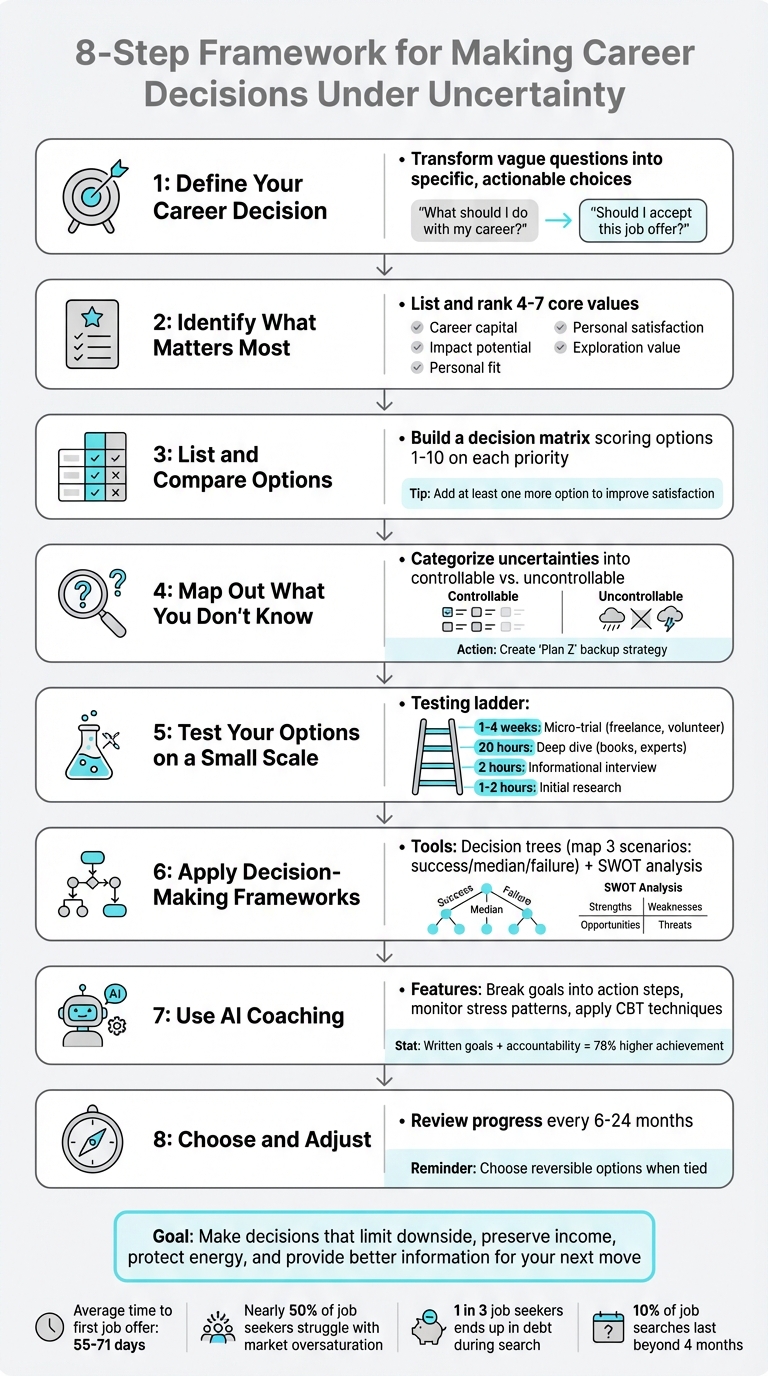
8-Step Framework for Making Career Decisions Under Uncertainty
Making Decisions During Uncertainty: 3 Methods | James Clear
sbb-itb-d5e73b4
Step 1: Define Your Career Decision
When career questions are too broad, they can leave you feeling stuck. Asking yourself something like, "What should I do with my life?" often leads to overthinking and focusing on unhelpful details.
The solution? Turn vague uncertainty into clear, actionable decisions. Instead of pondering, "What should I do with my career?", reframe it as, "Should I accept this job offer?" This small shift transforms endless contemplation into a practical next step.
As Polina, a Senior Leader at Amazon, puts it:
"Good decisions do not come from good luck. They come from good decision architecture." [4]
This idea of creating a structured decision-making process sets the foundation for the steps ahead.
Frame the Problem Clearly
Start by asking yourself, "What problem am I solving right now?" A single career question often hides multiple layers – whether it’s financial needs, career growth, or staying relevant in your industry.
Narrow your decision down to one clear sentence, keeping in mind the constraints that matter most to you. These could include salary expectations, location, or work-life balance. For instance: "Should I take the product manager role at Company A for $85,000 with remote flexibility, or the operations role at Company B for $78,000 with a 15-minute commute?"
Break your decision into three key areas: the role itself, the industry, and the work environment. This method helps you figure out whether you need a new job title, a shift to a different field, or simply a better team dynamic.
By clearly defining the problem, you can focus on the values that are most important to your decision.
Separate Immediate Choices from Long-Term Goals
It’s important to distinguish between short-term decisions (spanning 1–4 years) and your broader, long-term aspirations.
For immediate decisions, prioritize building career capital – things like new skills, valuable connections, and credentials – while also testing whether a particular path suits you. Long-term goals, on the other hand, should focus on creating meaningful impact and personal fulfillment. You don’t need to have your entire career mapped out right now. Instead, set a checkpoint in 6–12 months to evaluate your progress and adjust based on what you’ve learned.
This separation ensures that each step you take strengthens your career foundation while keeping you aligned with your bigger picture.
Think of career growth as a series of deliberate steps rather than a single, life-defining choice. Every decision should minimize risks, maintain financial stability, and provide clarity for your next move.
Step 2: Identify What Matters Most to You
When it comes to making career decisions, clarity about your priorities is everything. Without a clear sense of what truly matters to you, it’s easy to get swept up in choices that sound impressive but don’t actually align with your needs or long-term goals.
The key isn’t about finding a "perfect" career. Instead, it’s about making a choice that supports your energy, keeps you financially secure, and helps you grow for whatever comes next. As Ashliana Spence, a Freelance Marketing and Growth Operations Consultant, puts it:
"The goal is not to find the perfect or right career. The goal is to make a decision that limits downside, preserves income, protects your energy, and gives you better information for the next move." [2]
Be honest with yourself about what motivates you, including practical aspects like salary and job security. Ignoring these realities can lead to burnout or dissatisfaction over time [5].
List Your Top 4-7 Values
Take some time to identify 4–7 concrete priorities that will guide your career decisions [5]. These shouldn’t be vague ideals but specific, measurable factors that you can use to evaluate your options.
Focus on what genuinely energizes you, not just what looks appealing on paper. A sustainable career isn’t about chasing theoretical excitement – it’s about finding something you can commit to without draining yourself [2].
Your list of values should touch on these five areas:
- Career capital: Skills and credentials that grow in value over time.
- Impact potential: The difference you can make in your role.
- Personal fit: How well the job aligns with your strengths and preferences.
- Personal satisfaction: How much you enjoy the day-to-day work.
- Exploration value: How much you’ll learn about yourself and your career path [5].
Define your non-negotiables clearly. These are the must-haves, like a minimum income, level of job stability, flexibility, or work-life balance. Think of these as hard boundaries, not nice-to-haves [2].
For a reality check, try the "Two-Column Truth Test": In one column, write what you tell others you want from your career. In the other, write what you actually want. The difference between the two can reveal your true priorities [3].
Once you’ve nailed down your core values, the next step is to rank them so you can objectively compare your career options.
Rank Your Priorities
With your values in hand, rank them to create a clear benchmark for evaluating choices. This ranking will help you weigh competing priorities, like deciding between a job with high growth potential and one offering better work-life balance.
To make this process more objective, create a career scorecard. Rate each option on your top priorities using a scale of 1 to 10. Include factors like salary potential, job difficulty, stress levels, and how transferable the skills are to other roles [5]. This method ensures you don’t overemphasize one factor while ignoring others.
If two options score closely, use reversibility as a tie-breaker. Ask yourself: Which path would be easier to leave if it doesn’t work out? Which one builds skills that will remain useful no matter where you go next? [2] For example, if you’re torn between a secure government job and a dynamic startup role, consider which option offers more flexibility if your priorities shift later.
To refine your rankings, get feedback from someone you trust. They might spot biases or blind spots in your thinking [6]. You can also try the 10/10/10 rule: Picture how you’ll feel about your decision 10 minutes, 10 months, and 10 years from now [1].
Finally, conduct a "pre-mortem": Imagine your chosen path has failed two years down the line. Work backward to figure out which priority you might have overlooked. If something critical comes up, adjust your rankings accordingly [5] [1].
Step 3: List and Compare Your Options
Now that you’ve clarified your priorities, it’s time to explore career paths and evaluate them side by side. Don’t box yourself into a narrow set of choices. Research suggests that adding just one more option to your decision-making process can significantly improve your satisfaction with the final choice [5].
Start by thinking beyond the obvious. If you already have a clear long-term goal, try working backwards – identify the steps needed to get there. If you’re still figuring things out, consider working forwards by focusing on immediate opportunities to grow and learn. You can also group similar interests into "role families" (like operations, product management, or customer success) to keep your options open while building a connected skill set [2].
Don’t get stuck on job titles alone. Instead, do some "requirements research" – review 20–30 job postings for the same type of role. This will help you spot patterns in the skills and tools employers are looking for [2]. Keep in mind that the same title can mean very different things depending on the industry, company size, or workplace culture [2].
Build a Decision Matrix
A decision matrix helps you turn your priorities into measurable data. Start by listing your top 4–7 priorities as rows (e.g., career capital, personal fit, impact potential, and personal satisfaction). Then, add your career options as columns. Score each option on a scale of 1 to 10 for every factor [5][6].
Here’s an example:
| Priority Factor | Startup Operations | Corporate Data Analyst | Non-profit Program Manager |
|---|---|---|---|
| Career Capital | 8/10 | 6/10 | 5/10 |
| Personal Fit | 7/10 | 9/10 | 6/10 |
| Impact Potential | 5/10 | 4/10 | 9/10 |
| Personal Satisfaction | 9/10 | 5/10 | 7/10 |
| Total Score | 29 | 24 | 27 |
Use the total scores as a guide. If one option scores lower but still feels right, it might signal that you’ve overlooked an important factor. To account for uncertainty, think about upside and downside scenarios: What’s the best-case (top 5%) and worst-case (bottom 5%) outcome for each option? This perspective can help you weigh risks and rewards [5].
Filter Out Non-Viable Options
Before diving into every possibility, narrow down your list. Eliminate paths that don’t meet your baseline needs. For example, cut out options that fall short of your income requirements, flexibility needs, or preferred work environment [2]. Look for "dominant options" – choices that outperform others across all your criteria – and remove the weaker alternatives [6].
If two options score closely, use reversibility as a tie-breaker. Ask yourself: Which path would be easier to leave if it doesn’t work out? Which one builds transferable skills that will be valuable no matter what comes next? [5] A more flexible option may be worth choosing even if it’s not your top pick.
Finally, try an "elimination prompt": If your top options weren’t available, what would you choose instead? This can help you uncover alternatives you might have missed [5].
Step 4: Map Out What You Don’t Know
When making career decisions, uncertainty is inevitable. Instead of letting it overwhelm you, tackle it head-on. Start by identifying the unknowns and organizing them into manageable categories. This approach helps you address risks and make more informed choices.
List Your Uncertainties
Begin by listing the questions that are keeping you stuck. For example: "Will I enjoy this job?", "Am I qualified enough to get hired?", or "How will I perform compared to others?" [1][5]. Break these uncertainties into categories, such as job requirements, personal satisfaction, and potential impact [2][5].
Once you’ve outlined your questions, sort them into two groups: things you can control and things you can’t. Internal factors – like developing new skills or evaluating how well a role aligns with your strengths – are within your control. External factors, such as market trends or economic conditions, are not [2]. Next, prioritize uncertainties that are most relevant to your decision. For example, some questions might be resolved with a quick conversation, while others could require hands-on experience, like a short internship [1][5].
To systematically address these unknowns, try using a "ladder of tests." Start small: spend an hour or two researching online. If questions remain, schedule an informational interview with someone in the field. Still unsure? Dedicate around 20 hours to reading and consulting multiple experts. If needed, take it a step further by committing to a short-term project or volunteer opportunity lasting one to four weeks [1][5]. This structured approach ensures you gather the insights you need without wasting time.
Plan for Worst-Case Scenarios
Fear of failure can loom larger than the actual risks. To confront this, try a premortem exercise: imagine it’s two years in the future, and your career choice didn’t pan out. Reflect on what might have gone wrong – maybe you underestimated financial needs, overlooked a skill gap, or had unrealistic expectations about work-life balance [1][5]. Identifying these risks now allows you to address them proactively.
Next, create a "Plan Z", your safety net if things don’t work out. This might include moving in with family, dipping into savings, or taking a temporary job to stay afloat [5]. Knowing you have a fallback plan can ease the pressure of pursuing a risky but rewarding "Plan A." Keep in mind that about one in three job seekers ends up in debt during their search, which can push them toward less-than-ideal roles [2]. A solid backup plan gives you the freedom to make bolder choices.
Finally, consider how easy it would be to reverse your decision. Opting for a role that builds transferable skills can give you the flexibility to pivot if things don’t go as planned [5]. This way, even if uncertainties don’t resolve in your favor, you won’t feel trapped in a dead-end path.
Step 5: Test Your Options on a Small Scale
Once you’ve identified uncertainties, the next step is to test your options in a practical way. Instead of diving headfirst into a major career change, try small-scale experiments. These low-risk trials can help you gather real-world insights and see if a particular path aligns with your expectations – without committing months or years upfront.
Run Low-Risk Experiments
Start simple. Spend 1–2 hours doing some initial research – browse industry reviews, check out job boards, and look up common qualifications or skills needed [1][5]. If you’re still curious, take it a step further: set up an informational interview with someone already working in the field. A two-hour chat can uncover details you won’t find online, like the daily challenges or hidden aspects of the role [1][5].
To dig deeper, invest 20 hours in more focused activities. This could include reading industry-specific books or talking to three professionals in various roles [1]. If you’re still unsure, try a 1–4 week micro-trial – freelance, volunteer, or even start a blog related to the field [1][5][2]. These short-term commitments give you a hands-on feel for the work, helping you decide if it’s worth pursuing further. Additionally, applying to a handful of jobs can help you gauge market demand and your own interest in the role [5][2].
The beauty of these experiments? They’re quick and low-risk, offering valuable insights without tying you down for too long.
Document What You Learn
Testing only works if you track what you discover. Use a decision journal to jot down what you tried, what surprised you, and what you learned about your skills, interests, and stress levels [2]. Be specific – avoid vague impressions. For instance, note whether the work energized or drained you, how quickly you picked up new skills, and how others responded to your contributions [2].
After each experiment, ask yourself targeted questions: Did you enjoy the work itself, or was it the people you interacted with? What tasks felt natural, and which ones were challenging? [7]. This kind of reflection helps you turn scattered experiences into actionable insights. As 80,000 Hours explains:
"One good indicator that you’ve done enough research is that your best guesses have stopped changing" [1].
When your findings start to confirm the same patterns, you’ll know it’s time to take the next step with confidence.
Step 6: Apply Decision-Making Frameworks
Once you’ve tested your options and gathered practical insights, it’s time to bring some structure to your analysis. Instead of relying on gut instincts or a simple pros-and-cons list, decision-making frameworks like decision trees and SWOT analysis can help you evaluate career paths more systematically and tackle uncertainties with clarity.
Map Scenarios with Decision Trees
Decision trees are a great way to visualize all possible outcomes for each career option. Start by defining three scenarios for every path you’re considering: a "Success" scenario (top 5% of outcomes), a "Failure" scenario (bottom 5%), and a "Median" scenario (the most likely outcome) [5]. For instance, if you’re thinking about moving into consulting, your success scenario might involve quick promotions and excellent earnings, while the failure scenario could include burnout or a stalled career.
Evaluate each scenario based on factors like impact potential, career capital, personal fit, and overall satisfaction [5]. Then, assign probabilities to these scenarios and calculate the expected value for each path. Also, think about flexibility – how easy would it be to pivot if things don’t go as planned? As 80,000 Hours points out, transitioning from academia to industry is often simpler than the reverse [5].
Before committing, eliminate options that carry significant risks, such as burnout, financial instability, or reputational harm [5]. And don’t forget to set a review point – say, 6 to 24 months down the line – to reassess your decision tree as you gain more experience and insights [1].
Use SWOT Analysis for Career Choices
While decision trees focus on mapping sequential outcomes, SWOT analysis offers a snapshot of how well a specific role aligns with your current situation. It evaluates internal strengths and weaknesses alongside external opportunities and threats [8]. To identify potential threats, try a "premortem" exercise: imagine that your plan has failed two years from now, then work backward to figure out what went wrong [1].
Using both frameworks together can make your decision-making process even stronger. Start with a SWOT analysis to clarify the problem and uncover any biases. Then, use a decision tree to map out the steps and test your assumptions. This layered approach, often called cluster thinking, helps you view your choices from different angles, making it less likely that you’ll judge a decision solely by how it turns out [6].
| Tool | Best Used For |
|---|---|
| Decision Tree | Comparing multiple paths with high uncertainty and sequential steps [5] |
| SWOT Analysis | Assessing a specific role or offer against personal capabilities and the external environment [8] |
Step 7: Use AI Coaching to Navigate Uncertainty
Even after you’ve mapped out potential scenarios, it’s easy to get stuck in a loop of overthinking. As the saying goes, "Overthinking isn’t analysis. It’s avoidance disguised as diligence" [9]. This is where AI coaching steps in, helping you transform endless deliberation into actionable progress. By setting clear criteria and breaking down overwhelming decisions into smaller, testable steps, AI coaching helps you move forward with confidence.
Turn Goals into Action Steps with Aidx.ai
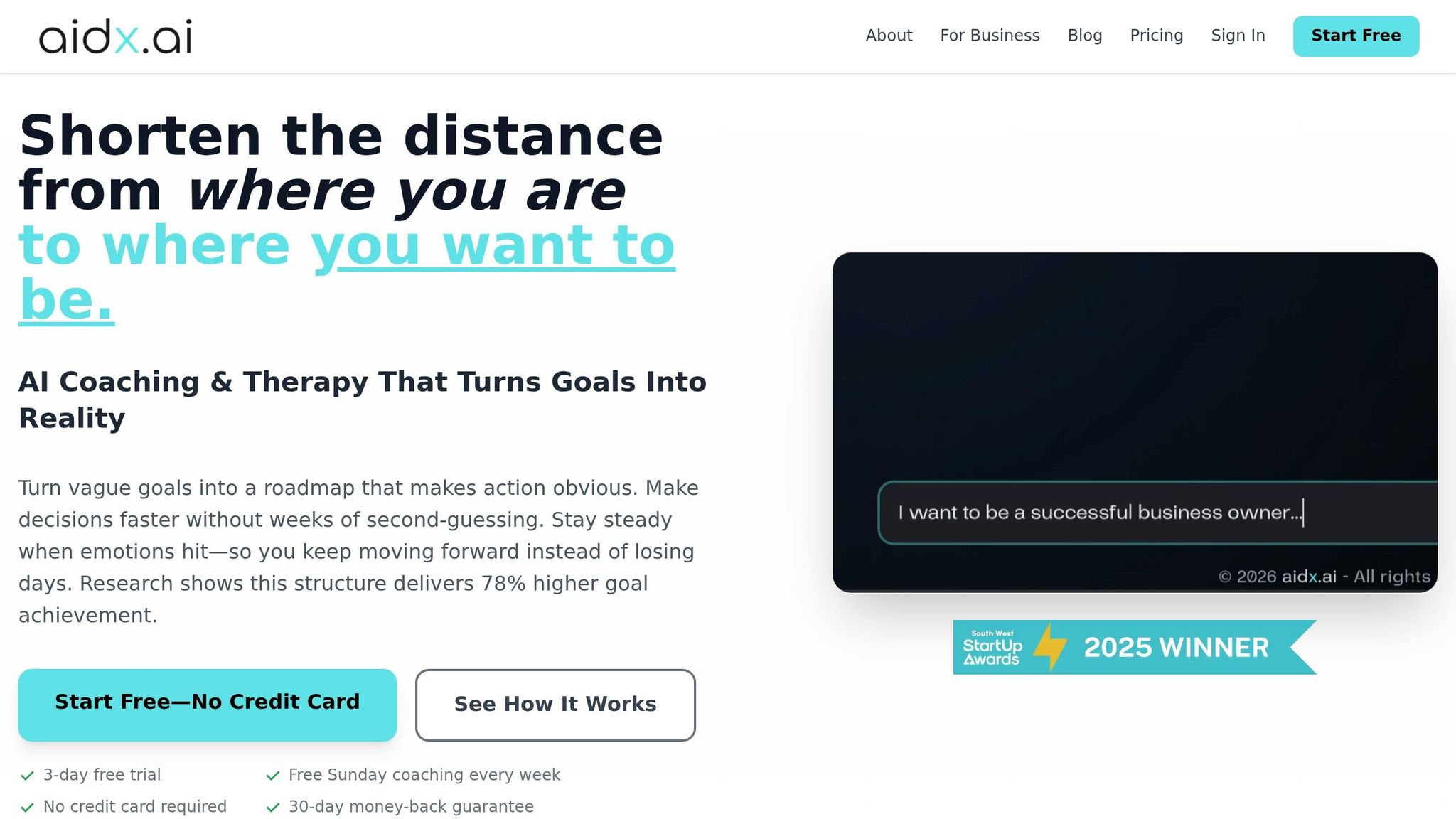
Vague goals like "explore consulting" often lead to inaction. That’s where Aidx.ai’s Roadmap feature comes into play. It takes those unclear ambitions and translates them into specific, measurable steps. For example, "I want to change careers" becomes a visual plan with clear milestones. Research from Dominican University has shown that writing down goals, paired with action steps and regular accountability, can increase achievement rates by 78%. Aidx.ai integrates this research-backed structure directly into its platform.
Instead of overwhelming you with long-term commitments, Aidx.ai breaks down your goals into smaller, testable steps. Plus, it tracks key metrics throughout the process, helping you stay focused and avoid decision fatigue – something that can be especially draining during lengthy hiring cycles [2].
Monitor Stress and Decision Patterns
Career uncertainty doesn’t just make decision-making harder – it can also create emotional patterns that hold you back. Aidx.ai’s Insights feature monitors your communication over time to detect stress levels, signs of burnout, and recurring thought loops. If you find yourself stuck on the same concerns without making progress, the AI flags these patterns, signaling when analysis has turned into avoidance [9].
By identifying these emotional roadblocks early, you can adjust course before stress takes over. Aidx.ai also acts as a virtual coach, highlighting milestones to keep you motivated, especially during job searches that last beyond four months – a situation faced by about 10% of job seekers [2].
The platform goes a step further by incorporating Cognitive Behavioral Therapy (CBT) techniques to refine your decision-making process.
Break Down Decisions with CBT Methods
Using Cognitive Behavioral Therapy (CBT) techniques, Aidx.ai helps you break down big career decisions into smaller, more manageable parts. For instance, instead of tackling the overwhelming question, "Should I switch industries?" the platform guides you to break it into three components: role, industry, and work environment [2].
This method treats uncertainty like a scientific experiment. Rather than trying to solve everything at once, you investigate each piece individually. The platform helps you uncover the root causes of hesitation, shifting your mindset from "I don’t know what to do" to "Here’s what I need to test next" [10][11]. This structured, step-by-step approach not only reduces stress but also builds clarity and confidence as you move forward.
Step 8: Choose a Direction and Adjust as You Go
Take Your First Step
Certainty is hard to come by, especially when it comes to career decisions. Instead of waiting for the "perfect" choice, start with a small, low-cost test. This lets you gather feedback and make adjustments along the way. The focus here isn’t on locking in a lifelong career – it’s about picking the next step that minimizes risk while giving you better insights for your future moves [2].
When you’re stuck between similar options, go for the one that’s easier to reverse. In other words, choose the path that allows you to pivot more easily if things don’t pan out [5][2]. To stay on track, break your plan into specific, actionable steps. For example, use an if-then framework: "If it’s Monday at 9:00 AM, then I’ll send three LinkedIn messages to people in consulting roles." This approach, known as implementation intentions, has been shown to boost follow-through [5].
Once you’ve taken that first step, keep an eye on your progress and be ready to adjust if needed.
Review Your Progress Regularly
Career planning isn’t a one-and-done decision – it’s an ongoing process. Regular reviews help ensure your path aligns with your evolving goals. Set a reminder on your calendar to review your progress every 6 to 24 months [5][1]. During these check-ins, ask yourself: Are you seeing the growth you expected? Have you encountered significant setbacks or feedback suggesting a change is necessary? Are there better opportunities on the horizon?
Before you even start, make a list of warning signs that indicate you’re on the wrong path. These could be things like, "I haven’t learned a new skill in six months" or "I still dread Monday mornings after three months in this role." If any of these show up, it’s time for an immediate reassessment [5].
To make your reflections more concrete, keep a decision journal. Document what you’ve tried, what surprised you, and what you’ve learned. This helps turn vague feelings into actionable insights for future decisions [2].
Use what you’ve learned from your journal and your experiments to tweak your approach. Just like you used tools like SWOT analysis and decision trees earlier, these regular reviews will help you validate your progress and identify areas that need adjustment. Career planning is all about staying flexible and learning as you go.
Conclusion
Career decisions are rarely straightforward, and they seldom come with guarantees. The goal isn’t to erase uncertainty but to handle it in a structured way. Start by clearly defining your decision, separating short-term priorities from long-term goals, and ensuring your choices align with your personal values. Tools like decision matrices, SWOT analysis, and decision trees can help transform abstract feelings into clear comparisons.
As Ashliana Spence from Huntr explains:
"The goal is not to find the perfect or right career. The goal is to make a decision that limits downside, preserves income, protects your energy, and gives you better information for the next move." [2]
Take small, low-risk steps such as informational interviews or short-term projects. Keep track of your results in a decision journal to spot patterns and improve your approach. Platforms like Aidx.ai can assist by breaking down complex decisions using CBT techniques, monitoring stress that might cloud your thinking, and turning your goals into actionable plans with weekly accountability. This iterative approach ensures you’re ready for ongoing evaluations.
Once you’ve gathered insights, choose a path that offers flexibility, take that first step, and review your progress within 6 to 24 months. Remember, career planning is a continuous journey, not a single choice. On average, it takes 55 to 71 days to land a first job offer [2], and nearly half of job seekers point to market oversaturation as a major challenge [2]. Patience and adaptability will be your greatest allies.
FAQs
How do I choose when two options score almost the same?
When two choices seem equally good, a structured approach can help you focus on what truly matters. Start by identifying your top 2–3 criteria and rule out any option that doesn’t align with them. Next, picture yourself having already made the decision – your emotional response can often uncover your genuine preference. Finally, think about the long-term effects of your choice and commit to it. This method not only simplifies tough decisions but also helps you feel more confident in your final pick.
What’s the fastest way to test a career path before committing?
The fastest way to dive into a potential career path is by trying hands-on methods like informational interviews, trial projects, or short-term experiments. These strategies give you practical experience and immediate feedback, helping you figure out if the role matches your skills and interests – without locking yourself into a long-term commitment.
How can I tell if I’m overthinking vs. doing real research?
Overthinking tends to trap you in a cycle of repetitive thoughts, constant second-guessing, and mounting confusion, even when you’re actively seeking information. It’s like spinning your wheels – giving the illusion of productivity while avoiding actual decisions. In contrast, real research pushes you forward by introducing fresh insights and helping you refine your understanding.
One way to break free from overthinking is to set a firm deadline for making a decision. If you notice you’re rehashing the same arguments without uncovering anything new, it’s a sign you’re stuck. Shift your focus to gathering new information or perspectives that can genuinely help you move forward.