
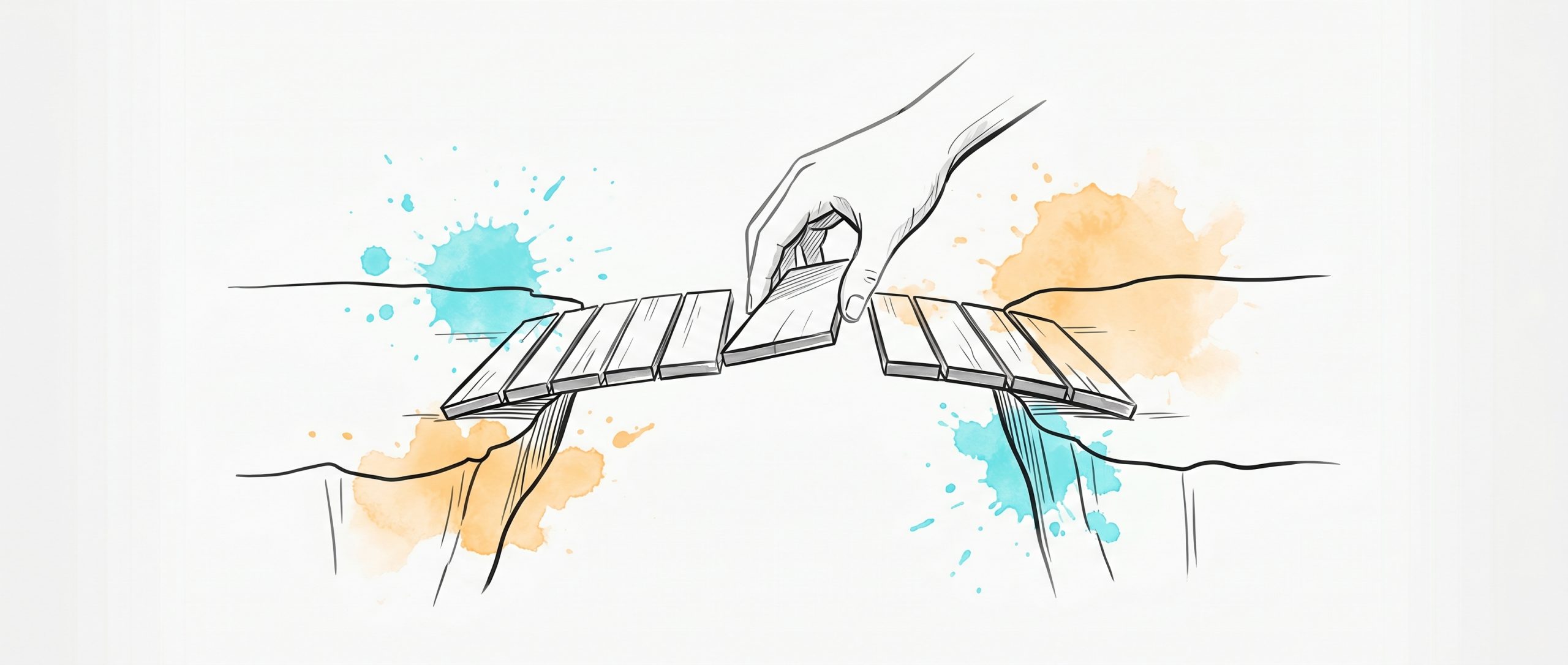
When two people on your team stop working well together, the cost isn’t abstract. The friction shows up in slower handoffs, careful emails copied to you “just so there’s a record,” and good people quietly updating their CVs. Team conflict resolution is the manager’s craft of stepping into that friction early, getting underneath the positions to what each person actually needs, and helping the two of them work together again — without taking sides or pretending the disagreement never happened.
This guide is about conflict between team members: two colleagues at odds, and you as their manager in the middle. It’s built on established research rather than slogans, and every claim links to its source. (If you’re trying to cool down a single heated conversation in the moment, that’s a related but narrower skill — see our guide to de-escalating a conflict.)
Why team conflict matters more than it looks
Conflict at work is common, and it’s expensive in human terms. In the CIPD’s Good Work Index 2024, a quarter of UK employees — around eight million people — reported experiencing some form of conflict at work in the previous year. Among those who did, the most common forms were being undermined or humiliated (48%), being shouted at or having a heated argument (35%), and verbal abuse or insult (34%).
What that conflict does to people is the part managers can’t afford to ignore. In the same study, employees who experienced conflict were roughly twice as likely to say they planned to leave within twelve months (33%, versus 16% of those who hadn’t). Only 28% felt their work was good for their mental health, against 43% of colleagues without conflict. Unresolved friction between two people rarely stays between two people — it shapes whether a whole team feels safe enough to do good work.
Not all conflict is the same
It helps to separate what people are fighting about from how it feels between them. Researchers distinguish two kinds:
- Task conflict — disagreement about the work itself: the right approach, the priorities, who owns what.
- Relationship conflict — friction that has become personal: irritation, distrust, feeling disrespected.
It’s tempting to assume task conflict is “healthy debate” and therefore harmless. The evidence is more sobering. A widely cited meta-analysis by De Dreu and Weingart (Journal of Applied Psychology, 2003) found that both task and relationship conflict were, on average, negatively related to team performance and satisfaction — and that the two tend to bleed into each other. A clean argument about strategy curdles into “I just can’t work with them.” Your job as a manager is partly to catch task conflict before it turns relational, and to untangle the two when it already has.
Spotting it early
Conflict between team members rarely arrives as a shouting match. More often it surfaces as quiet changes in how people behave around each other. Worth paying attention to:
- Two colleagues who used to collaborate now route everything through you instead of talking to each other.
- Meetings go oddly polite — agreement on the surface, no real engagement underneath.
- Handoffs between the two slow down, or start coming with a defensive paper trail.
- One person consistently goes quiet when the other speaks.
None of these prove conflict — people have off weeks, and over-reading normal friction can create the very tension you’re worried about. But a sustained shift in how two specific people work together is a signal worth a quiet, private check-in before it hardens.
Five ways people handle conflict (and when each fits)
The most established map of conflict behaviour is the Thomas-Kilmann Conflict Mode Instrument, developed by Kenneth Thomas and Ralph Kilmann in 1974. It plots five styles along two dimensions: assertiveness (how much you push for your own goals) and cooperativeness (how much you factor in the other person’s). No single style is “right” — the skill is matching the style to the situation, and noticing which one you and your team members default to (overview).
| Style | What it looks like | Fits when… | Watch out for |
|---|---|---|---|
| Collaborating | Work together to satisfy both sets of concerns fully | The issue and the relationship both matter; there’s time to dig in | It’s slower — don’t force it on trivial decisions |
| Compromising | Each side gives a little to reach a workable middle | A fair, fast resolution beats a perfect one; power is roughly equal | Nobody’s fully satisfied; can become a reflex |
| Accommodating | Yield to the other’s position | You’re wrong, the issue matters far more to them, or harmony is the priority | Repeated accommodation breeds quiet resentment |
| Competing | Pursue your own position firmly | A fast, decisive call is needed — safety, ethics, a hard deadline | Erodes trust if it’s your go-to |
| Avoiding | Step back, delay, or sidestep | Tempers need to cool first, or the issue genuinely isn’t worth it | Real issues fester when permanently avoided |
Most chronic team conflict comes from a style mismatch left to run: a competer paired with an accommodator, or two avoiders who never name the thing between them. Simply helping each person see their own default — and that the other isn’t being difficult, just wired differently — often takes the heat out before any formal step is needed.
A manager’s path through it: positions vs. interests
When two team members are genuinely stuck, the most useful tool is the distinction between positions and interests, drawn from Roger Fisher and William Ury’s Getting to Yes. As they put it: “Your position is something you have decided upon. Your interests are what caused you to so decide” (Harvard Program on Negotiation).
Two people locked on incompatible positions (“we ship Friday” vs. “we delay”) can almost always find room once you surface the interests beneath them (one needs to keep a client promise; the other needs to not ship something broken with their name on it). Those interests usually aren’t in conflict at all. Here’s a practical sequence built on that idea:
- Talk to each person separately first. Hear both sides privately before you bring anyone together. You’re listening for the interest under the position, not deciding who’s right.
- Set neutral ground. A private, even-footed conversation — not your office with you behind the desk as judge. Make it explicit that the goal is a way forward, not a verdict.
- Separate the people from the problem. Frame the issue as a shared problem the three of you are solving — “how do we hit the deadline without shipping something we’ll regret” — rather than a contest between two people.
- Ask each to state their interest, not their demand. A simple prompt helps: “What matters most to you here, and what are you worried about?” Have each person reflect back what they heard the other say before responding.
- Build the agreement together. Generate options that serve both interests, then make the resolution concrete: who does what, by when, and how you’ll all know it’s working.
- Follow up. Put a check-in on the calendar — a fortnight out, then a month. Resolution isn’t a single conversation; it’s whether the new way of working actually holds.
Throughout, your stance matters as much as your steps. Stay curious rather than judgmental, keep the conversation on interests rather than personalities, and resist the urge to impose a solution — people uphold agreements they helped build, not ones handed down to them.
Words that cool a conflict instead of feeding it
The language you model in the room sets the tone for how the two of them speak to each other. A few reliable moves:
- Trade accusation for curiosity. “You’re being unreasonable” shuts a person down. “Help me understand what’s driving the concern about the timeline” opens them up.
- Reflect before you respond. “So what I’m hearing is that you need more lead time to test — have I got that right?” People de-escalate when they feel accurately heard.
- Name the shared goal. “We both want this to land well for the client” reminds two people who’ve started seeing each other as the obstacle that they’re actually on the same side.
For the moment-to-moment skill of bringing the temperature down when a conversation is already heated, our companion guide on de-escalating conflict goes deeper.
Building a team where conflict stays healthy
The best conflict resolution is the conflict that never hardens — because the team has the safety to raise small frictions before they grow. The research behind this is psychological safety, defined by Harvard’s Amy Edmondson as “a shared belief held by members of a team that the team is safe for interpersonal risk-taking” — that you can ask a question, admit a mistake, or challenge an idea without fear of embarrassment or punishment (Edmondson, 1999). Google’s later research into effective teams found it to be the single biggest differentiator of high-performing groups.
You build it in small, repeated ways:
- Make roles clear. A surprising amount of “personality clash” is really two people with overlapping or fuzzy responsibilities. Clarifying who owns what removes the friction at the source.
- Model fallibility. When you admit your own mistakes out loud, you make it safe for everyone else to.
- Treat disagreement as normal. Thank people for raising hard points. A team that can argue well in the open rarely needs to argue badly behind closed doors.
- Don’t let things fester. Address small tensions while they’re still small. Avoidance is comfortable in the moment and costly over time.
Where to find support
Sitting in the middle of a conflict between two people you manage is genuinely hard — you’re holding two perspectives, your own judgment, and a relationship with each. It helps to think it through with something outside the situation.
aidx.ai is an AI coaching and therapy service you can talk through a situation with — to prepare for a difficult conversation, pressure-test how you’re framing it, or work out which approach fits the two people involved. It’s a private space to think before you step into the room, not a replacement for your own judgment, your HR partner, or — where a conflict involves harassment, discrimination, or anything that may need formal handling — the proper channels for those.
The short version
- Conflict between team members is common and costly — it’s one of the strongest predictors of people choosing to leave.
- Catch it early; a sustained shift in how two people work together is your signal.
- Know the five conflict styles, and match the response to the situation rather than defaulting to one.
- When you mediate, get underneath positions to interests — that’s where workable solutions live.
- The long game is psychological safety: a team that can raise small frictions openly rarely lets them grow into big ones.
Last reviewed: June 2026.
This article is general information for managers, not legal or HR advice. Conflicts involving harassment, discrimination, bullying, or risk to anyone’s safety should be handled through your organisation’s formal procedures and, where appropriate, qualified HR or legal professionals.