
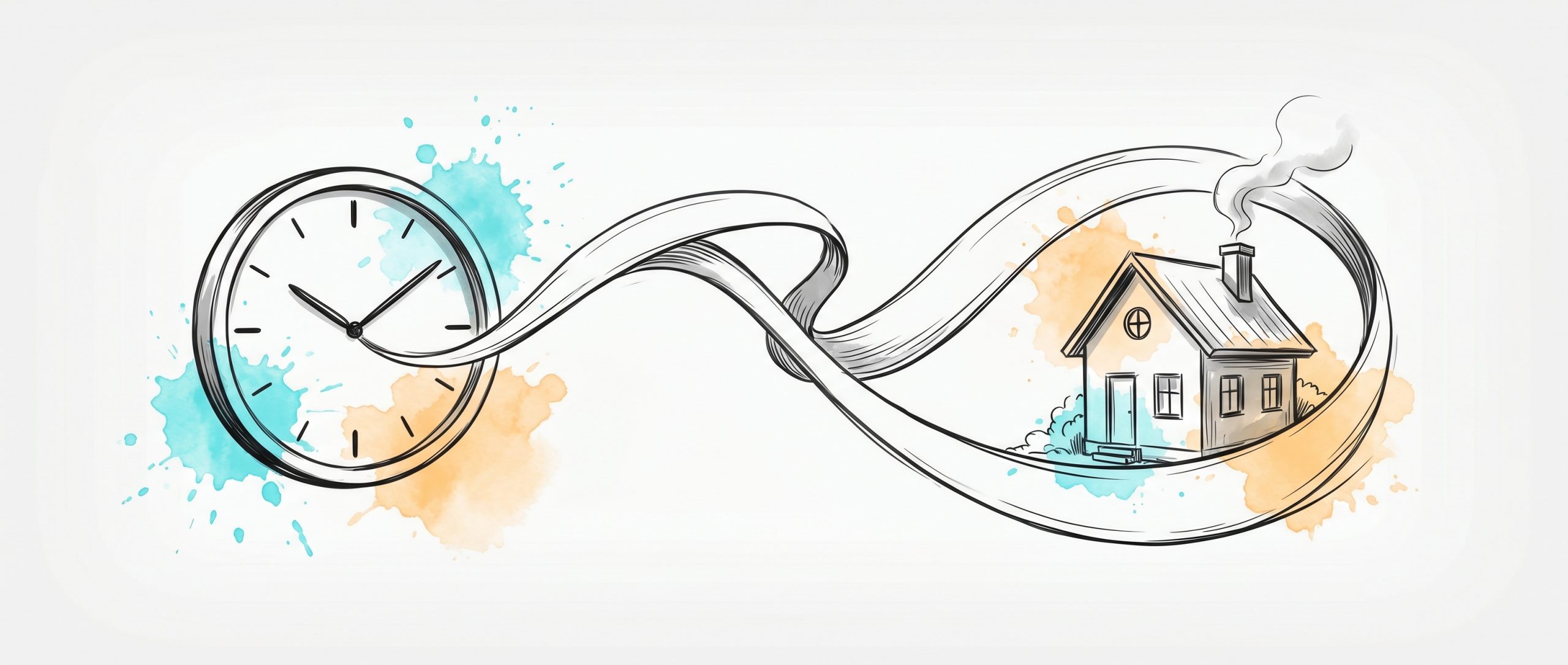
A work-life balance conflict is the friction you feel when the demands of your job and the demands of the rest of your life pull against each other — and meeting one means short-changing the other. It’s the late meeting that collides with dinner at home, the message that arrives just as you’ve finally switched off, the sense that you’re doing two jobs badly instead of one job well. This kind of conflict is normal, it’s well-studied, and — once you understand what’s actually happening — it’s far more workable than it feels in the moment.
This guide explains what a work-life conflict really is (psychologists have a precise definition), why it lands so hard, and a set of concrete, evidence-based things you can do about it — starting today, without needing your whole company to change first.
What a work-life balance conflict actually is
The feeling has a name in psychology: work-family conflict, or more broadly work-life conflict. In a foundational 1985 paper, researchers Jeffrey Greenhaus and Nicholas Beutell defined it as a form of inter-role conflict — a clash between two roles you hold (worker and parent, employee and partner, professional and friend) where “the role pressures from the work and family domains are mutually incompatible in some respect.” In plain terms: being good at one role makes it harder to be good at the other.[1]
They described three distinct forms it takes. Recognising which one you’re caught in is the first step to loosening it.
| Form of conflict | What it is | Everyday example |
|---|---|---|
| Time-based | Time spent on one role leaves too little for the other. | A standing 6 pm call that means you keep missing bedtime. |
| Strain-based | Strain from one role spills into the other — you’re physically present but mentally drained. | A stressful day at work leaves you snappy and absent at dinner. |
| Behavior-based | The behaviour one role rewards is wrong for the other. | The decisive, guarded style that works in negotiations chills things at home. |
This matters because the three forms call for different fixes. A time-based conflict is solved by renegotiating the calendar. A strain-based one is solved by recovery — actually unwinding between domains. A behaviour-based one is solved by learning to switch modes. Treating all three as “I just need to manage my time better” is why generic advice so often fails.
Why it spills over — and why it feels so heavy
Work-life conflict rarely stays in its lane. Occupational psychologists call this spillover: mood, stress, and energy transfer from one part of your life into another within the same person — a hard day at work carries home in your shoulders and your tone of voice. It can also cross over to the people around you: in the spillover–crossover model described by researchers Arnold Bakker and Evangelia Demerouti, your work strain first spills into your home life, then transmits to your partner or family through everyday interaction.[2] That’s why a rough quarter at work can quietly become a rough quarter at home for everyone in the house.
A big driver of modern spillover is the “always-on” expectation. Researchers Larissa Barber and Alecia Santuzzi named the specific version of this workplace telepressure: a strong urge to respond to messages quickly, paired with a preoccupation with how fast you reply. In their studies, higher telepressure was linked to poorer ability to mentally detach from work, more burnout, more sleep problems, and more health-related absence.[3] The phone in your pocket doesn’t just deliver a message — it keeps a part of your mind at work even when your body has gone home.
And the stakes aren’t only emotional. In a 2021 joint analysis covering 194 countries, the World Health Organization and the International Labour Organization found that working 55 or more hours a week was associated with a 35% higher risk of stroke and a 17% higher risk of dying from ischemic heart disease, compared with working 35–40 hours. They estimated that long working hours were linked to 745,000 deaths from stroke and heart disease in 2016.[4] Chronic overwork isn’t a badge of commitment; over years, it’s a genuine health risk.
None of this is meant to alarm you. It’s meant to make the case that protecting the line between work and life is a reasonable, evidence-backed thing to do — not self-indulgence.
How to resolve a work-life balance conflict: a practical approach
You can’t always change your workload. You can almost always change how you negotiate, recover, and set limits inside it. Here are five moves that hold up to the evidence.
1. Name the conflict precisely
Before solving, diagnose. Is this time-based (the hours genuinely don’t fit), strain-based (the hours fit but you’re too depleted to be present), or behaviour-based (you can’t seem to shift out of “work mode”)? Most people discover their conflict is mostly one of the three. The label tells you where to aim — a calendar problem, a recovery problem, or a switching problem — instead of throwing willpower at all of it at once.
2. Protect recovery, not just rest
Rest and recovery aren’t the same. Researchers Sabine Sonnentag and Charlotte Fritz identified psychological detachment — genuinely switching off mentally from work during your off-hours — as one of the key experiences that lets people recuperate. In their research, people who detached, relaxed, and felt a sense of control over their free time reported lower exhaustion, fewer health complaints, and higher life satisfaction.[5] Scrolling work email on the sofa is rest for your body but not detachment for your mind — and it’s detachment that does the repair. Build one reliable “off-ramp” into your evening: a walk, a workout, cooking, anything that fully occupies your attention elsewhere.
3. Set boundaries you can actually hold
A boundary is a rule about your own behaviour, not a demand on someone else’s. “I stop checking messages after 7 pm” is a boundary; “stop emailing me at night” is a wish. Start with one specific, defensible limit and communicate it plainly to the people it affects: “I’m offline after 7 so I can be present at home — I’ll pick anything urgent up first thing.” Reduce the friction that makes you cave: move work apps off your home screen, turn off after-hours notifications, leave the laptop in another room. If guilt comes up — and it often does — that’s worth working on directly; we cover it in our guide to setting healthy boundaries without guilt and in strengthening emotional boundaries.
4. Renegotiate, rather than quietly endure
Many work-life conflicts are structural, not personal — and structures can be discussed. Surfacing flexibility is one of the highest-leverage moves available. In the American Psychological Association’s 2023 Work in America survey of 2,515 U.S. workers, 67% of those without the flexibility to balance work and personal life reported negative effects on their mental health, compared with 23% of those who had that flexibility.[6] Flexibility isn’t a perk; it’s protective. Use “I” statements that put the need on the table without blame — “I do my best focused work in the morning; could we move our standing call so it doesn’t cut across school pickup?” — and come with a proposed alternative, not just a complaint. A manager can rarely fix a problem they haven’t heard named.
5. Bring empathy to the table — including for yourself
The version of empathy that resolves conflict isn’t softness; it’s accuracy. When you genuinely try to understand the other side — the manager who fears the team will drift, the partner who feels second to your inbox — you usually find a workable need underneath the friction, and a solution that serves both. Active listening (reflecting back what you heard before you respond) and validating the other person’s feeling, even when you don’t agree with their conclusion, are the practical mechanics of it.
And turn the same empathy inward. Spillover is contagious: the calmer and more recovered you are, the less your stress crosses over onto the people you came home to. Self-criticism for “not balancing it all” only adds strain to a strain-based conflict. Treating yourself as you would a colleague in the same bind is not indulgence — it’s how you stop the cycle from feeding itself.
Where a coach — human or AI — fits in
A lot of work-life conflict gets resolved not in a meeting but in the quiet thinking before it: working out which form of conflict you’re really in, rehearsing the boundary conversation so it comes out clear rather than defensive, noticing the spillover before it reaches the dinner table. That reflective work is exactly what coaching is for — and it’s the kind of thing that’s most useful in the moment it’s needed, not three weeks later at a scheduled appointment.
This is the gap aidx.ai is built for. It’s award-winning AI coaching and therapy — recognized as AI Startup of the Year by the UK Startup Awards (South West) — a companion you can talk to by text or voice — on the commute, on a lunch break, in the ten minutes before the conversation you’re dreading. It draws on established, evidence-based approaches (including CBT, ACT, DBT, and NLP) to help you think a situation through, regulate the stress that’s spilling over, and prepare what you actually want to say. It’s available whenever the conflict is live, which is often when it matters most.
To be clear about what it is and isn’t: aidx.ai is an AI companion for everyday strain — overwhelm, stress, boundary-setting, the friction between work and home. It is not a clinician, it does not diagnose or treat conditions, and it isn’t a substitute for professional or crisis care. If you’re dealing with acute distress, please reach out to a qualified professional or a local crisis line. For the ordinary-but-heavy work of keeping work and life in a livable balance, though, having something thoughtful to think out loud with can make the difference between reacting and choosing.
Frequently asked questions
What is a work-life balance conflict?
It’s a clash between the demands of your job and the demands of the rest of your life, where meeting one means falling short on the other. Psychologists call it work-family or work-life conflict and describe three forms: time-based (not enough hours), strain-based (too depleted to be present), and behaviour-based (the style one role rewards doesn’t fit the other).[1]
How do I resolve a work-life conflict?
Start by naming which of the three forms you’re in, then match the fix: renegotiate the calendar for time conflicts, protect genuine recovery and detachment for strain conflicts, and practise switching out of “work mode” for behaviour conflicts. Set one specific, holdable boundary, surface the need to the people it affects with a proposed alternative, and bring empathy — to others and to yourself — to the conversation.
Why does work stress follow me home?
Because of spillover — stress and mood transfer between domains within the same person — and crossover, where it then transmits to the people around you. The “always-on” expectation makes it worse by keeping part of your mind at work even off the clock. Building in deliberate recovery time, where you genuinely detach from work, is one of the most evidence-backed ways to break the cycle.[5]
Related reading
- How to Manage Stress at Work: A Practical, Evidence-Based Guide
- How to Recover From Burnout: An Evidence-Based Recovery Guide
- Setting Healthy Boundaries Without Guilt
- Mastering the Art of Saying No: Assertiveness & Boundaries
References
- Greenhaus, J. H., & Beutell, N. J. (1985). Sources of conflict between work and family roles. Academy of Management Review, 10(1), 76–88. journals.aom.org
- Bakker, A. B., & Demerouti, E. (2013). The spillover–crossover model. In New Frontiers in Work and Family Research. Full text (PDF)
- Barber, L. K., & Santuzzi, A. M. (2015). Please respond ASAP: Workplace telepressure and employee recovery. Journal of Occupational Health Psychology, 20(2), 172–189. PubMed
- World Health Organization / International Labour Organization (2021). Long working hours increasing deaths from heart disease and stroke. who.int
- Sonnentag, S., & Fritz, C. (2007). The Recovery Experience Questionnaire. Journal of Occupational Health Psychology, 12(3), 204–221. PubMed
- American Psychological Association (2023). Work in America Survey: Workplaces as engines of psychological health and well-being. apa.org
Last reviewed: June 2026. This article is general information about work-life balance, not professional, medical, or psychological advice. If work-related stress is seriously affecting your health, relationships, or daily functioning, consider speaking with a qualified professional; in a crisis, contact your local emergency or crisis service.