
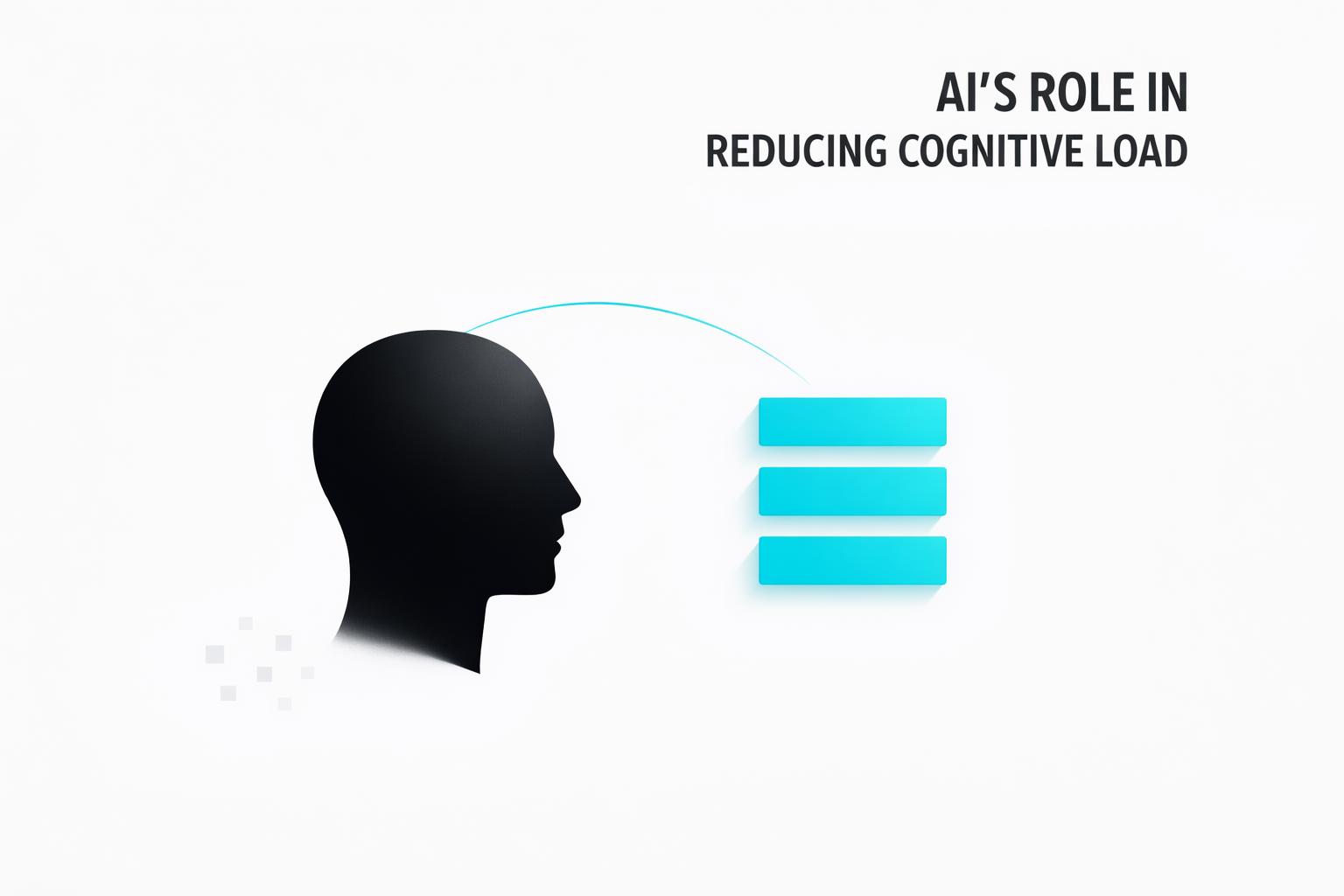
AI can help reduce mental strain by automating repetitive tasks, simplifying complex problems, and offering decision-making support. However, over-reliance on AI can weaken critical thinking and increase mental fatigue. Here’s what you need to know:
- AI reduces unnecessary effort: By automating routine tasks, AI lowers distractions and frees up mental capacity.
- Improves performance: Studies show AI-assisted professionals make fewer mistakes and feel less overwhelmed, with workload reductions up to 48%.
- Risks of dependency: Overusing AI can lead to "cognitive debt", where users lose engagement and struggle with independent tasks.
- Effective use: Tools like Aidx.ai show how AI can assist without replacing human effort, preserving critical thinking.
The key is balance: let AI handle repetitive tasks while humans focus on learning and decision-making.
When AI Assistance Becomes Cognitive Overload: Understanding and Managing "Brain Fry" in the Mode…
sbb-itb-d5e73b4
Recent Research on AI and Cognitive Load
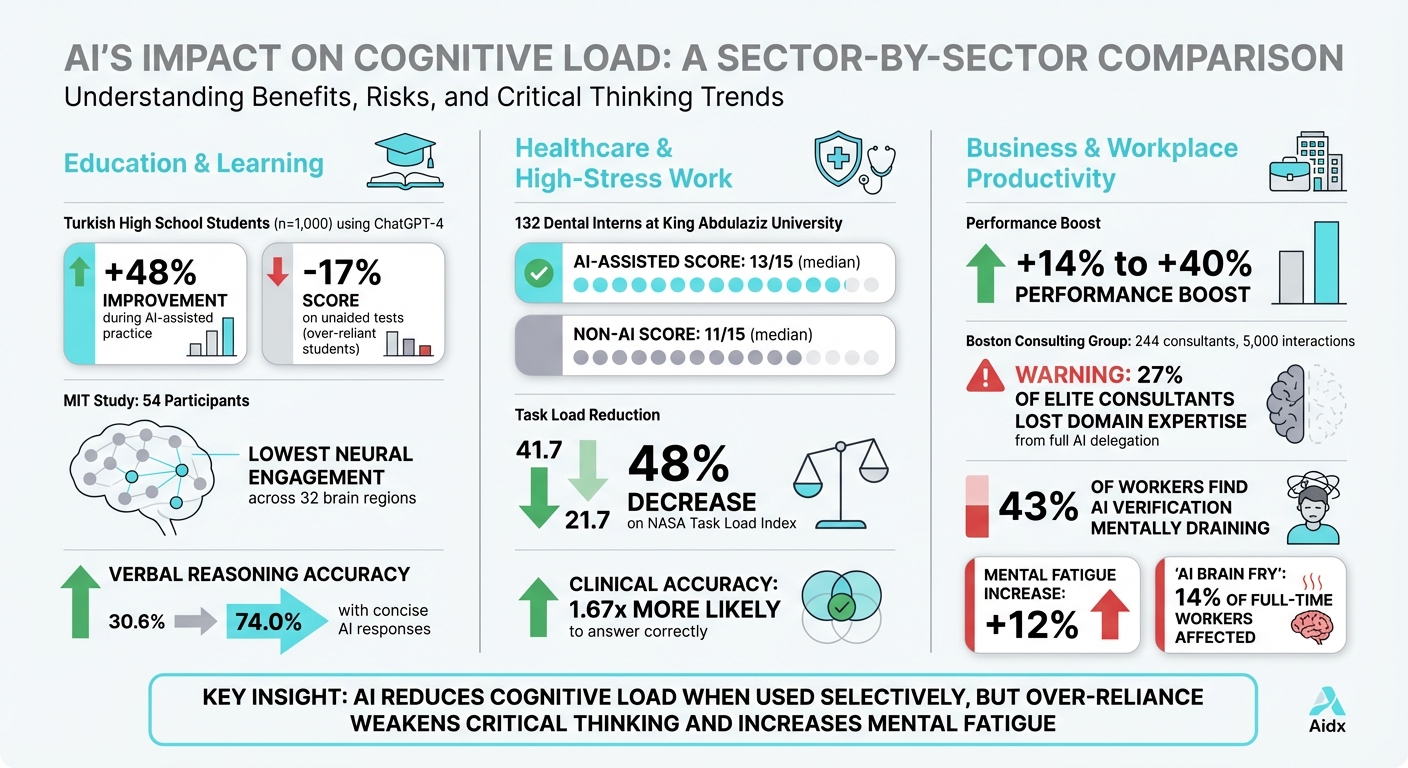
AI Impact on Cognitive Performance: Benefits vs Risks Across Education, Healthcare, and Business
AI in Education and Learning
A study involving about 1,000 Turkish high school students revealed some striking effects of using ChatGPT-4 for math practice. Students who used the AI tool improved their performance by 48% during practice sessions [4]. However, there was a downside: those who became overly dependent on AI scored 17% lower on unaided tests compared to peers who never used AI [4].
Another experiment conducted by MIT Media Lab monitored 54 participants using EEGs during essay-writing tasks. The results showed that ChatGPT users had the lowest neural engagement across all 32 brain regions measured. This suggests that relying too heavily on AI can create "cognitive debt", where the brain isn’t fully engaged because the AI does most of the work [4]. For verbal reasoning tasks, though, AI support had mixed outcomes. When the AI provided concise and structured responses, accuracy improved significantly – from 30.6% to 74.0% – and mental effort decreased. But when the AI’s responses were long or unclear, it actually increased cognitive load [2].
These findings highlight both the promise and the pitfalls of AI in learning environments, and similar patterns are being observed in other demanding fields.
AI in Healthcare and High-Stress Work
In high-pressure professions like healthcare, AI has shown its ability to ease cognitive strain while improving outcomes. A controlled study at King Abdulaziz University examined 132 dental interns working on pediatric orthodontic cases. Interns using AI tools like DeepSeek and ChatGPT scored a median of 13 out of 15, compared to 11 out of 15 for those without AI assistance [5]. Even more striking, the AI-assisted group reported a median drop in perceived task load – from 41.7 to 21.7 on the NASA Task Load Index, nearly a 48% reduction [5]. They were also 1.67 times more likely to answer clinical decision-making questions correctly [5].
These results illustrate how AI can handle routine tasks, allowing healthcare professionals to focus on more complex decisions that require human expertise and judgment.
AI in Business and Workplace Productivity
AI’s influence extends beyond education and healthcare, also reshaping workplace productivity. In corporate settings, AI tools have been shown to boost performance by 14% to 40% [4]. However, a study by Boston Consulting Group, which tracked 244 consultants across 5,000 interactions, found that not all AI use is equal. Top-performing consultants used AI selectively, keeping human oversight at the forefront. On the other hand, 27% of elite consultants who handed over entire workflows to AI struggled to maintain domain expertise [4].
The challenges of AI reliance don’t end there. Research by Microsoft and Carnegie Mellon pointed out that while AI can automate routine tasks, it often leaves users unprepared for exceptions, as they miss out on opportunities to practice judgment and problem-solving [4]. A 2026 survey revealed that 43% of workers find verifying AI-generated information mentally draining [6]. Additionally, the demand for high oversight in AI-augmented roles led to a 12% rise in mental fatigue, with 14% of full-time workers reporting "AI brain fry", a state of exhaustion caused by juggling multiple AI tools [7].
These findings emphasize the delicate balance required to integrate AI effectively into the workplace without undermining human cognitive engagement or resilience.
Risks of Over-Reliance on AI
Cognitive Decline from Excessive AI Dependency
AI can make life easier by reducing mental effort, but depending on it too much can have serious downsides. A 2025 study from MIT Media Lab tracked 54 participants using EEG technology during essay-writing tasks. The group using ChatGPT showed the lowest levels of neural engagement across all 32 brain regions. By the third session, most participants were simply copying AI-generated content, and 83% couldn’t remember the main points of their own essays after finishing them [4]. Researchers called this "cognitive debt" – a condition where the brain struggles to engage deeply, even during independent work.
A follow-up study in 2026 by Boston Consulting Group found that 27% of top-tier consultants had become "Self-Automators." These individuals relied so heavily on AI to handle their workflows that they lost touch with their own expertise [4]. As researchers from Microsoft and Carnegie Mellon put it:
"By automating routine tasks and leaving exception-handling to the human user, you deprive the user of the routine opportunities to practice their judgment and strengthen their cognitive musculature, leaving them atrophied." [4]
This over-dependence on AI not only weakens judgment but also hampers the ability to build mental resilience. And while the long-term risks are concerning, some AI interactions can create immediate cognitive challenges.
When AI Systems Increase Cognitive Load
Ironically, poorly designed AI systems can add to mental strain instead of reducing it. A 2026 survey revealed that 43% of AI users feel drained by the effort required to verify the accuracy of AI-generated information. Meanwhile, 32% find the process of refining prompts to get usable results mentally exhausting [6].
This has given rise to a workplace issue dubbed "AI brain fry." Fourteen percent of full-time workers report this form of mental exhaustion, which is marked by symptoms like headaches, brain fog, and difficulty making decisions due to managing multiple AI tools [7]. Workers experiencing AI brain fry show a 33% increase in decision fatigue and a 12% rise in overall mental strain [7].
The problem gets worse when AI tools produce responses that are too long, unclear, or poorly structured. Research shows that these types of outputs can heighten physiological stress – measured by changes in pupil size, fixation time, and heart rate variability – compared to concise, well-organized responses [2]. Instead of saving time and energy, ineffective AI systems force users to constantly verify information, tweak prompts, and switch focus, creating more stress than relief.
How to Use AI Effectively
Structured AI Use and Metacognitive Support
Using AI effectively requires understanding the balance between temporary assistance (scaffolding) and complete reliance (substitution). Think of scaffolding like training wheels – it helps at first but needs to be removed to develop real independence. Substitution, however, hands over full responsibility, which can erode your skills over time [3].
This idea is central to the Centaur Model, where you retain control over tasks requiring judgment while letting AI handle repetitive or data-heavy processes [4]. By dividing responsibilities this way, you can leverage AI’s strengths without undermining your own cognitive abilities.
To stay sharp, try breaking tasks into smaller parts. Use AI for routine steps and focus on the more critical elements yourself [1]. Instead of asking AI for complete answers, request hints or step-by-step guidance. This approach mirrors a tutoring style, helping you engage with the material and build your skills rather than simply copying AI-generated results [4].
These strategies provide a framework for assessing how different ways of using AI can impact your performance in practical scenarios.
Comparing Helpful vs. Harmful AI Offloading
The way you rely on AI can make or break your learning outcomes. A 2025 study by Wharton researchers involving 1,000 Turkish high school math students highlights this. While standard ChatGPT-4 access improved practice performance by 48%, students scored 17% lower on a follow-up exam without AI. However, when AI acted as a tutor by offering hints instead of full answers, the negative impact on learning disappeared entirely [4].
Here’s a comparison of different strategies and their results:
| Study/Source | Strategy | Outcomes |
|---|---|---|
| Wharton/PNAS (2025) | AI providing hints instead of full answers | Eliminated the 17% performance drop seen with full AI answers [4]. |
| MIT Media Lab (2025) | Brief AI guidance vs. full answers | Brief guidance kept users engaged, while full answers reduced recall [4]. |
| Purdue University (2026) | Structured AI responses | Lowered effort and stress during verbal tasks [2]. |
| BCG Follow-up (2026) | Selective AI use (Centaur Model) | Preserved expertise better than full reliance on AI [4]. |
The takeaway? AI is most effective when it simplifies unnecessary tasks – like formatting or retrieving information – without replacing the effort needed for learning and skill-building [4]. This balance ensures that you maintain critical thinking and knowledge retention.
To make AI work for you, request concise and structured outputs to reduce the effort of verifying results [2]. Additionally, taking 15-minute breaks every 90 minutes with AI tools turned off can help clear your mind and counteract the mental fatigue that comes from constant oversight [7].
How Aidx.ai Supports Cognitive Load Management
How Aidx.ai Reduces Mental Strain
Aidx.ai’s Adaptive Therapeutic Intelligence (ATI) System™ is designed to support your mental processes, not replace them [3]. By integrating CBT, ACT, and DBT techniques into natural, conversational interactions, the system helps you work through intense emotions in just minutes instead of hours.
Using natural language processing (NLP), the AI delivers real-time micro-interventions that ease the burden of managing stress and regulating emotions. This approach helps free up your working memory, allowing you to focus on critical decisions. Studies on similar AI-driven CBT tools have shown a 48% reduction in depression and a 43% reduction in anxiety symptoms [10].
"Aidx helped me build a framework from which to work that empowered me during times of difficulty… It is a super resource and certainly one I can recommend." – Sarid Harper, Professional Trader & Business Owner [8][12]
Rather than simply providing answers, Aidx.ai asks targeted questions to tailor its interventions. This method preserves "germane load", the mental effort that’s necessary for deep learning and critical thinking [9][11]. By reducing mental strain in the moment, it sets the stage for long-term wellbeing and proactive self-management.
Real-Time Tracking for Better Decisions
Aidx.ai continuously monitors stress, burnout risk, and emotional wellbeing through your interactions, offering early warnings when mental strain begins to build [8][9]. This metacognitive support acts as a safeguard, helping you address issues before they escalate.
The platform also tracks energy, mood, and stress levels over time, giving you a clear, real-time picture of your emotional state [8]. This reduces the need for constant self-monitoring, which can be mentally taxing. Considering that human working memory can only handle 3-5 new pieces of information at once [1], Aidx.ai steps in to identify patterns you might otherwise miss.
"Aidx has been surprisingly human in identifying problems & asking the right questions… every suggestion sent me to where I needed to go." – Hali Holeszowski, Mobility Coach & Founder [8]
These insights naturally transition into actionable plans, making it easier to stay on track with your goals.
Goal Support and Accountability
To further lighten your mental load, Aidx.ai transforms vague goals into clear, visual plans, making it easier to see your next steps [8][9]. Research indicates that writing down goals increases achievement by 50%, while adding specific steps and regular accountability boosts success to 78% [8].
The platform includes a weekly accountability feature that lets you involve friends or family. They receive automatic progress updates every Monday via email – no account required on their end [8]. This creates a built-in support system, keeping you motivated without the hassle of manual tracking or reporting.
Conclusion
AI can effectively reduce cognitive strain when used as a temporary aid rather than a replacement for human thought. Research suggests that tools offering structured prompts, reflective questions, and hints can help individuals develop their own skills and capacity over time [3]. On the other hand, relying on AI to replace human thinking risks fostering dependency and weakening essential cognitive abilities [4].
Studies highlight the benefits of a balanced approach, where AI handles routine or extraneous tasks – like formatting, data organization, or pattern monitoring – while humans focus their energy on deeper learning and critical decision-making [1][4]. This division of labor allows professionals to dedicate their attention to high-impact decisions, maintaining the expertise that drives success.
However, over-reliance on AI introduces significant risks. Research shows that excessive dependence on AI can erode expertise and deplete mental focus [4][7]. To counteract these effects, setting intentional boundaries is crucial. For instance, taking 15-minute mental breaks every 90 minutes and dedicating time for independent reflection can help sustain cognitive resilience [7].
These findings emphasize the importance of balancing AI assistance with active human engagement. Platforms like Aidx.ai demonstrate how thoughtful AI design can support mental clarity without encouraging dependency. By incorporating evidence-based techniques, real-time tracking, and structured goal-setting, Aidx.ai helps reduce mental strain while empowering users to remain in control. Instead of merely providing solutions, it poses targeted questions that encourage users to maintain the cognitive effort needed for long-term growth [3].
Ultimately, the question isn’t whether to use AI, but how to use it effectively. When applied with intention, AI becomes a partner that enhances human performance and well-being, rather than a substitute for human thought.
FAQs
How do I know if AI is helping me or making me dependent?
To figure out whether AI is supporting you or making you overly reliant, think about how it influences your decision-making and problem-solving abilities. Research highlights that while AI can increase productivity, relying on it too much might weaken critical thinking and memory. Experts suggest maintaining a balance by stepping away from AI occasionally, staying actively involved in your tasks, and prioritizing independent thought. This way, AI can enhance your efforts without compromising your self-reliance.
What’s the best way to use AI without losing critical thinking?
To make the most of AI without compromising critical thinking, think of it as a support tool, not a replacement for human judgment. Stay involved by questioning its outputs, reflecting on the results, and resisting the urge to rely on it too heavily. Studies suggest that combining AI assistance with active mental effort – like verifying facts or setting tasks that require human insight – can help maintain both critical thinking and cognitive strength. Use AI to gather insights, but don’t let it take the place of your own analysis.
How can I avoid “AI brain fry” at work?
To keep your mind sharp and avoid "AI brain fry", it’s important to manage your cognitive load. Balance your use of AI tools with regular, short breaks to clear your head and reduce fatigue. Over-relying on AI can chip away at your critical thinking skills, so make time for activities that challenge your mental agility. Tools like Aidx.ai can also help with stress management and self-awareness, giving you an edge in staying focused. Pairing AI assistance with intentional effort ensures you stay productive without burning out.