
Burnout is costing businesses $322 billion every year, and 63% of employees reported experiencing it in 2024. Stress is rising, engagement is dropping, and traditional mental health programs are failing to keep up. AI tools like Aidx.ai are stepping in to fill the gap, offering 24/7, private, and evidence-based support to employees.
Here’s why this matters:
- Burnout and disengagement are driving high turnover and lost productivity.
- Traditional Employee Assistance Programs (EAPs) have low usage rates (3–8%) and don’t provide ongoing support.
- AI platforms detect stress early, provide tailored coaching, and improve employee wellbeing.
For every $1 spent on mental health, companies see a $4 return in performance and retention. With affordable pricing and secure, encrypted conversations, AI tools are reshaping workplace mental health. By 2027, 75% of organizations are expected to adopt these solutions, making now the time to act.
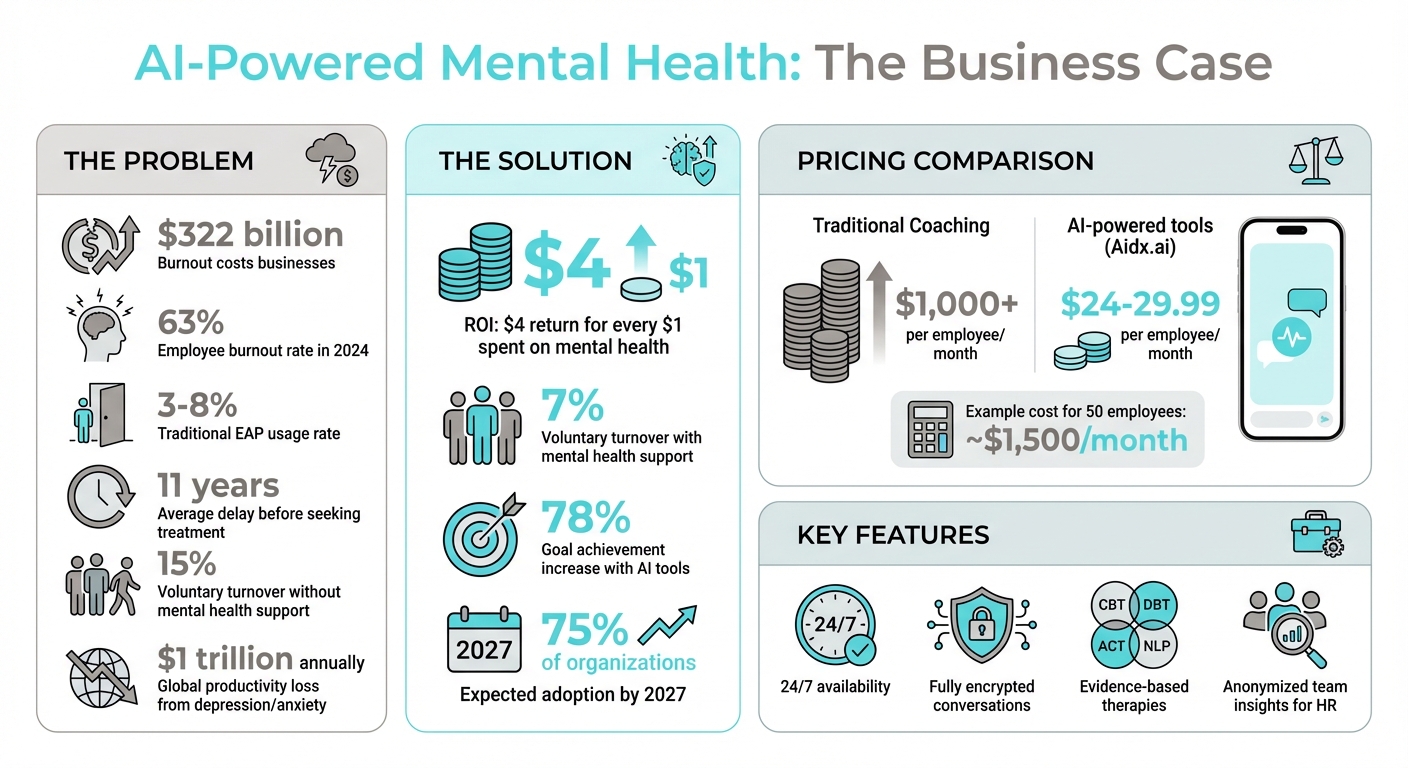
AI-Powered Mental Health ROI and Impact Statistics for Corporate Teams
Common Mental Health Problems in Corporate Teams
Burnout and Chronic Stress
Burnout is becoming increasingly common among American workers, and the reasons are clear but relentless. Repetitive tasks drain mental energy, leaving little room for fulfilling work. In high-pressure fields like healthcare and hospitality, the emotional toll is constant. Even those in mental health professions aren’t exempt – 67% of them report severe burnout due to overwhelming caseloads [4]. Over time, chronic stress chips away at job satisfaction, leading to overload and reduced productivity. Often, these issues go unnoticed by management until an employee decides to leave.
Dr. Neha Chaudhary, Chief Medical Officer at Modern Health, puts it plainly: "People are getting sicker. They’re struggling, and it’s impacting the way they’re showing up at work, with their families and for themselves. It starts taking a toll and it wears people down" [4].
The numbers back this up. Companies that neglect mental health support see voluntary turnover rates of 15%, compared to just 7% in organizations where leaders actively prioritize employee wellbeing [1]. Unchecked stress not only drives burnout but also quietly undermines overall engagement.
Low Employee Engagement
Disengagement often sneaks in quietly. Top performers may gradually lose interest over months before eventually leaving [1]. In the meantime, team dynamics suffer – conflicts simmer, focus wanes, and emotional exhaustion spreads. This has far-reaching consequences. For example, in customer-facing industries, burned-out employees may deliver subpar service, dragging down team morale. On a larger scale, depression and anxiety-related productivity losses cost the global economy around $1 trillion every year [2][5]. These warning signs highlight the shortcomings of traditional support systems.
Why Traditional Mental Health Support Falls Short
Employee Assistance Programs (EAPs) were designed with crisis management in mind, not ongoing prevention. The process itself can be a hurdle – calling an unfamiliar person during work hours, recounting struggles from the beginning, and hoping for timely help. Each session often starts from scratch, with no continuity, and managers lack insight into team stress levels until problems have escalated. On top of that, providing personalized, human-led therapy for every team member is often financially unfeasible.
Paul Posey, CEO of ComPsych, points out another issue: "The impulse to wait until everything is figured out before communicating is understandable. But in the absence of communication, rumors form, narratives harden, and fear sets in" [3].
Traditional systems not only fail to provide timely, accessible support but also struggle to build the trust employees need to seek help. On average, people wait 11 years from the onset of mental health symptoms before seeking treatment [4]. By then, careers may be derailed, and teams have already lost valuable talent. These gaps in support reveal an urgent need for solutions that promote continuous engagement and long-term mental wellbeing.
sbb-itb-d5e73b4
How AI-Powered Mental Health Tools Work
Evidence-Based Support Available Instantly
AI-powered mental health platforms offer immediate, evidence-based therapeutic support tailored to individual needs. These tools rely on established therapies like CBT (Cognitive Behavioral Therapy), DBT (Dialectical Behavior Therapy), ACT (Acceptance and Commitment Therapy), and NLP (Neuro-Linguistic Programming). Instead of generic chatbot interactions, they provide personalized coaching to help employees handle stress, regulate emotions, and set achievable goals.
Take platforms like Aidx.ai, for example. They combine these therapeutic methods with structured accountability systems. Research highlights that setting written goals with actionable steps and incorporating weekly check-ins can boost achievement rates by 78%. By integrating goal-setting into their design, AI tools turn vague aspirations into measurable progress. Employees can process challenging situations in minutes instead of dwelling on them for days. These tools also deliver real-time support for emotional regulation and decision-making – areas where traditional Employee Assistance Programs (EAPs) often fall short. This combination of instant, tailored assistance aligns perfectly with the fast-paced demands of modern workplaces.
24/7 Access with Privacy Protection
A major hurdle in accessing mental health support is availability. Traditional EAPs often operate during standard business hours, requiring employees to call unfamiliar professionals – sometimes during work, which can feel awkward or inconvenient. AI-powered platforms remove these barriers entirely by offering support anytime, anywhere, and on any device.
Privacy is another key concern. Tools like Aidx.ai ensure conversations are fully encrypted and inaccessible to managers or HR teams. Employees can trust that their interactions remain private and secure, with platforms adhering to GDPR and other privacy standards. Leadership teams only have access to anonymized, aggregated data, such as overall stress trends or burnout risks, without identifying individuals. This approach fosters trust and encourages employees to use the tools without fear of exposure.
As Aidx.ai emphasizes: "Individual conversations are encrypted and never visible to managers. Dashboards show team trends only – never personal details. Trust is the foundation, not an afterthought" [1].
Around-the-clock, secure access creates a foundation for continuous, personalized engagement, meeting employees where and when they need support.
Personalized Support for Individuals and Teams
With instant, secure access in place, these platforms go a step further by providing ongoing, adaptive support that benefits both individuals and teams. AI tools can retain interaction histories, adjust coaching styles based on user behavior, and present progress visually through roadmaps. For individual employees, this means seamless continuity – the AI builds on prior sessions to deliver personalized suggestions and reminders.
On a broader scale, these tools provide insights that might otherwise go unnoticed. By monitoring trends over time, they can identify rising stress levels weeks before they lead to burnout or resignations, giving HR and leadership teams the chance to act early. This proactive approach shifts companies away from reactive crisis management toward solutions that prevent issues from escalating. According to Gartner, 75% of organizations are expected to adopt AI-driven coaching and mental health tools by 2027 [1].
Matt McCreary, Chief Product Officer at CuraLinc, captures the balance well: "AI can be a valuable tool in mental health, but it’s not a substitute for clinical judgment or human connection. We need to ensure that technology supports – not overrides – the expertise of mental health professionals" [6].
Benefits of AI Mental Health Tools for Corporate Teams
Better Employee Wellbeing and Performance
When employees have access to quick, personalized support, they’re better equipped to manage stress and stay focused on their priorities. AI-powered platforms like Aidx.ai provide team members with tools to navigate tough moments before minor stressors develop into full-blown burnout.
Here’s why this matters: companies with robust mental health programs experience a voluntary turnover rate of just 7%, compared to 15% in organizations without such support. Even more compelling, for every dollar spent on mental health initiatives, businesses see a $4 return in improved employee performance and retention [1]. When employees feel supported, they stay engaged and productive, cutting down on the expensive cycle of recruiting and training new talent. This directly addresses widespread corporate issues like burnout and disengagement, both of which drain productivity and contribute to talent loss.
Affordable and Scalable for Large Teams
Traditional coaching services can cost upwards of $1,000 per employee each month, making them impractical for large-scale deployment. In contrast, Aidx.ai offers a much more budget-friendly option, with pricing set at $29.99 per user per month on a monthly plan, or $24 per user per month with annual billing (minimum five users) [1]. For a team of 50 employees, that’s roughly $1,500 per month on the monthly plan.
This makes AI tools accessible for teams of various sizes without straining budgets. For larger organizations with 50 or more users, enterprise pricing is available. Plus, companies can start with a 14-day free pilot to evaluate the platform’s impact before making a commitment [1]. Employees also benefit from a simple, private chat interface that encourages active use.
By delivering instant, personalized, and evidence-based support at a fraction of the cost of traditional methods, AI platforms offer a clear financial advantage. Consider this: burnout alone costs businesses $322 billion annually due to lost productivity, turnover, and disengagement [1]. Preventing burnout through AI tools provides measurable returns that far outweigh subscription fees.
Data Insights for HR Teams
AI platforms don’t just help employees – they also empower HR teams with valuable insights. Through anonymized, aggregated dashboards, HR can identify team-wide trends like rising stress levels, engagement dips, or burnout risks – all without compromising individual privacy [1].
These insights enable HR to take targeted action. For example, if data shows that sleep-related stress is a major issue within a team, HR could roll out initiatives like "Sleep Awareness Month" or provide managers with tailored resources and communication strategies [7]. This kind of focused approach ensures companies address real challenges rather than relying on one-size-fits-all wellness programs.
How to Add AI Mental Health Tools to Your Workplace
Start with a Trial Period
A great way to introduce AI mental health tools is by starting with a trial period. For example, platforms like Aidx.ai offer a 14-day free pilot program, giving your team a chance to experience its benefits firsthand [1]. During this time, employees can access 24/7 coaching through any device after receiving email invitations [1]. This approach minimizes risk while allowing you to assess whether the tool is being used and if it helps tackle issues like burnout or disengagement. Considering that 75% of organizations are expected to adopt AI-driven coaching and mental health tools by 2027 [1], starting now with a pilot program places your organization ahead of the curve.
Get Team Leads and Employees Involved
For AI tools to make an impact, employees need to feel comfortable using them. That’s where leadership plays a key role. When managers actively promote mental health resources, employee satisfaction can grow at twice the rate [1]. Equip team leads with simple communication tools for one-on-one conversations, especially when someone appears stressed or overwhelmed [7].
Clear and early communication is critical. Explain how the tool works, emphasizing that HR only sees aggregated trends while individual conversations remain private. Highlight that AI tools are designed to enhance support, not replace the human connection [3]. You could even introduce the platform during benefits orientation so new hires view it as a standard, confidential resource from day one [7]. With leadership on board, you’ll also be better positioned to use the platform’s insights for refining your mental health strategies.
Use Insights for Ongoing Improvement
Once employees begin using the platform, HR can tap into anonymized insights to identify trends and make data-driven decisions. Dashboards can reveal team-wide patterns, such as increased stress levels or drops in engagement, all while protecting individual privacy [1]. Instead of rolling out generic wellness programs, use this data to create targeted initiatives. For example, if the insights reveal communication struggles in a specific department, you could provide managers with conflict resolution training or organize team-building workshops focused on psychological safety [7]. Treating these insights as a core part of your mental health strategy ensures your approach adapts to your team’s evolving needs.
AI and Workplace Wellness: A New Era for Mental Health | The AI+HI Project
Conclusion
AI-driven mental health tools are changing the way companies support their employees. Instead of waiting for burnout to lead to resignations, platforms like Aidx.ai provide 24/7 coaching that detects stress patterns early – addressing burnout and engagement issues head-on. Considering that traditional Employee Assistance Programs only see utilization rates of 3–8% [1], these accessible and private AI tools fill a much-needed gap in workplace mental health support.
The financial case is hard to ignore. For every $1 spent, businesses see a $4 return in performance and retention [1]. With burnout costing $322 billion annually [1], investing in AI-powered solutions – priced at approximately $25 per user per month [1] – not only reduces expenses but also provides valuable data insights for targeted action.
"This isn’t a perk – it’s infrastructure." – World Health Organization [1]
The future points toward widespread adoption. By 2027, 75% of organizations are expected to integrate AI-driven mental health tools [1], giving early adopters a notable edge. These tools combine privacy-focused design, evidence-based therapies, and actionable data insights, making employee wellbeing a core part of business operations that directly impacts productivity, retention, and team performance.
To stay ahead, starting with a pilot program is key. A trial can help assess engagement and evaluate insights from the platform’s dashboard before scaling up. In today’s workplace, proactive mental health support isn’t just a nice-to-have – it’s the cornerstone of building and maintaining high-performing teams.
FAQs
Is Aidx.ai private for employees?
Aidx.ai prioritizes employee privacy by using encrypted conversations that are neither sold nor shared. Users maintain full control over their data, with the option to delete everything at any time, ensuring complete confidentiality.
How does AI spot burnout early?
AI can spot burnout early by examining real-time data on employee stress and engagement. Platforms like Aidx.ai track behavioral patterns, communication habits, and subtle signs of fatigue – things that traditional tools like surveys often overlook. This allows for timely interventions, such as offering coaching or additional support, which can help prevent severe burnout, lower turnover rates, and keep productivity levels steady. With AI-powered dashboards and daily check-ins, managers gain the insights they need to address team stress before it escalates.
How do HR teams use the dashboard safely?
HR teams rely on dashboards to keep an eye on employee well-being while maintaining strict privacy standards. These tools provide insights into factors like stress levels, team interactions, and potential burnout, helping organizations offer timely support. To ensure employees feel safe, companies need to implement robust data privacy measures, restrict access to only authorized staff, and conduct regular audits to monitor usage. Open communication about how data is collected and safeguarded fosters trust and promotes the ethical application of AI-driven mental health tools.