
AI mindfulness combines meditation with artificial intelligence to help you make decisions faster and with more clarity. By analyzing your emotional and physical state in real time, AI tools provide personalized mindfulness exercises to reduce stress, improve focus, and enhance decision-making. Here’s what you need to know:
- What it does: Tracks stress levels, mood, and physical signals like heart rate to offer tailored mindfulness guidance.
- Why it matters: Stress clouds judgment, but mindfulness creates a mental pause, improving logical thinking and decision speed.
- How it works: AI tools provide real-time feedback and exercises like breathing techniques, emotional noting, and guided meditations.
- Results: Regular practice boosts focus, reduces anxiety, and strengthens brain regions tied to decision-making.
AI-powered mindfulness tools like Aidx.ai offer features such as stress tracking, personalized sessions, and accountability reports to fit seamlessly into your daily routine. Whether you’re managing work stress or preparing for a big decision, these tools can help you stay calm, focused, and effective.
David Allen, CEO of GTD on AI, mindfulness, productivity and clarity

sbb-itb-d5e73b4
How AI Mindfulness Improves Cognitive Function
Mindfulness can physically reshape the brain. Studies show that in just eight weeks, it can increase gray matter density in the prefrontal cortex – the area responsible for planning, decision-making, and self-control [1]. This isn’t just theory; these changes are visible on brain scans.
Brain Changes Through Mindfulness Practice
Mindfulness strengthens the link between two key brain regions: the prefrontal cortex (responsible for rational thinking) and the amygdala (which governs emotional responses). Stress often triggers cortisol release, which suppresses the prefrontal cortex, allowing emotional reactions to take over. Regular mindfulness practice helps regulate this process, calming the amygdala and reducing the likelihood of an "amygdala hijack."
"Regular mindfulness practice strengthens the neural pathways between your prefrontal cortex and amygdala, giving you what neuroscientists call ‘cognitive flexibility.’" – Sarah Thompson, Author, Ahead [1]
This "cognitive flexibility" creates a crucial pause between feeling stressed and reacting impulsively. In that pause, better decisions can emerge. The brain transitions from a reactive state (urgent and constricted) to a responsive state (calm and open), enabling choices that align with long-term values rather than immediate emotions. These neural shifts support sharper, more thoughtful decision-making.
Interestingly, long-term meditators experience slower gray matter decline as they age. Research shows a correlation coefficient of r = -0.58 for meditators compared to r = -0.77 for non-meditators [6]. This suggests that mindfulness not only enhances cognitive function but also helps preserve it over time.
Real-Time Biofeedback for Mental Clarity
AI mindfulness tools take this practice a step further by tracking physical signals – like heart rate, breathing patterns, and even brain activity – to provide real-time insights into your mental state. For instance, if your heart rate variability drops or your breathing becomes shallow, the AI can guide you through techniques like the Breath Triangle (inhale for four counts, hold for four, exhale for four). This activates the parasympathetic nervous system, helping to clear mental fog [1].
These tools enhance what’s known as interoceptive awareness – your ability to sense and interpret internal bodily signals. Instead of vaguely feeling "stressed", you can recognize specific physical cues and address them before they escalate. By pinpointing the timing and intensity of these moments, AI helps optimize neural adaptation and avoid plateaus in training. It tailors mindfulness exercises to your unique needs, ensuring each session is effective.
How AI Personalizes Mindfulness
AI takes personalization to the next level. You can describe your situation, and within seconds, it generates a tailored mindfulness session [5].
"AI-powered meditation uses artificial intelligence… to generate personalized guided meditation sessions in real-time based on your specific emotional state, situation, and needs." – StillMind Blog [5]
The system evaluates multiple factors: your emotional state (e.g., anxiety or restlessness), whether you’re focused on past regrets or future worries, and the specific challenge you’re facing, such as work stress or interpersonal conflict. Based on this analysis, it selects from techniques like grounding for anxiety, noting for racing thoughts, or progressive relaxation for better sleep [5].
This level of customization has real benefits. Tailored sessions lead to 40% better sustained use over six weeks and improve practice consistency by 52% [5]. AI algorithms are impressively accurate, matching meditation techniques to emotional states 87% of the time, as confirmed by experienced meditation teachers [5].
Platforms like Aidx.ai go even further by identifying patterns over time. By analyzing conversations and bio-data, these systems can detect stress trends, burnout risks, and emotional shifts that might otherwise go unnoticed [4]. They adapt coaching styles to fit your thinking patterns and provide weekly accountability reports. This structured approach has been shown to increase goal achievement by 78% [4].
AI Mindfulness Techniques for Better Decisions
AI-powered mindfulness tools are stepping up to help with decision-making under pressure. These systems provide customized sessions tailored to your specific needs – whether you’re nervous about an upcoming presentation or overwhelmed by an overflowing inbox. And the impact is clear: personalized meditation sessions boost consistency in practice by 52% compared to generic options [5].
Guided Meditations for Focus and Clarity
With AI tools, you can describe your exact situation – like "147 unread emails and decision paralysis" – and receive a session designed just for you. No more scrolling through endless pre-recorded tracks to find something that fits [5].
What makes this approach so effective is how AI differentiates between types of stress. For example, the anxiety you feel before a big meeting isn’t the same as general restlessness or dwelling on past mistakes. AI considers both time focus (future worries vs. past regrets) and context (work-related, interpersonal, or existential challenges) to deliver the right practice [5].
"The AI version was just more responsive… having a voice guide me through the practice – one that actually acknowledged what I was dealing with that day – felt more natural than I expected." – User Review, InTheMoment App [7]
The results speak for themselves. AI-generated meditations score higher in relevance (8.7/10) compared to pre-recorded sessions (6.2/10) in pilot studies. Plus, users stick with these tools 40% longer over six weeks. These personalized sessions help prevent "amygdala hijack" – a stress response that shuts down rational thinking – keeping your decision-making brain, the prefrontal cortex, fully engaged during high-pressure moments.
Smart Break Reminders
AI doesn’t stop at meditations. It can also monitor your physiological signals – like pulse rate and breathing patterns – to detect when stress is building. Instead of interrupting you on a rigid schedule, it prompts a mindfulness break exactly when you need it most. This ensures the reminders don’t disrupt productive flow states or miss critical moments of tension.
These breaks promote what neuroscientists call "cognitive flexibility", allowing your brain to pause and make intentional choices rather than reacting impulsively. Techniques like the STOP method – Stop, Take a breath, Observe, and Proceed – are especially helpful during these moments [2]. Another quick reset is the Breath Triangle: inhale for four counts, hold for four, and exhale for four. This activates the parasympathetic nervous system, calming the stress response. Even a simple 90-second body scan can release tension in areas like your shoulders or jaw, helping you regain focus.
While these smart reminders tackle stress in the moment, the real game-changer is how AI tracks your emotional patterns over time.
Tracking Stress Patterns with AI
AI tools like Aidx.ai analyze your inputs and interactions to uncover long-term trends in mood, energy, and stress. By spotting early signs of burnout, these systems can recommend proactive interventions at just the right time [9].
For example, AI might notice whether your stress is tied to immediate nerves or broader worries about the future. Based on this analysis, it could suggest grounding exercises for sudden anxiety or visualization techniques before a big presentation [5]. This eliminates the need to sift through large content libraries, saving your mental energy for the decisions that matter.
Structured AI coaching also boosts accountability, leading to 78% higher goal achievement [9]. Over time, the system builds a "mental map" of your stress triggers, helping you recognize physical cues – like tight shoulders or a knotted stomach – that signal reactive impulses. This awareness ensures you stay aligned with your priorities, even during hectic or high-stakes situations.
Adding AI Mindfulness to Your Daily Routine
Mindfulness doesn’t have to take hours out of your day. By weaving in small, intentional moments – like during your coffee break or before diving into emails – you can create a meaningful practice. AI tools simplify this process by helping you decide what to focus on and when to do it.
These bite-sized practices fit effortlessly into your routine, helping you approach the day with a clearer, more centered mindset.
Morning Mindfulness for Mental Clarity
Kicking off your morning with an AI-guided mindfulness session can set you up for better focus and quicker decision-making. For example, you can describe your upcoming challenges – like "a packed schedule with tight deadlines" – and within 30 seconds, get a customized 5-15 minute session tailored to your needs [5]. This eliminates the mental drain of deciding where to start before the day even begins.
Another approach is using transition moments to check in with yourself. Take your morning coffee as an opportunity to pause for just 30 seconds. Ask yourself: How’s my mental state? Are my shoulders tense? Is my mind already racing through the day’s tasks? These quick self-assessments can help you catch stress early, before it builds up [3].
Pre-Decision Mindfulness Practices
Before making big decisions, try the STOP technique: Stop, Take a breath, Observe your emotions and physical state, and Proceed with intention [2]. This simple method, which takes less than a minute, gives you a moment to pause and think before acting impulsively.
Another helpful practice is emotional noting. If you’re feeling overwhelmed, label the emotion – like saying, "I feel anxious" or "I’m frustrated." This small step creates enough distance from the emotion to prevent it from clouding your judgment [2]. You can also ask yourself three reflective questions: "Does this align with my values?", "Will my future self appreciate this choice?", and "Am I acting out of fear or intention?" [10]. These mindful pauses help shift decisions from reactive to intentional.
While these quick practices help in the moment, tracking your progress ensures mindfulness becomes a lasting habit.
Tracking Progress and Staying Accountable
When it comes to mindfulness, consistency beats duration. Something as simple as taking three mindful breaths before every meeting can build resilience over time, even more than occasional long sessions [2]. But staying consistent can be tricky without accountability. Tools like Aidx.ai can help by sending automated weekly progress reports to a friend or family member every Monday – no account needed on their end [9]. This eliminates the hassle of manual check-ins while keeping you motivated.
Aidx also turns your goals into visual roadmaps with clear, trackable steps [9]. Research shows that writing down goals, breaking them into actionable steps, and having weekly accountability increases the likelihood of success [9]. Over time, the AI can even identify patterns of stress or burnout, prompting you to make adjustments before things spiral [9].
"Aidx helped me build a framework from which to work that empowered me during times of difficulty." – Sarid Harper, Professional Trader & Business Owner [9]
The Science Behind AI Mindfulness
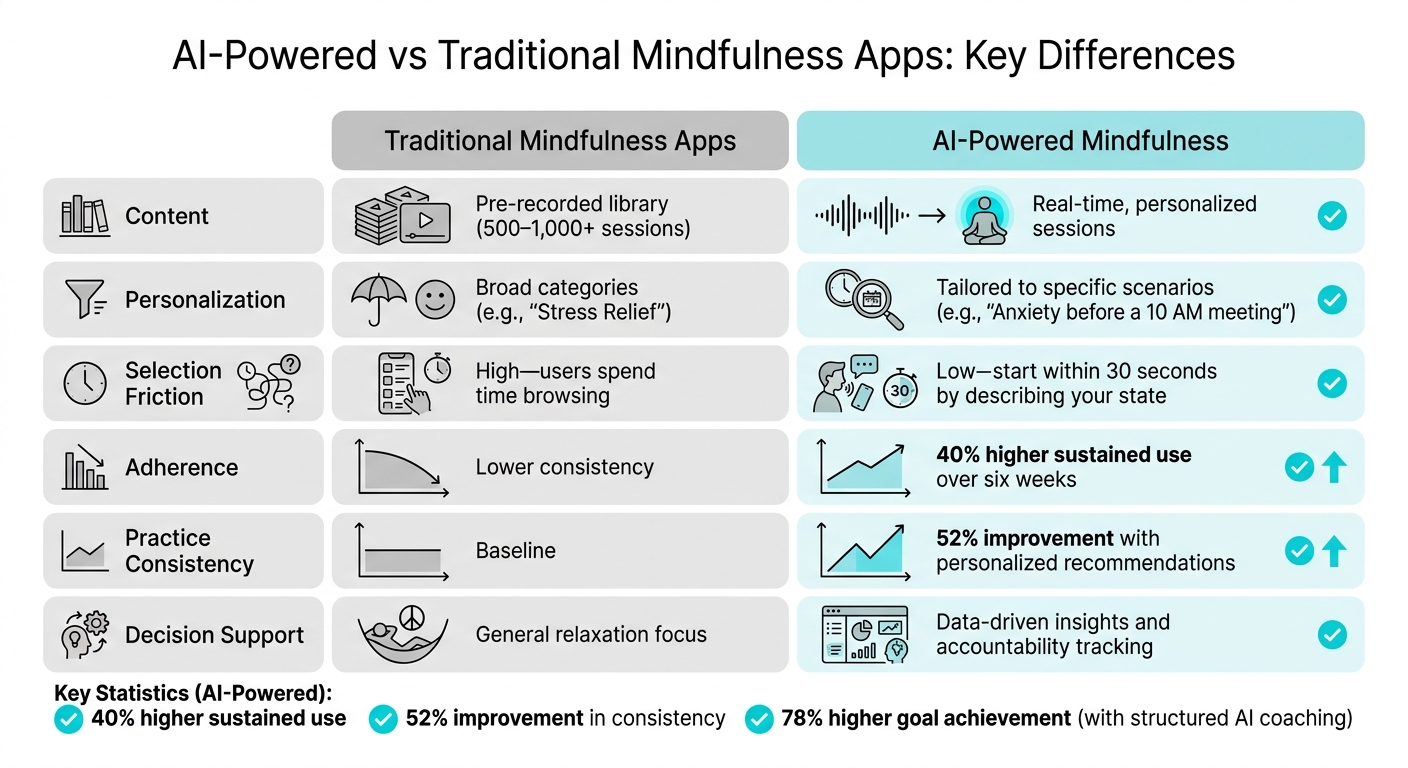
AI-Powered vs Traditional Mindfulness Apps Comparison
Scientific research continues to shed light on how mindfulness impacts decision-making, building on its well-documented benefits for brain health.
Research on Mindfulness and Decision-Making
Mindfulness has been shown to rewire the brain by strengthening the connection between the prefrontal cortex and the amygdala [1]. This improved neural pathway helps create a moment of pause when stress triggers a cortisol spike, a process referred to as cognitive flexibility [1]. This mechanism explains how mindfulness enhances decision-making under pressure. AI tools leverage these insights, tailoring mindfulness practices to fit an individual’s cognitive profile, which can improve decision-making speed and accuracy.
Evidence supports mindfulness meditation’s effectiveness in reducing anxiety by 30–40% for those with anxiety disorders and decreasing depression relapse rates by 43% compared to standard care [5]. Additionally, individuals with higher mindfulness levels are less likely to fall prey to cognitive biases, such as confirmation bias or the sunk cost fallacy [8].
How AI Accelerates Results
AI-powered mindfulness tools take these benefits further by personalizing the experience. For instance, a study led by Amena Begum Sumi at the University of Dhaka studied 312 adults using AI-enhanced Mindfulness-Based Cognitive Behavior Therapy. The findings were impressive: depression scores dropped from 15.9 to 10.4, anxiety scores from 14.7 to 9.8, and mindfulness skills improved from 3.1 to 3.7 [11]. AI achieves this by matching specific techniques – like grounding exercises for performance anxiety or progressive relaxation for better sleep – to the user’s real-time emotional state, making interventions more impactful.
Comparing AI-Powered and Traditional Mindfulness
| Feature | Traditional Mindfulness Apps | AI-Powered Mindfulness |
|---|---|---|
| Content | Pre-recorded library (500–1,000+ sessions) | Real-time, personalized sessions [5] |
| Personalization | Broad categories (e.g., "Stress Relief") | Tailored to specific scenarios (e.g., "Anxiety before a 10 AM meeting") [5] |
| Selection Friction | High – users spend time browsing | Low – start within 30 seconds by describing your state [5] |
| Adherence | Lower consistency | 40% higher sustained use over six weeks [5] |
| Consistency | Baseline | 52% improvement with personalized recommendations [5] |
| Decision Support | General relaxation focus | Data-driven insights and accountability tracking [9] |
Platforms like Aidx.ai combine personalized mindfulness with structured accountability, including written goals and weekly progress tracking. This approach has been shown to increase goal achievement by 78% [9]. By bridging the gap between intention and action, AI-powered tools empower users to make quicker, more confident decisions through tailored and data-driven mindfulness practices.
Conclusion: Make Faster, Smarter Decisions with AI Mindfulness
Key Benefits Summary
AI-powered mindfulness offers clarity in moments, helping you tackle tough emails, challenging conversations, and other stressors without weeks of overthinking. In just one session, you can approach situations with a clearer, more focused mind[4].
Science supports these results: practicing mindfulness consistently for eight weeks has been shown to increase gray matter density in the prefrontal cortex. This is the part of the brain responsible for decision-making and sound judgment[1]. With AI, these benefits are amplified by personalizing techniques to fit your current mental state[1][3]. This means you can spot signs of burnout early, address hidden biases, and develop the mental flexibility to respond thoughtfully instead of reacting impulsively.
Accountability plays a big role in achieving success. Studies show that adding action steps and regular accountability to written goals can lead to 78% higher achievement rates[4]. AI platforms streamline this process by turning vague goals into clear, actionable roadmaps.
Best of all, these benefits are easy to incorporate into your day with quick, daily practices that fit naturally into your routine.
Getting Started with AI Mindfulness
You don’t need to overhaul your schedule to get started. Dedicate just five minutes during moments like your morning coffee or commute to practice the STOP Technique: Stop, take a breath, observe, and proceed[2]. It’s a simple way to bring mindfulness into your day.
Ready to take the first step? Aidx.ai offers a free Starter Plan that includes life coaching, roadmap tracking, weekly accountability reports, and stress insights – no credit card required. For expanded access, including business and performance coaching modes, the Monthly Plan is available for $29.99/month or $24/month when billed annually at $288[4].
As psychologist Vera Martins shared:
"It was amazing to see how Aidx managed the specificities of the issue so well"[4]
With tools grounded in proven methods like CBT, DBT, and ACT, combined with 24/7 accessibility and an accountability structure, Aidx.ai is designed to help you find clarity whenever you need it.
FAQs
What data does AI mindfulness use to detect stress in real time?
AI mindfulness relies on biometric sensors such as heart rate variability (HRV), galvanic skin response (GSR), and electrodermal activity (EDA). These sensors measure physiological markers that are directly connected to stress levels, making it possible to detect stress in real time.
How fast can AI-guided mindfulness help me make clearer decisions?
AI-guided mindfulness offers a way to sharpen decision-making by boosting mental clarity and emotional awareness, even during high-pressure moments. It encourages a deliberate pause, allowing you to assess situations and respond thoughtfully rather than reacting on impulse. With regular practice woven into your daily life, this approach can lead to quicker, more confident choices. While the timeline for results may differ from person to person, consistent mindfulness practice proves especially helpful in navigating high-stress scenarios with greater ease.
Is my personal data private when using Aidx.ai?
Your personal data is safe with Aidx.ai. All conversations are encrypted, never sold or shared, and no one – human or otherwise – accesses them. Plus, you have the option to delete all your data whenever you want, giving you full control over your information.