
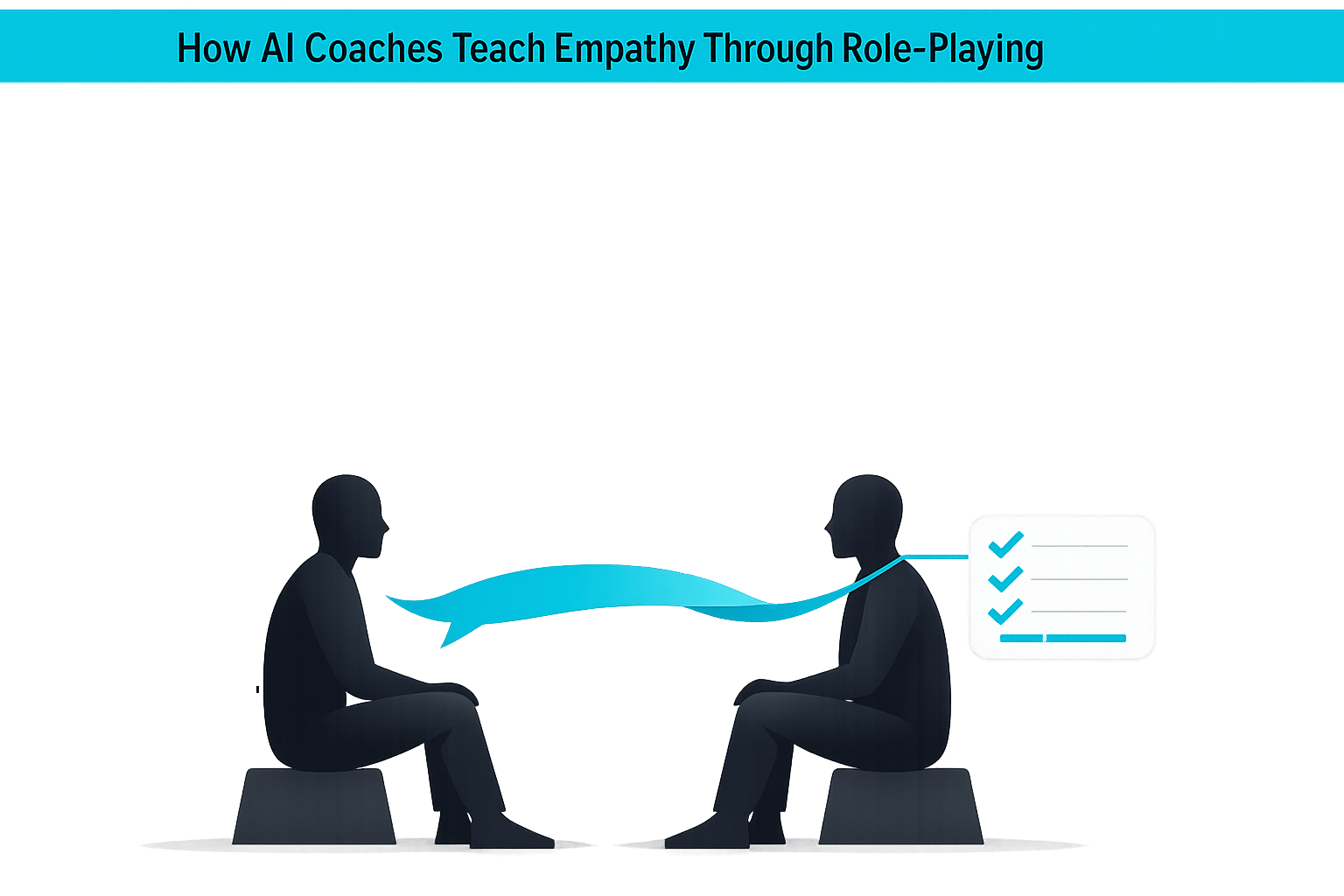
AI tools like Aidx.ai are changing how people improve empathy skills. By simulating tough conversations with AI personas, you can practice handling emotional situations, resolving conflicts, and supporting others effectively. Unlike traditional role-playing, which can be time-consuming and subjective, AI offers consistent, instant feedback. It helps you identify where conversations go wrong and refine your approach using evidence-based techniques like CBT, DBT, and ACT.
Key Features:
- Real-Time Feedback: AI highlights areas for improvement instantly.
- Dynamic Scenarios: Practice with personas that adapt to your words and tone.
- Progress Tracking: Monitor growth and adjust goals with measurable insights.
- Flexible Access: Practice anytime with plans starting at $0 for basic use.
Whether you’re preparing for a tough work conversation or navigating personal challenges, Aidx.ai provides a safe, judgment-free space to build empathy.
The Science of Empathy and Role-Playing
Cognitive vs. Affective Empathy
Empathy is built on two key skills. Cognitive empathy involves understanding the "who" and "what" of a situation – grasping a person’s background, their limitations, and the reasoning behind their actions. It’s the skill that helps you figure out why someone might resist change or hold a specific viewpoint, whether in a workplace or personal setting.
Affective empathy, on the other hand, is about connecting with and responding to someone’s emotional state. This ability is what helps you stay composed when, for example, you receive a harsh email from a client or when a colleague vents their frustrations. It allows you to manage your own emotions while staying in tune with theirs.
AI tools are now blending these two types of empathy. Platforms like Aidx.ai use features such as personas and Mood Sliders (e.g., Friendly, Skeptical, Combative), along with a Mood Matrix, to model emotional shifts based on how you interact. These tools are designed to sharpen both cognitive and affective empathy, making role-playing exercises more realistic and impactful. By combining these skills, Aidx.ai creates scenarios that bring empathy to life in a practical, hands-on way.
Why Role-Playing Builds Empathy
Role-playing is a powerful way to understand how your words affect others. With AI, you can see this in action. For instance, if you dismiss someone’s concerns or use an abrasive tone, the AI’s "Combative" slider will jump, showing you the immediate emotional impact of your approach.
"If you genuinely listen, ask smart follow-ups, and acknowledge what the client went through with the last vendor, they warm up. They talk more. They’re less suspicious."
- Alex Radulovic, PurpleOwl
One of the biggest advantages of AI role-play is its flexibility. You can repeat a challenging conversation as many times as you need, experimenting with different responses to shift the mood from skeptical to friendly. Unlike traditional training, which might take a week of a manager’s time for just a few hours of practice per team member, AI offers unlimited, on-demand sessions. Plus, it eliminates bias and scheduling conflicts, making it a practical tool for empathy training. Aidx.ai demonstrates how interactive role-play can transform the way we develop and apply empathy in real-world scenarios.
sbb-itb-d5e73b4
AI Role Playing with Expressive Understanding: Coaching
How Aidx.ai Helps You Practice Empathy

Aidx.ai turns empathy training into an interactive experience. Instead of just learning theories, you engage in simulated conversations with AI personas that adapt to your responses in real time. These dynamic exchanges mimic actual human interactions, helping you practice empathy in a more realistic way.
The platform uses a variety of personas and scenarios – like conflict resolution or emotional support – so you can refine your communication skills. For example, you might practice supporting someone under stress, but the approach will differ based on the persona. One might be skeptical and reserved, while another could be more open and emotional. This setup pushes you to tailor your responses to fit the situation and personality.
Role-Play Scenarios in Aidx.ai
Aidx.ai’s Life Mode offers scenarios designed around tough conversations. These include situations like validating someone’s emotions without being dismissive, resolving disagreements calmly, or helping someone navigate a major life change. These scenarios mirror real-life complexity, where your tone and word choice carry as much weight as your intentions. Plus, adjustable mood indicators show how your responses impact the emotional tone of the conversation.
Real-Time Feedback on Your Responses
Throughout your session, Aidx.ai provides instant feedback, acting like a supportive coach to help you refine your approach. This real-time guidance strengthens both cognitive and emotional empathy skills by using proven frameworks such as Cognitive Behavioral Therapy (CBT), Dialectical Behavior Therapy (DBT), and Acceptance and Commitment Therapy (ACT). Techniques like paraphrasing, reflection, and emotional validation are emphasized.
If you miss an opportunity to validate someone’s feelings or jump too quickly into problem-solving, the AI points it out and suggests alternative ways to respond. This trial-and-error approach lets you test different strategies until you find what works best.
Studies show that practicing with AI avatars can boost confidence in applying interpersonal skills in real-life situations by up to 275% [3].
Tracking Your Empathy Development
Aidx.ai also tracks your progress through its Insights Engine, which monitors patterns in your conversations, stress levels, and emotional well-being. This data helps ensure your practice translates into measurable improvements. The Visual Roadmap feature lays out your development step-by-step, showing where you started, what you’ve worked on, and where you’re heading next.
To keep you accountable, the platform sends automated weekly updates – every Monday – to a trusted friend or family member. Research incorporated into the system shows that combining written goals, actionable steps, and regular accountability boosts goal achievement rates by 78% [1].
How to Practice Empathy with Aidx.ai
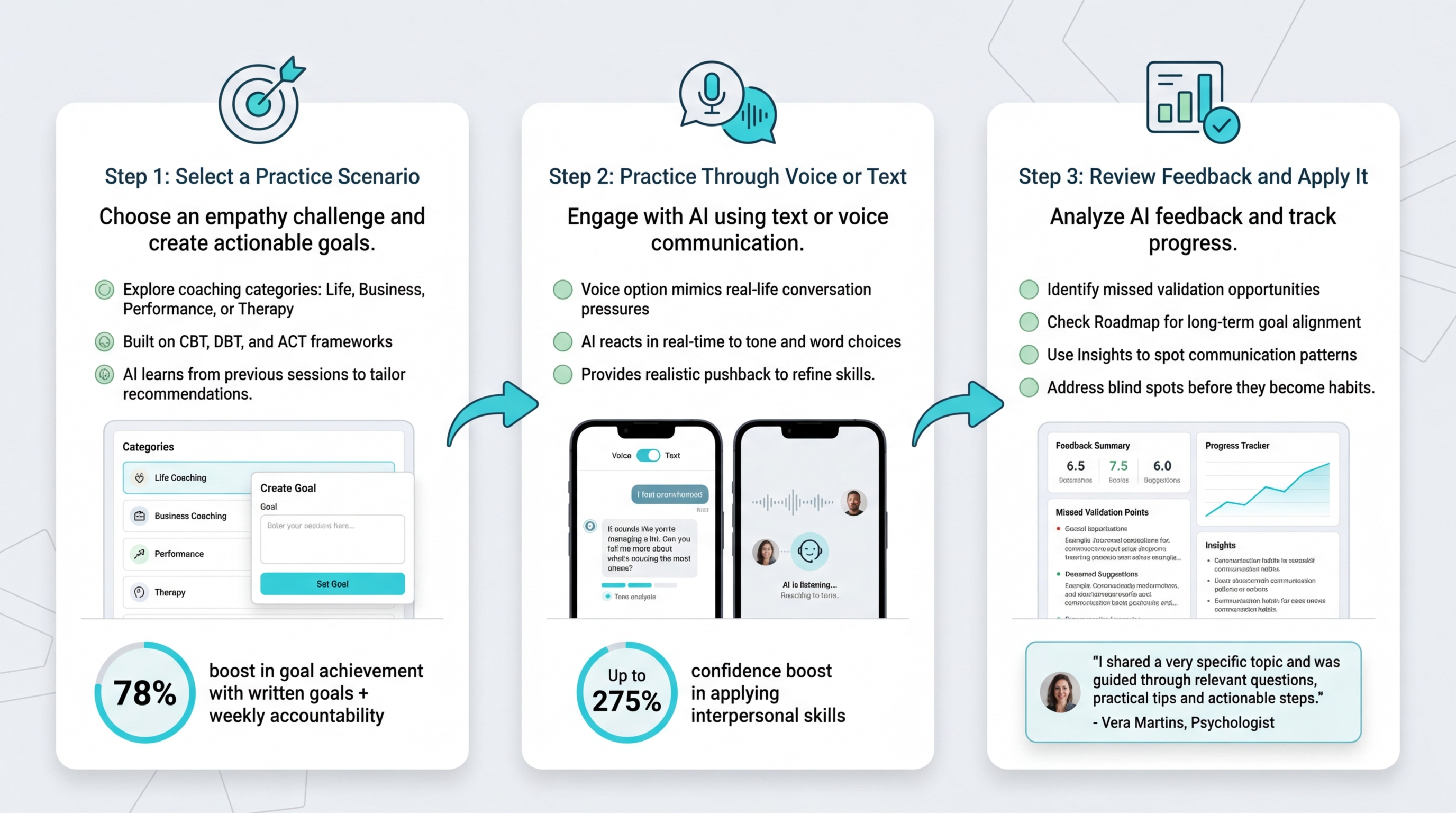
3-Step Process for Practicing Empathy with AI Role-Playing
Aidx.ai uses role-play techniques to help you sharpen your empathy skills. With its Roadmap feature, the platform transforms vague goals like "be more empathetic" into clear, actionable steps. This structured method is grounded in research, which shows that setting written goals with specific action plans and weekly accountability can boost goal achievement by 78% [1].
Step 1: Select a Practice Scenario
Start by choosing an empathy challenge and turning it into a well-defined, actionable goal using the Roadmap. You can explore coaching categories like Life Coaching, Business Coaching, Performance Coaching, or Therapy. Each scenario is built on evidence-based frameworks such as CBT, DBT, and ACT, ensuring you’re practicing with clinically supported methods [1].
What’s even better? The AI learns from your previous sessions, tailoring its scenario recommendations based on your history and current objectives [1]. Once you’ve chosen a scenario, you’re ready to dive into real-time practice.
Step 2: Practice Through Voice or Text
Next, engage with the AI using text or voice communication. The voice option stands out for empathy training because it mimics the pressures and subtleties of real-life conversations [1]. The AI reacts in real time, adjusting to your tone and word choices. It provides realistic pushback when needed, helping you grasp how your words emotionally impact others [1][4].
The dynamic interaction is designed to refine your interpersonal skills. Studies indicate that practicing with AI avatars can boost confidence in applying these skills in real-life situations by up to 275% [3].
"I shared a very specific topic and was guided through relevant questions, practical tips and actionable steps. The process was very natural and, above all, it was very useful." – Vera Martins, Psychologist & Business Owner [1]
Step 3: Review Feedback and Apply It
After practice, review the AI’s feedback to identify missed opportunities for validation or moments where you may have rushed to problem-solving. The platform offers immediate, evidence-based guidance to help you improve.
Check your Roadmap to see how your session aligns with your long-term empathy goals [1]. Additionally, the Insights feature highlights patterns in your communication that might hinder empathy, helping you address these blind spots before they become ingrained [1].
Common Empathy Practice Scenarios
Aidx.ai focuses on teaching empathy through real-life situations that enhance emotional understanding. The platform incorporates a "Mood Matrix" system where the AI’s responses shift based on how you interact. For instance, validating emotions can make the AI more receptive, while dismissing feelings or rushing to solutions might lead to increased resistance. This system mimics how people react when emotional cues are either acknowledged or overlooked. Let’s dive into some scenarios designed to sharpen your empathetic skills.
Scenario 1: Supporting Someone Under Stress
When someone feels overwhelmed, they’re not looking for instant fixes – they want to be heard. In this scenario, the AI portrays someone juggling work stress, family issues, or personal struggles. Your task is to stay present and resist the urge to jump into problem-solving. The AI begins with mood traits like "Reserved" or "Chaotic", and your goal is to practice active listening and validate their feelings. Doing so helps the AI persona become more open and approachable. On the flip side, offering generic advice or downplaying their emotions causes the AI to withdraw. Afterward, you can review a mood timeline that pinpoints where your actions built rapport or created distance.
Scenario 2: Handling Conflicts with Empathy
Conflict situations challenge your ability to balance understanding with maintaining boundaries. Aidx.ai sets up scenarios where the AI starts off skeptical or confrontational. Your job is to reduce tension without becoming defensive. The AI reacts in real-time to your tone and word choices, encouraging you to fine-tune your delivery under pressure. By acknowledging the other person’s perspective before presenting your own, you can observe how your actions either calm the situation or escalate it.
Scenario 3: Helping Someone Through Transitions
Big life changes – like career shifts, breakups, or health issues – require a deeper level of empathy. In these scenarios, the AI engages in conversations filled with vulnerability, reflecting emotions like uncertainty or resistance. The challenge is to ask thoughtful follow-up questions rather than jumping in with reassurances too soon. The AI monitors whether you’re able to uncover hidden concerns or if you stay on the surface. You can replay these scenarios as often as needed, allowing you to refine your approach until you get it just right – like mastering a challenging level in a game.
Conclusion
Empathy is a skill that grows stronger with consistent effort and practice. Through realistic role-playing scenarios, you can develop the ability to navigate challenging conversations effectively. Aidx.ai offers a platform where your words directly shape outcomes, showing how acknowledging stress can open up meaningful dialogue, while dismissing emotions can shut it down. With instant feedback, it becomes easier to refine your communication skills in a practical way.
The results speak for themselves. Users report being able to process difficult emotions in minutes, avoiding the all-too-common spiral of losing entire days to anxiety. This steadiness translates into smoother personal and professional interactions, with friends, family, and colleagues noticing a more composed and thoughtful approach to conflict resolution [1]. The more you engage with Aidx.ai’s "boss fight" scenarios, the more these responses become second nature in real-life situations [2].
This shift is something users have experienced firsthand:
"Aidx has been surprisingly human in identifying problems & asking the right questions. But faster! I got sucked into the conversation like I was talking to an educated & empathetic therapist." – Hali Holeszowski, Mobility Coach & Founder [1]
Whether you’re working through workplace challenges or navigating personal changes, the ability to stay present and respond with understanding can make all the difference. Aidx.ai provides a safe environment to experiment, revisit conversations, and fine-tune your approach – without the pressure of real-world consequences. Plus, with options like the free Starter Plan for weekly practice or the $29.99/month plan for unlimited access, it’s easy to fit into your schedule [1].
With regular, structured practice, empathy can become second nature. Aidx.ai helps make that transformation both measurable and achievable.
FAQs
How does AI role-play actually build empathy?
AI role-playing creates a space where users can engage with realistic and challenging scenarios, allowing them to practice responding to a variety of emotional cues and perspectives. This kind of interaction offers a safe way to explore and understand others’ feelings, helping develop more compassionate and thoughtful responses.
Tools like Aidx.ai take this a step further by tailoring interactions based on user behavior. They provide personalized feedback and use proven techniques to encourage empathetic communication. With repeated practice, users can build stronger emotional awareness, which translates into better communication, healthier relationships, and a deeper understanding of social dynamics in everyday life.
What should I practice first for a hard conversation?
Start by focusing on self-awareness and managing your emotions. Take time to recognize your feelings and identify what might trigger them, so you can approach the conversation with a calm and clear mindset. Tools like Aidx.ai can be incredibly helpful here. They use proven methods like Cognitive Behavioral Therapy (CBT) and Acceptance and Commitment Therapy (ACT) to help you better understand and regulate your emotions while improving how you communicate.
Another great way to prepare is through role-playing with AI. By simulating challenging scenarios, you can practice your responses, refine your approach, and gain confidence before tackling the actual conversation.
How do I know I’m improving over time?
You can monitor your progress by analyzing measurable data such as goal achievements, stress levels, burnout risks, and emotional well-being patterns. With Aidx.ai’s progress tracking tools and visual roadmap features, these insights are presented in a way that makes it easy to understand how far you’ve come and where you’re headed.