
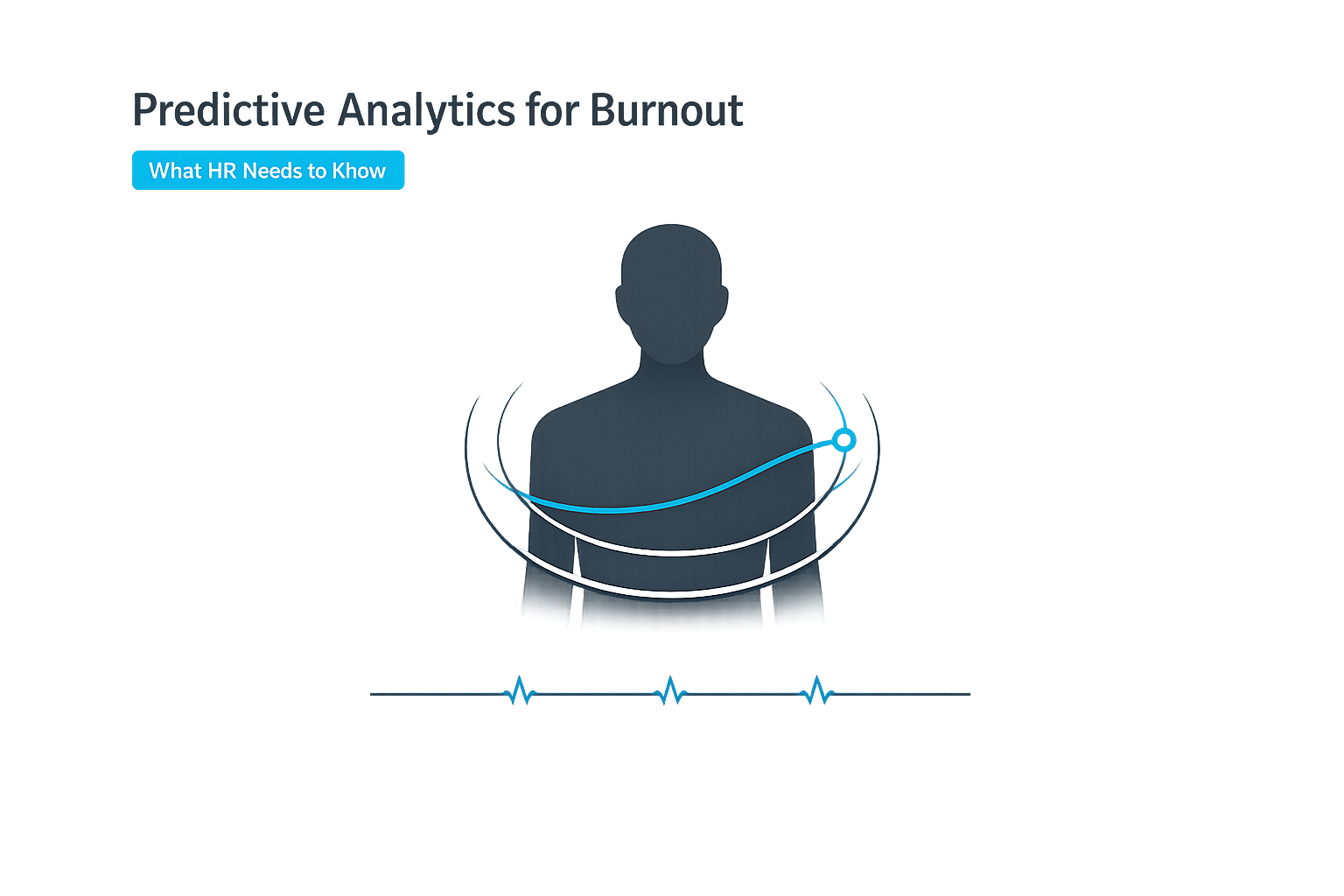
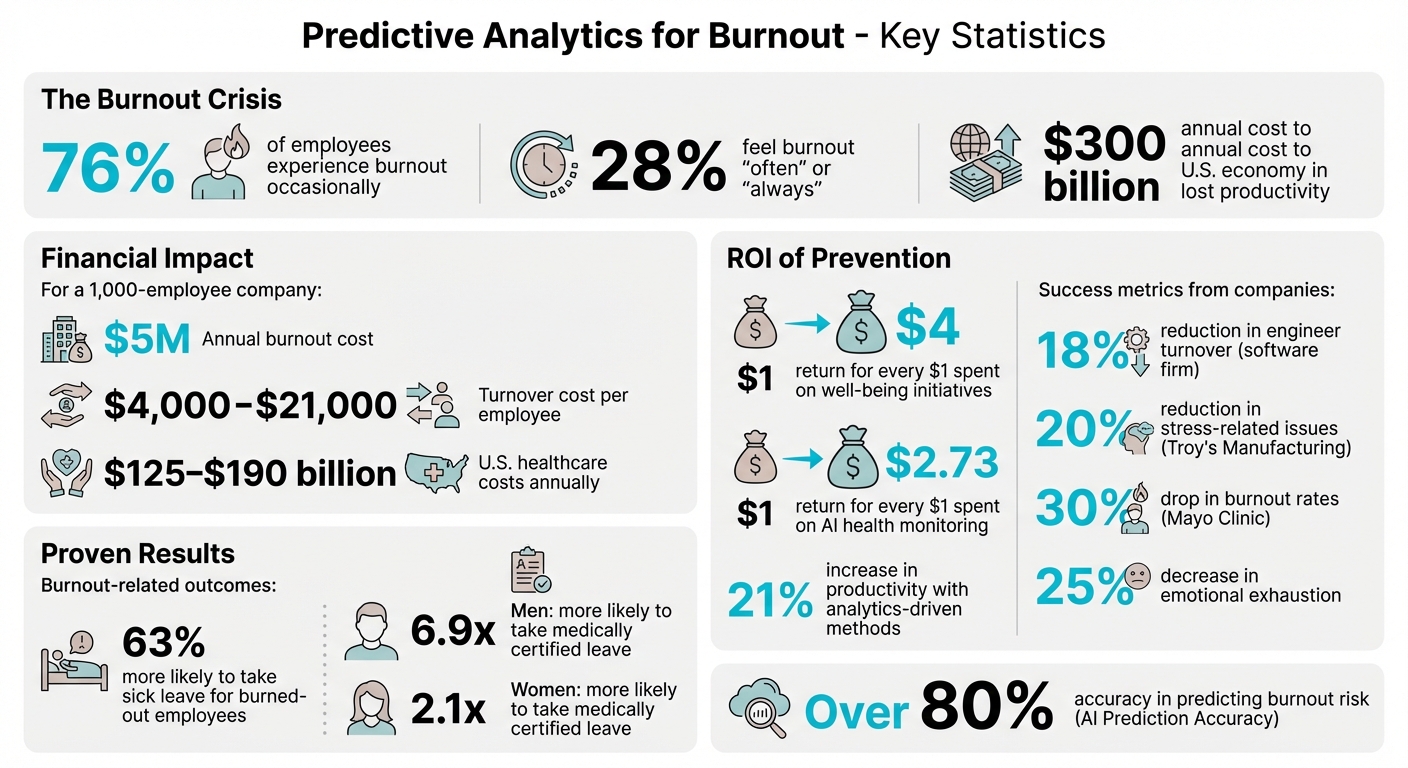
Burnout is a growing concern for organizations, with 76% of employees experiencing it occasionally and 28% feeling it "often" or "always." The financial toll is significant, costing U.S. companies millions annually. Traditional HR methods often detect burnout too late, but predictive analytics offers a proactive solution. By analyzing patterns like after-hours work, slower response times, and absenteeism, companies can identify burnout risks months in advance and take action.
Key takeaways:
- Burnout costs: $5M annually for a 1,000-employee company.
- Turnover costs: $4,000–$21,000 per employee.
- Predictive analytics benefits: Uses real-time data (emails, workload, HR records) to spot early burnout signs.
- ROI on well-being initiatives: $1 spent = $4 return via productivity and fewer absences.
Predictive tools analyze communication, workload, and HR data to detect stress indicators like overtime, skipped breaks, or negative communication tone. AI systems assign risk scores, enabling timely interventions such as workload adjustments or wellness programs and AI coaching. Companies integrating these tools have reported reduced turnover and improved employee well-being, proving that addressing burnout early is both effective and cost-efficient.
Burnout Statistics and ROI of Predictive Analytics for HR Teams
Predicting Employee Turnover with AI Data Analytics with Tyler Hochman
sbb-itb-d5e73b4
How Predictive Analytics Detects Early Burnout Signs
Predictive analytics keeps a close eye on digital footprints – like emails, project management tools, HR records, and communication apps – to spot early signs of burnout before they spiral out of control. The system establishes a baseline for each employee, tracking their usual work hours, response times, and meeting loads. When deviations occur – like someone who typically logs off at 6:00 PM suddenly sending emails at 11:00 PM for several days in a row, or an increase in errors on routine tasks – the system flags these as potential warning signs. These subtle deviations help pinpoint areas for concern that might otherwise go unnoticed.
Data Sources for Burnout Detection
Predictive systems rely on a variety of data points to build a detailed view of an employee’s well-being. Communication patterns are a key source of insight. For instance, email and chat activity, response times, and even the tone of written messages (analyzed through sentiment analysis) can provide clues. A shift toward negative language or reduced participation in virtual meetings might hint at emotional fatigue.
Workload-related data offers another critical perspective. These systems track start and end times, after-hours or weekend logins, and whether employees are skipping breaks. A packed calendar full of back-to-back meetings, leaving no breathing room, is a major red flag for burnout. Other indicators include declining work quality, more frequent errors, and missed deadlines.
HR and behavioral metrics complete the picture. Patterns like unplanned absences, increased sick leave, or underutilized vacation days can signal trouble. A drop in engagement with professional development opportunities might also point to early signs of disengagement. Some platforms even measure "context switching" – how often someone jumps between different apps – as an indicator of mental strain.
| Data Category | Specific Metrics Tracked |
|---|---|
| Communication | Email/chat volume, response times, sentiment/tone, meeting input |
| Work Habits | Overtime hours, weekend logins, skipped breaks, start/end times |
| Performance | Task completion rates, error frequency, deadlines, quality scores |
| HR/Admin | Absences, sick leave, vacation usage, turnover trends |
Analysis Methods for Burnout Prediction
Machine learning plays a central role in identifying patterns that suggest burnout risk. For example, three straight weeks of high overtime paired with low meeting attendance might automatically trigger a managerial alert. Natural Language Processing (NLP) adds another layer by analyzing emails, chat messages, and survey responses for shifts in tone – such as rising frustration or cynicism – that could indicate emotional exhaustion.
Advanced platforms assign dynamic risk scores that update in real time. When an employee’s score crosses a certain threshold, managers are notified with detailed insights, allowing HR teams to step in with tailored support. This proactive approach means intervention happens before burnout becomes a serious issue.
"AI doesn’t just flag risk, it continuously learns from engagement patterns, helping HR teams refine policies and culture in real-time."
- Jenny Kiesewetter, Cangrade
Wearable devices also contribute valuable physiological data to enhance burnout detection.
Additional Data from Wearable Devices
Some companies have started integrating wearable data – like heart rate variability, sleep patterns, and ECG readings – into their burnout detection systems. These devices can reveal stress levels that traditional methods might miss.
Take Troy’s Manufacturing Company, for example. By combining wearable health data with production schedules and HR records, they reduced stress-related issues by 20% [1]. Similarly, a large software firm monitored coding activity and sprint workloads alongside after-hours communication patterns, cutting engineer turnover by 18% in just one year [2].
The real-time nature of wearable data is its biggest strength. Instead of waiting for employees to self-report feeling overwhelmed, these systems can identify physiological signs of stress early. Managers can then take action – like redistributing tasks or offering recovery days – before burnout fully sets in. By blending digital and physiological data, organizations get a more complete view, enabling them to manage burnout proactively.
Burnout Indicators HR Teams Should Track
Keeping an eye on the right metrics is crucial for identifying burnout before it spirals into a bigger issue. HR teams should focus on measurable indicators that reveal early signs of burnout, allowing for timely intervention.
Workload and Productivity Metrics
Employees working over 40 hours a week are more likely to experience burnout. Late-night work – especially after 9:00 PM – or shifts longer than 10 hours can hinder their ability to mentally detach from work, a key factor in maintaining psychological well-being [2].
Another important metric is the balance between uninterrupted focus time and meeting hours. Studies suggest that knowledge workers need at least 3.5 to 4 hours of uninterrupted focus time daily to maintain productivity [10]. Signs of mental fatigue can also show up as slower response times – about 25% slower than usual – or a drop in meaningful output per hour [10].
Other red flags include rising rework and error rates, missed deadlines, and declining task completion compared to historical performance. For instance, NHS Scotland reported a 15% reduction in burnout during high-stress periods by implementing better systems, while Deloitte saw a 30% drop in overwhelm by introducing flexible work policies and digital detox initiatives [1].
Beyond workload, changes in communication habits can also signal burnout.
Engagement and Communication Patterns
Shifts in how employees communicate and engage can reveal stress long before exhaustion becomes obvious. For example, a sudden drop in proactive communication often points to underlying issues [10].
If an employee’s meeting participation drops by 20–40% or their contributions noticeably decline, it’s worth investigating further [11][2]. Tools like Natural Language Processing (NLP) are increasingly being used to analyze changes in sentiment and tone within written communications. A rise in negativity or cynicism, paired with reduced communication overall, often precedes visible burnout symptoms [10][7][4].
For example, the tech company Gorgias used leadership analytics and the Coachello coaching platform to support its distributed teams, achieving a 60% boost in employee motivation and a 75% increase in perceived growth [11].
"Burnout is not a failure of individual resilience but a failure of organisational design" – Harvard Business Review [11]
These communication and engagement patterns provide another layer of insight for addressing burnout early.
Absenteeism and Attendance Patterns
Absenteeism trends are another key indicator of burnout. A sudden rise in unplanned or short-term absences often signals emotional fatigue, with burned-out employees being 63% more likely to take sick leave [12][8].
Ignoring vacation time is another warning sign. Employees who consistently skip holidays or fail to use their annual leave are at greater risk of burnout [8][7]. Dashboards that track leave usage can highlight these patterns and help managers intervene early.
Team-wide spikes in absenteeism can point to systemic issues, such as uneven workloads or poor management practices [12][8]. Severe burnout can lead to even more concerning trends – men experiencing burnout are 6.9 times more likely, and women 2.1 times more likely, to take medically certified sick leave in the future [10]. Withdrawal behaviors, like skipping meetings or avoiding voluntary activities, often appear before formal absenteeism patterns emerge [10][7].
| Metric Pattern | Potential Burnout Risk |
|---|---|
| High Overtime + Low Engagement | High Risk |
| Stable Output + Rising Absenteeism | Moderate Risk |
| Declining Performance + Low Feedback Participation | High Risk |
| Frequent Short-term Leave + High Rework Rate | High Risk |
HR teams can also use automated alerts to catch early warning signs. For instance, if an employee’s hours increase by 20% while their participation in other activities drops, it’s a clear signal to investigate [3]. By integrating attendance, performance, and engagement data into a unified HRMS, teams can better distinguish between temporary workload spikes and genuine burnout risks [12][7][3].
These combined metrics offer a well-rounded approach to spotting burnout early and taking proactive steps to support your team and address it.
Setting Up Burnout Alerts and Manager Responses
Once HR teams pinpoint the right metrics, the next step is to turn that data into actionable strategies. The focus is on catching burnout early, setting up alert systems that notify the right people at the right time, and equipping managers to step in effectively.
Creating Burnout Alert Systems
A well-designed alert system pulls data from multiple sources – HRMS, project management tools, emails, and chats – into a single dashboard. This consolidated view helps identify patterns that might not stand out when looking at isolated metrics. For instance, working late hours might not raise concerns on its own, but when paired with declining participation in training and increased absenteeism, it signals a more serious issue [3].
To make these systems effective, set clear risk thresholds. For example, a 20% increase in overtime over three weeks combined with lower team engagement could trigger an alert. AI models play a key role here, predicting burnout with over 80% accuracy [3][13].
"AI highlights patterns, but managers provide context. A short-term project deadline may explain higher hours, while other cases require closer attention." – KnowledgeCity [3]
These alerts enable timely and informed managerial interventions.
Manager Intervention Strategies
Once alerts are in place, the next step is for managers to act based on the data. When an alert is triggered, managers should assess whether the issue stems from a temporary workload spike or a longer-term trend [3]. Responses can then be tailored to the severity of the alert. For moderate concerns, a quick check-in like, "How’s your workload feeling lately?" might suffice. For higher-risk situations, more direct actions – such as redistributing tasks, offering flexible schedules, or mandating recovery days – may be needed [3][9].
Another effective strategy is automating repetitive tasks for employees flagged by the system. This reduces mental strain and allows them to focus on more meaningful work [6]. For example, an IT software company used AI to monitor coding activity, sprint workloads, and after-hours communication. By responding to burnout alerts with adjusted timelines and recovery days, they reduced engineer turnover by 18% in just one year [2].
Transparency is essential. Employees should know that these interventions are based on objective data – like increased overtime or skipped breaks – rather than subjective opinions [3].
Real Examples of Burnout Prevention Programs
Several companies have successfully implemented predictive burnout systems with tangible results. Unilever trained over 4,000 employees as "Mental Health First Aiders" to provide peer support. Paired with proactive monitoring, this initiative improved employee mental well-being scores by 35% [1].
At Mayo Clinic, machine learning was used to analyze wellness data and burnout symptoms, leading to a 30% drop in reported burnout rates [1]. Similarly, InnovateX, a tech startup, identified absenteeism and engagement patterns through machine learning. By tailoring wellness programs to these insights, they reduced unscheduled absences by 30% within a year [1].
The financial benefits are clear too. Every $1 invested in mental health initiatives generates a $4 return through increased productivity and reduced absenteeism [2]. Companies using AI for health monitoring see a return of about $2.73 for every $1 spent [6]. Considering burnout costs the U.S. economy an estimated $300 billion annually in lost productivity [13], these programs make both business and personal sense.
Training managers in Mental Health First Aid is another crucial step. Leaders equipped to respond to AI alerts with empathy and understanding are key to these programs’ success [1]. The goal is to combine human support with data-driven insights, creating a safety net that enhances, rather than replaces, personal interactions.
Creating Personalized Wellness Plans from Predictive Data
Customizing Support for Individual Employees
With predictive analytics, HR teams can now move beyond generic wellness strategies and craft solutions tailored to individual employee needs. By assigning risk scores, the system evaluates behavioral data – like frequent overtime, communication tone, or packed meeting schedules – to pinpoint specific areas where support is needed [2][7]. Instead of a one-size-fits-all approach, these insights enable targeted interventions. For instance, an employee overwhelmed by back-to-back meetings might benefit from workload adjustments, while someone showing signs of negativity in emails could be offered mindfulness or mental health resources [4][7].
Automated nudges also play a key role. When high stress is detected, the system can suggest timely actions, such as encouraging an employee to log off after multiple late-night sessions or directing them to relevant wellness tools when their digital habits shift [4]. Real-world examples highlight the impact: IBM reduced turnover in high-risk departments by 20% by integrating psychological data with performance metrics [14]. Similarly, Deloitte’s data-driven well-being initiatives, which addressed mental health concerns flagged by predictive tools, led to a 15% improvement in performance metrics [14].
Managers benefit from this data too, receiving tailored recommendations to support their team members effectively [3][4]. For example, they might adjust an employee’s workload or training schedule based on flagged risks [3]. To ensure ongoing success, it’s essential to track how well these personalized strategies are working and refine them over time.
Tracking Wellness Program Results
Measuring the success of personalized wellness plans is critical. Metrics like participation rates in suggested resources, changes in employee sentiment post-intervention, and ROI analyses help gauge effectiveness. For example, Target used predictive analytics to monitor scheduling patterns, attendance, and employee feedback, resulting in a 20% productivity boost and a 10% drop in turnover within just one year [14].
Advanced systems take it a step further by creating a continuous feedback loop. This means data from intervention outcomes is fed back into the predictive model, improving future recommendations [3][7]. Over time, this process identifies the most effective resources for different employee groups – whether it’s flexible work options, digital detox programs, or restructured workloads. Companies using these analytics-driven methods have reported a 21% increase in productivity and significant reductions in attrition [14].
"AI doesn’t just flag risk, it continuously learns from engagement patterns, helping HR teams refine policies and culture in real-time." – Jenny Kiesewetter, Cangrade [4]
Building a Long-Term Burnout Prevention Framework
Gradual Implementation Approach
Rolling out predictive analytics to address burnout requires careful planning and step-by-step execution. Start by identifying measurable indicators of burnout risk. These could include data points like a 20% rise in overtime hours over three weeks, reduced participation in training sessions, more unplanned absences, or noticeable changes in communication tone [3][8]. Centralizing these data streams – whether from HR systems, project management tools, or communication platforms – into a unified dashboard is critical [3].
Once the data infrastructure is in place, set up alert triggers with clear thresholds. These should be fine-tuned over time to minimize false positives and ensure accuracy [3][9]. Use the insights from these alerts as conversation starters for managers to assess whether an issue stems from a one-off deadline or points to ongoing stress [3][8][11]. Tailor interventions to individual needs instead of relying solely on broad wellness programs. For instance, strategies like redistributing tasks or offering flexible schedules can be far more effective [5][7][11].
Regularly evaluate the success of these interventions and feed the results back into the AI system. This continuous improvement loop sharpens detection and response over time [3]. Take the example of FatCat Coders, a remote-first company that, in May 2025, analyzed workforce data to find that their top performers worked best during six-hour focused windows. By introducing a company-wide six-hour workday, they managed to sustain productivity while reducing fatigue [5].
This methodical rollout lays the groundwork for integrating deeper mental health initiatives into the system.
Combining Analytics with Mental Health Programs
Once the analytics system is running smoothly, the next step is to link it with mental health resources. Predictive analytics works best when paired with existing support systems, shifting the focus from treating symptoms after they appear to redesigning the workplace to prevent them [11]. For example, when the analytics flag a high-risk employee, the system can instantly recommend resources like Employee Assistance Programs (EAPs) or similar mental health tools [7].
These insights also help managers approach employees with empathy before issues escalate. Instead of waiting for performance to decline, real-time data allows managers to ask meaningful questions about workload and well-being [3][8][11]. A great example is Gorgias, a tech company that, in November 2025, combined leadership analytics with the Coachello coaching platform. The results? A 60% increase in employee motivation, a 75% boost in perceived growth, and 98% of participants successfully applying coaching lessons to their daily work [11].
"Burnout is not a failure of individual resilience but a failure of organisational design." – Harvard Business Review [11]
Transparency is key to building trust. Employees need to know what data is being collected and how it will be used to support them, not penalize them. When employees understand the purpose, 59% are more open to supervisor intervention if they’re at risk of burnout, seeing it as an act of care rather than surveillance [15].
Using Aidx.ai for Scalable Burnout Monitoring
For companies aiming to scale personalized burnout prevention, platforms like Aidx.ai offer a privacy-first solution. Aidx.ai uses evidence-based methods – including CBT, DBT, ACT, and NLP – to provide 24/7 AI-powered coaching tailored to individual employee needs. Its Insights feature monitors stress levels, burnout risk, and emotional well-being through ongoing interactions, flagging potential issues early.
Aidx.ai also includes a structured accountability system. Employees can set clear goals, outline actionable steps, and receive weekly progress updates sent to designated contacts. Research shows that having defined goals paired with regular accountability increases success rates by 78%. This system allows employees to address emotional challenges quickly – often in minutes rather than days.
Privacy is at the core of Aidx.ai. Conversations are encrypted, never shared or sold, and no human monitoring is involved. Users can delete all their data at any time, ensuring compliance with GDPR. With plans starting at $29.99 per month, Aidx.ai offers expert-level, personalized support at a fraction of the cost of traditional coaching services.
Conclusion
Predictive analytics is reshaping how HR teams tackle burnout, focusing on prevention before problems spiral out of control. By continuously analyzing work patterns, AI tools can pick up on subtle stress indicators that might otherwise go unnoticed, offering a chance to intervene early and effectively [7]. This shift moves HR from passive observation to taking meaningful, people-focused action.
The financial impact of burnout is staggering. U.S. businesses lose between $125 billion and $190 billion annually to healthcare costs related to burnout. On the flip side, companies using AI-driven health monitoring report a return of approximately $2.73 for every dollar spent [6]. Beyond the numbers, workplaces that adopt these systems have seen a 25% drop in emotional exhaustion and an 18% reduction in employee turnover [6][2].
But technology alone isn’t the answer – it’s just one piece of the puzzle. Employees need to trust the system, which means being transparent about what data is collected and how it’s used to support their well-being. Pairing analytics with real mental health resources and equipping managers with proper training can create a workplace culture where seeking help feels normal. The aim isn’t to replace human support but to enhance it with tools that act as an early warning system, ensuring no one falls through the cracks.
For HR teams, the path forward is clear: identify measurable stress signals, set actionable thresholds, and empower managers with the insights they need to act. Whether overseeing a team of 50 or 5,000, predictive analytics makes it possible to scale burnout prevention while keeping the focus on people.
FAQs
How accurate are burnout prediction models in real workplaces?
Burnout prediction models have demonstrated strong potential in identifying employees who may be at risk, offering a way to step in early and address stress-related challenges. Their effectiveness, however, hinges on the quality of the data they rely on and the specific workplace environment they are applied to. Research indicates that these models can pinpoint at-risk individuals with a high degree of precision, paving the way for timely interventions.
That said, several factors can influence how reliable these predictions are. The depth and breadth of the data, the specific indicators being tracked, and how well the workplace integrates these insights can all play a role. To get the best results, these models should be part of a larger, ongoing employee well-being initiative. Regular updates and validation of the models are crucial to ensure they remain accurate and effective over time.
What data can HR use without violating employee privacy or trust?
HR teams have access to aggregated, anonymized data like productivity trends, attendance records, sick leave statistics, and engagement metrics – such as participation in training or collaboration activities. When used carefully, these insights can help identify potential burnout risks. However, it’s crucial to handle this data responsibly. Avoid overstepping boundaries by monitoring personal communications or collecting sensitive health information without explicit consent. Instead, focus on leveraging data already collected through standard HR processes to maintain employee trust.
How should managers respond when someone’s burnout risk score rises?
When an employee shows signs of burnout through an increased risk score, it’s crucial for managers to step in with timely and supportive actions. Start by opening up a conversation – create a space where the employee feels comfortable sharing their concerns. Offering access to mental health resources, like counseling or employee assistance programs, can make a big difference. Additionally, consider adjusting their workload or extending deadlines to help ease the pressure.
Taking action early can help reduce stress and build a sense of trust. It also encourages a workplace environment where employees feel safe discussing their well-being and confident that their challenges will be met with understanding and support.