
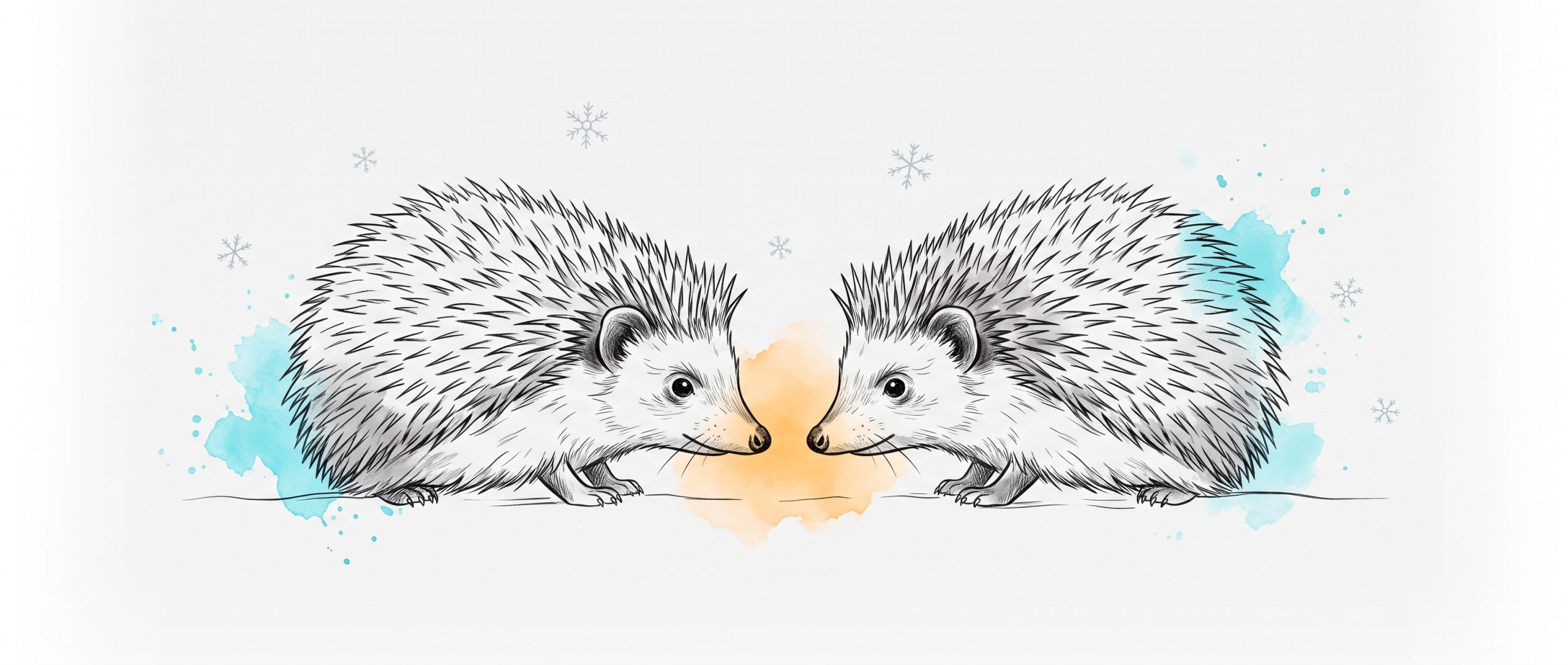
Fearful avoidant attachment is a pattern in close relationships where you want closeness and fear it at the same time. Someone gets near and part of you leans in; then the same closeness starts to feel dangerous, and you pull back, sometimes sharply. From the outside it can look like hot and cold. From the inside it usually feels like being pulled in two directions by two real needs: to be loved, and to stay safe from being hurt.
This article is for the person who recognises themselves in that description, and for the person trying to love someone who comes close and then disappears. It covers where the term comes from, why it is not quite the same thing as “disorganized attachment” (whatever the internet says), how it relates to difficult early experiences, and what the evidence honestly says about change.
What fearful avoidant attachment is
The term comes from a 1991 model by psychologists Kim Bartholomew and Leonard Horowitz. They defined four attachment patterns by crossing two things: whether your view of yourself is positive or negative, and whether your view of other people is positive or negative. Each combination gets a name:
| Positive view of others | Negative view of others | |
|---|---|---|
| Positive view of self | Secure | Dismissing (dismissive-avoidant) |
| Negative view of self | Preoccupied (anxious) | Fearful (fearful-avoidant) |
Fearful is the corner where both views are negative. Put plainly: “I am not sure I am worth loving, and I am not sure other people can be trusted with me.” If you hold both of those at once, closeness is something you want and something you brace against. That is why the push-pull is the pattern’s signature.
Most attachment research today measures two dimensions rather than four boxes: attachment anxiety (worry about rejection and abandonment) and attachment avoidance (discomfort with closeness and depending on people). A large 2015 study found that people spread out continuously along these dimensions rather than falling into distinct types. In those terms, fearful-avoidant means scoring high on both. It is a position you occupy, often more in some relationships than others, not a fixed type you are.
Two things it is not:
- It is not a diagnosis. No diagnostic manual lists it. It describes how you relate, not what is wrong with you.
- It is not avoidant personality disorder. The words overlap, so the two get confused. Avoidant personality disorder is a clinical diagnosis marked by persistent social anxiety, heightened sensitivity to rejection and feelings of inadequacy, together with a longing for connection. Fearful-avoidant attachment is a relationship pattern studied in a separate body of research. You can have either without the other.
Signs in relationships: the push-pull
The clearest sign is not any single behaviour but a cycle. People who identify with the pattern often describe it running something like this (a plain-language description, not a research model):
- Drawn in. Strong attraction, a wish to be really known, sometimes fast intimacy.
- Alarm. As things deepen, fear rises: of being seen too clearly, of being left, of being hurt the way you expect to be.
- Retreat. Going cold, picking fights, finding a flaw, going quiet, or ending things suddenly.
- Loneliness, and the pull back. Distance brings relief at first, then longing, and the cycle starts again.
Other things people with this pattern often describe:
- Reading small changes in a partner’s tone or reply time as signs of rejection.
- Wanting reassurance, then distrusting it when it comes.
- Finding it hard to share needs directly, so they come out as tests or sudden withdrawal.
- Feeling most anxious when things are going well, as if the good part cannot last.
- Strong feelings in conflict that are hard to calm, alongside an urge to get away.
There is research behind the push-pull. Across six studies, Mario Mikulincer and colleagues found that people high in attachment anxiety were strongly ambivalent about closeness, wanting it and fearing rejection at once, and that this conflict got stronger in situations that invited either moving closer or pulling away. People high in avoidance were ambivalent about distance, mainly when the relationship context was negative. The study looked at the two dimensions separately, not at a “fearful” group, so applying it here is an inference. But someone high on both is carrying both conflicts, which fits what people with this pattern describe.
None of these signs alone means much. Everyone has wobbly days. What marks the pattern is that closeness reliably sets off both the wish to come nearer and the urge to escape.
Fearful avoidant vs disorganized attachment
Online, “fearful avoidant” and “disorganized” are usually treated as two names for the same thing. They are related, but they come from different research traditions and are not interchangeable.
- “Disorganized” comes from infant research. It describes babies who, when stressed, show contradictory or confused behaviour towards a caregiver instead of a clear way of seeking comfort. A meta-analysis of nearly 80 studies and more than 6,000 infant–parent pairs found about 15% of infants in ordinary middle-class families show it, and that the rate may be two or even three times higher in some settings and clinical groups, such as where there is maltreatment. The same review notes that frightening parental behaviour may play a role, but is not the only cause. In adults, it has been assessed with interviews such as the Adult Attachment Interview and, more recently, with questionnaires.
- “Fearful” comes from the self-report tradition. It is defined by how adults describe themselves and others, in Bartholomew’s model and in questionnaires that measure anxiety and avoidance.
The two overlap, and that is why they get merged. But measuring adult disorganization is still unsettled. A 2023 systematic review of 18 measures concluded that, because of inconsistent quality, it is “challenging to reach sufficient conclusions” about the best instrument. And a 2024 study of 318 college students built a self-report measure of romantic disorganization that captured fear, distrust and disoriented behaviour; it was only moderately related to existing anxiety and avoidance measures, and it helped explain the link between childhood maltreatment and difficulty regulating emotions beyond what anxiety and avoidance captured. That is one study of one student sample, but it points the same way.
The honest line: fearful-avoidant and disorganized are related, not interchangeable. Most online quizzes ask the kind of self-report questions that measure anxiety and avoidance, so a quiz result labelled “disorganized” is likely closer to fearful-avoidant (high anxiety plus high avoidance) than to what researchers mean by disorganization.
Fearful avoidant vs anxious vs dismissive avoidant
It helps to see fearful-avoidant next to its neighbours. Our articles on anxious attachment style and avoidant attachment style cover each in depth.
| Anxious | Dismissive-avoidant | Fearful-avoidant | |
|---|---|---|---|
| Anxiety / avoidance | High / low | Low / high | High / high |
| Under stress | Moves closer, seeks reassurance | Withdraws, minimises | Does both, often in turns |
| Inner stance | “Don’t leave me.” | “I’m fine on my own.” | “I want you close, and it scares me.” |
“Anxious-avoidant” is sometimes used as another name for fearful-avoidant, and sometimes for a couple where one partner is anxious and the other avoidant. Check which one someone means.
Where it comes from
Attachment theory holds that early relationships shape our expectations about whether closeness is safe. A pattern where both self and others feel unsafe makes sense as a response to relationships that were loving and frightening at once, or unpredictable. That is theory, and early experience is one input among several; current relationships keep shaping attachment in adulthood.
What the research does show clearly is a link with trauma symptoms. A meta-analysis of 46 studies and 9,268 people found that of all the attachment patterns, fearful attachment had the largest association with post-traumatic stress symptoms (a correlation of about .44). Dismissing attachment showed no significant association. Two careful notes on that finding:
- It is a correlation. It does not show that attachment causes PTSD, or the other way round.
- It is not destiny. Plenty of people with a fearful pattern have no PTSD, and plenty of people with PTSD are not fearful-avoidant.
What it does suggest is that this pattern is common after hard experiences, which is a good reason to meet it with understanding rather than to treat it as a character flaw. It is a way of staying safe that made sense somewhere.
Can fearful avoidant attachment change?
Yes, attachment can shift, but the evidence is more modest than “heal your attachment style” content suggests. Here it is in order of how much weight it can bear.
Therapy is where change has been documented. A systematic review of studies that tracked attachment during psychological therapy found that attachment security increases and attachment anxiety decreases following therapy, but “findings are unclear with regard to attachment avoidance.” The authors say further controlled trials are needed.
What that means for fearful-avoidant. Because the pattern carries both high anxiety and high avoidance, it is reasonable to expect the anxious side (the fear of rejection, the need for reassurance) to ease more readily than the avoidant side (the urge to pull away). That is an inference from the review, not a finding about fearful-avoidant people specifically. It is still useful: if the fear softens before the distancing does, that is not failure. It is the order the evidence would predict.
And the honest gap. There is no good evidence that a self-help programme, an app, a workbook, a course or a blog post (this one included) changes attachment style. And because adult attachment is hard to measure reliably, an online quiz cannot tell you your attachment style, and cannot tell you when it has “healed”. Be wary of anything that promises a timeline.
What follows is practice, not a tested protocol. These are ways to make the next hard moment go a little differently:
- Learn your cycle. Write down the last time you pulled away: what happened just before, what you felt, what you did. Seeing the same steps repeat makes them easier to catch.
- Name both sides. “Part of me wants to stay, part of me wants to run” is truer than either half alone, and saying it to yourself (or to them) slows the swing.
- Pause before the exit. When the urge to end things or go cold hits, give it a delay: a day, a walk, a night’s sleep. Decide from calm, not from alarm.
- Ask for space with a return time. “I need a bit of time, and I’ll come back to this tonight” protects your need for distance without confirming the other person’s fear that you are gone.
- Collect evidence against the forecast. When you predicted rejection and it did not happen, notice it. The pattern runs on expectations, and expectations update slowly, one experience at a time.
- Consider therapy, especially if trauma is part of the story. That is where the evidence for change sits, and where painful history can be worked through safely.
If you want somewhere private to slow a reaction down and put the push and the pull into words before you act on either, aidx.ai, an AI coaching and therapy service, can help with that. It is AI, not a clinician, and it is not a treatment for attachment patterns or trauma.
If your partner is fearful avoidant
You cannot change someone else’s attachment pattern, and you cannot diagnose it from the outside either. Two studies of couples found that people read their partner’s attachment with moderate accuracy but tend to overestimate insecurity. So hold the label lightly. What you can do is understand what the pattern is protecting, and look after both people in the relationship, including yourself.
- Read the withdrawal as fear, not verdict. When they go cold after a close moment, it is often the closeness, not you, that set off the alarm. That does not make the withdrawal okay, but it changes what helps.
- Be steady rather than intense. For someone who expects to be hurt, predictability is likely to reassure more than intensity. Doing what you say, when you said you would, does more than big declarations.
- Respect their need for space, and ask for a return. Agree together on how breaks work: “Take the time you need; can we talk again tomorrow?” This meets the avoidant side without abandoning the anxious side.
- Ask for change gently. Research on avoidant partners found their anger and withdrawal eased when requests respected their autonomy and showed they were valued. The study was about avoidance in general, not fearful-avoidant specifically, but the principle carries over.
- Keep your own needs on the table. Understanding someone’s pattern does not mean accepting any treatment. You are allowed to want consistency, to say so, and to decide what you can live with.
The push-pull dynamic can make a relationship feel intensely bonding, especially when warmth returns after a cold spell. If that cycle starts to feel addictive rather than loving, our article on trauma bonds explains how intermittent closeness can create strong attachment, and our piece on why you keep repeating the same relationship patterns covers how couples get stuck in pursue–withdraw loops. And if a relationship involves fear, control or abuse, that is not an attachment style to accommodate; reach out to a domestic abuse service.
Common questions
Is fearful avoidant the same as avoidant personality disorder?
No. Avoidant personality disorder is a clinical diagnosis involving persistent social anxiety, sensitivity to rejection and feelings of inadequacy across many areas of life. Fearful-avoidant attachment is a relationship pattern, not a diagnosis. Some features sound similar, especially fear of rejection, but they are studied and assessed separately.
How do you love someone with avoidant personality disorder?
If someone has been diagnosed with avoidant personality disorder, the most helpful thing is usually patience, low-pressure invitations and encouragement to stay in their treatment, while looking after your own needs too. If you mean a partner who seems fearful-avoidant, see the section above. In either case, do not try to diagnose them yourself.
What are the characteristics of avoidant personality traits?
Clinically, avoidant personality is described in terms of social anxiety, fear of criticism or rejection, and feeling inadequate, often alongside a real wish for connection. That is a different thing from avoidant attachment, which describes how someone handles closeness in relationships specifically.
Can a quiz tell me my attachment style?
Only roughly. Researchers use validated questionnaires and interviews, and even among those, the measures of adult disorganized attachment are still unsettled. An online quiz can be a prompt for reflection, but it cannot diagnose you, and your result may differ from one relationship to another.
What do people on Reddit describe about fearful avoidant attachment?
Communities like r/FearfulAvoidant gather people who identify with the pattern to share their experiences, often of the push-pull cycle described above. Knowing you are not alone can be a comfort. Treat forum advice as personal experience, though, not evidence, and be cautious about self-labelling from a thread.
How long does it take to heal fearful avoidant attachment?
No one can honestly give a timeline. Attachment security has been shown to increase during therapy, but how much and how fast varies, and the evidence for change in avoidance specifically is unclear. Progress often looks like shorter swings and faster repair rather than a sudden switch.
Can two fearful avoidants be in a relationship?
Yes, though it may take more deliberate effort, because both people may want closeness and pull away, sometimes at the same moment. Agreeing on how to take space and come back, and getting support such as couples therapy, can matter more.
Are there good books on fearful avoidant attachment?
We do not recommend specific products here. If you look for a book, favour authors who cite research and avoid promises of quick fixes or guaranteed timelines.
Last reviewed: October 2026
References
- Bartholomew, K., & Horowitz, L. M. (1991). Attachment styles among young adults: a test of a four-category model. Journal of Personality and Social Psychology, 61(2), 226–244.
- Fraley, R. C., Hudson, N. W., Heffernan, M. E., & Segal, N. (2015). Are adult attachment styles categorical or dimensional? A taxometric analysis of general and relationship-specific attachment orientations. Journal of Personality and Social Psychology, 109(2), 354–368.
- Mikulincer, M., Shaver, P. R., Bar-On, N., & Ein-Dor, T. (2010). The pushes and pulls of close relationships: attachment insecurities and relational ambivalence. Journal of Personality and Social Psychology, 98(3), 450–468.
- Overall, N. C., Simpson, J. A., & Struthers, H. (2013). Buffering attachment-related avoidance: softening emotional and behavioral defenses during conflict discussions. Journal of Personality and Social Psychology, 104(5), 854–871.
- Pollard, C., Bucci, S., & Berry, K. (2023). A systematic review of measures of adult disorganized attachment. British Journal of Clinical Psychology, 62(2), 329–355.
- Sun, E. R., Kong, X., Mitala, J. A., Oh, J., & Jakubiak, B. K. (2026). Perceiving to provide: how partner attachment perceptions inform reassurance provision in romantic relationships. Personality and Social Psychology Bulletin. Online ahead of print.
- Taylor, P., Rietzschel, J., Danquah, A., & Berry, K. (2015). Changes in attachment representations during psychological therapy. Psychotherapy Research, 25(2), 222–238.
- Torrico, T. J., & Sapra, A. (2024). Avoidant personality disorder. In StatPearls. StatPearls Publishing.
- van IJzendoorn, M. H., Schuengel, C., & Bakermans-Kranenburg, M. J. (1999). Disorganized attachment in early childhood: meta-analysis of precursors, concomitants, and sequelae. Development and Psychopathology, 11(2), 225–249.
- Whittington, D. (2024). Disorganized attachment in emerging adulthood: measurement comparisons and relations to childhood maltreatment and emotion dysregulation. Family Process, 63(1), 348–363.
- Woodhouse, S., Ayers, S., & Field, A. P. (2015). The relationship between adult attachment style and post-traumatic stress symptoms: a meta-analysis. Journal of Anxiety Disorders, 35, 103–117.
This article is general information about relationships and emotional wellbeing. It is not psychological or medical advice, and it cannot diagnose or treat any condition. If your relationships are causing serious distress, involve abuse, or bring up the effects of past trauma, consider speaking with a qualified therapist or counsellor. If you are in crisis or thinking about harming yourself, contact your local emergency services or a crisis line right away: in the US, call or text 988 (Suicide & Crisis Lifeline); in the UK and Ireland, call Samaritans on 116 123.