
Contamination OCD is a form of obsessive-compulsive disorder in which the obsession is about being contaminated — and the compulsions are washing, cleaning, avoiding, and asking to be told it is fine. If that is what you are living with, you already know the part the word “contamination” hides: how much of your day it takes, how much of your home you have quietly written off, and how quickly the relief wears off after you wash.
Here is the short answer. Contamination OCD is not really a fear of germs. Germs are one possible content; the disorder is the loop, and the loop runs the same way whether the feared thing is a doorknob, a word, a person, or a memory. That is why cleaning does not end it — and why the treatment that works is not about deciding whether anything was clean. It is also why the most useful part of this article is the part almost nothing else on the subject covers: the kind of contamination with no contaminant in it at all.
What contamination OCD actually is
The mechanism is a loop with five steps, and it is the same loop in every form of OCD:
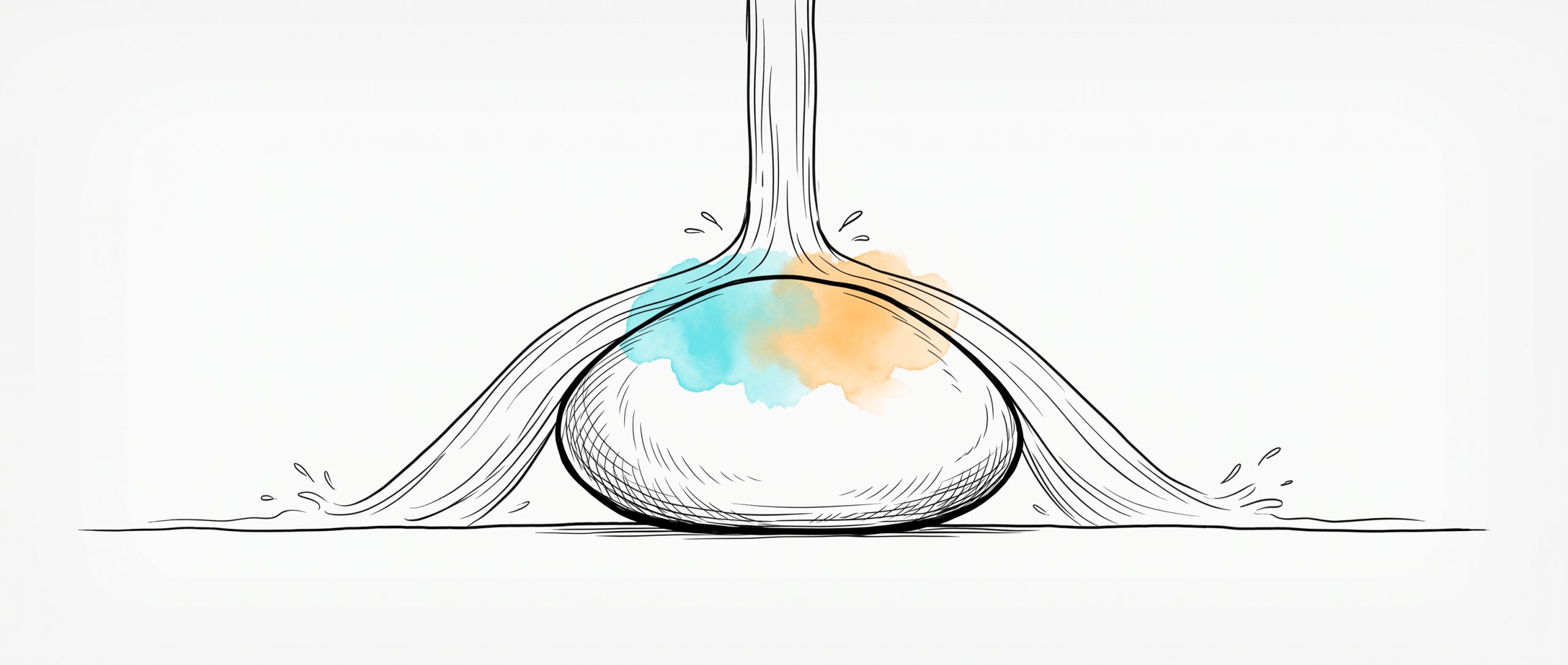
An intrusive thought or image arrives — that was dirty, I have been contaminated, I will pass it on. It produces a spike of anxiety or disgust. You do something to make that feeling stop: wash, change clothes, throw the item away, avoid the room, ask someone whether it was safe. The feeling drops. And because it dropped, your brain files the compulsion as the thing that saved you — so the next intrusion arrives with a little more authority, and the price of relief goes up.
Contamination is not an exotic corner of OCD. In a meta-analysis of 21 studies covering 5,124 participants, published in the American Journal of Psychiatry, cleaning and contamination emerged as one of four replicated symptom dimensions, alongside symmetry, forbidden thoughts and hoarding. Note the word: these are dimensions people score along, not boxes people belong in, and the authors were explicit that “there remains debate regarding the exact factor structure of OCD symptoms.” If you came here wondering how many types of OCD there are, that argument is its own piece; this one stays on contamination.
The International OCD Foundation’s fact sheet on contamination fears lists the typical compulsions plainly: repetitive washing, showering or disinfecting; throwing away or avoiding things that “can’t be cleaned”; maintaining clean areas in the home or workplace that others may not enter or touch; and “repeatedly asking others for reassurance that they, or certain things are safe.” It also names the costs people rarely say out loud: shrinking social contact, restricted movement outside the house, skin damage from washing.
What makes it a disorder rather than a preference is not the strength of the disgust. It is that, as the US National Institute of Mental Health puts it, the symptoms are “often time-consuming and can cause significant distress or interfere with daily life.”
Why “fear of germs” is the wrong description
Read the IOCDF’s own list of what people with contamination OCD fear and the germ framing falls apart on the page. Alongside viruses, bacteria and bodily fluids, it lists fears of contact with “magical things” — and gives examples: “bad luck, the names of illnesses, or other people who may seem to have some bad or dislikable traits”, and “objects associated with bad events (clothing worn to a funeral, for example)”.
None of that is microbiology. A person can scrub for an hour over a word, a name, a person they find morally objectionable, or a jumper they were wearing on a bad day. The psychologist Stanley Rachman made the point formally in a 2004 review in Behaviour Research and Therapy that still shapes how clinicians think about this: contamination “can occur without any physical contact”, and explaining that needs a different concept from hygiene.
This matters practically. If you understand your problem as a fear of germs, the obvious remedy is better information about germs — so you spend years researching, sanitising and reassuring yourself, all of which are compulsions. Understanding it as a loop points somewhere else entirely.
Mental contamination: feeling dirty with nothing on you
This is the part page after page skips, and it is the part that explains the sentence people are most ashamed of: I know it’s clean, and I still feel dirty.
Clinicians distinguish two things. Contact contamination is the familiar kind: you touched something, now you feel contaminated. Mental contamination is feelings of dirtiness or pollution arising without contact with any physical contaminant — typically traced to a human source rather than an object: a violation, a betrayal, a humiliation, an intrusive image, a memory.
It is common. In a study published in the Journal of Obsessive-Compulsive and Related Disorders, Anna Coughtrey and colleagues assessed 177 people with high obsessive-compulsive symptoms and found 46.3% scored in the range indicating clinically relevant mental contamination. In a subgroup of 54 participants with a formal OCD diagnosis, the figure was 44.4%. And crucially, 10.2% of the larger sample had mental contamination without clinically relevant contact contamination — people whose problem was never about touching anything.
Two caveats travel with those numbers: they come from self-report questionnaires rather than clinical interviews, and the cut-off for “clinically relevant” is a research convention, not a diagnostic threshold. Read them as a good estimate of how common this is, not as a diagnosis.
What it feels like was described by the same research group in a 2012 interview study of 20 people with contamination-based OCD in Behavioural and Cognitive Psychotherapy. Every single participant reported times they had felt dirty or contaminated with no physical contact at all. The feeling was described as diffuse internal dirtiness — notably not localised to the hands. It produced urges to wash in 100% of them, to neutralise in 80%, and to avoid in 85%. The study’s title is a participant’s own phrase: “It’s the feeling inside my head.”
Where does it come from? Sometimes from something that happened. In a study of 50 women who had experienced sexual assault, 30 (60%) reported feelings of mental pollution afterwards, and deliberately recalling the assault produced stronger feelings of dirtiness and stronger urges to wash than recalling a pleasant memory; nine women washed their hands during the recall. In a later experiment with 121 female undergraduates, simply listening to an audio recording describing a non-consensual kiss — no contact with anything — produced significant feelings of pollution and the urge to wash in that condition, and eight of those participants went and washed or rinsed. Rachman later argued in a psychological analysis of betrayal that betrayal themes intensify the effect, and that the betrayer often becomes the source of the contamination.
If your own sense of dirtiness traces back to something that was done to you, say that at an assessment. It is relevant clinical information, and it may change what treatment is offered.
Then there is the finding that does the most work for a reader. In a 2019 study in Behavior Therapy of 88 people with elevated contamination symptoms (half meeting criteria for OCD), mental contamination was positively associated with reactivity to physical contaminants even after participants had washed their hands. Washing removed the contaminant. It did not remove the feeling — because the feeling was never about the contaminant.
How solid is all this? A 2023 systematic review pulled together 67 studies across 58 reports and concluded that mental contamination is “a robust clinical construct within OCD” — while noting that the quality of the underlying studies is variable, and that only eight of them addressed treatment. So: a real, replicated phenomenon with a modest evidence base. Not a diagnosis, and not something to self-apply as a label.
Contamination OCD, germaphobia, and ordinary hygiene
People search for this difference constantly, usually because someone told them they are “just a bit of a germaphobe” and it did not fit. “Germaphobia” is not a formal diagnosis — the nearest clinical category is a specific phobia — but the everyday distinction is real and worth having.
| Careful hygiene | “Germaphobia” | Contamination OCD | |
|---|---|---|---|
| What drives it | Sensible judgement about risk | Intense fear of germs and illness specifically | An intrusive doubt that cannot be settled — about germs, or about something with no germ in it |
| What you do | Wash, then move on | Avoid the feared thing where you can | Rituals that must be done a particular way, repeated, and often extended to people and places nearby |
| How it ends | It ends | Fear drops once the threat is gone | Relief lasts minutes, then the doubt returns slightly stronger |
| Effect on life | Negligible | Some situations are avoided | Time-consuming and genuinely disabling — the IOCDF lists restricted movement, damaged relationships and skin damage |
The honest summary: the dividing line is not how frightened you are of dirt. It is whether the fear has organised your behaviour into a system you cannot stop running.
Why washing doesn’t work, and why avoidance grows
Washing works — for about ten minutes. That is precisely the problem. Each time the anxiety falls after a compulsion, you have taught yourself that the danger was real and that the ritual handled it. What you never get is the one experience that would change the pattern: finding out what happens when you do nothing.
Avoidance behaves the same way, and its costs compound faster. The IOCDF puts the question and the answer bluntly: “Can’t people simply avoid the things they fear?” — “The answer is a definite ‘no.’ OCD has a way of spreading out into many areas of a sufferer’s life, and avoidance only leads to more avoidance.” That is how one contaminated object becomes a contaminated shelf, then a room, then a category of people.
And reassurance is a compulsion. Asking your partner whether it was clean, re-reading an article, checking a symptom list once more — each is a wash performed with words, and each has the same shape: brief relief, slightly stronger doubt. The UK’s NICE guideline on OCD makes this a formal part of treatment, recommending that where family members “have become involved in compulsive behaviours, avoidance or reassurance seeking, treatment plans should help them reduce their involvement in these behaviours in a sensitive and supportive manner” (recommendation 1.5.2.9). The IOCDF tells families the same: don’t take part in rituals, don’t answer repetitive questions.
Which is why this article will not tell you that your hands are clean. Doing so would be the exact thing treatment is going to ask you to stop.
What actually changes it: ERP
The front-line psychological treatment for OCD, including contamination OCD, is Exposure and Response Prevention (ERP) — a form of cognitive behavioural therapy delivered by a trained clinician. The IOCDF describes the two halves precisely: exposure means “practicing confronting the thoughts, images, objects, and situations that make you anxious and/or provoke your obsessions”; response prevention means “making a choice not to do a compulsive behavior once the anxiety or obsessions have been ‘triggered.’”
In practice it is gradual and collaborative rather than dramatic: you and a clinician build a ladder from manageable to hard and climb it in order. The goal is not to prove anything is safe. It is to learn that you can carry the feeling of contamination without acting on it, until the alarm stops firing.
NICE scales the intensity to the impairment. For adults with mild functional impairment, it recommends low-intensity CBT including ERP — up to 10 therapist hours (1.5.1.1). Where that is inadequate or the impairment is moderate, it recommends a choice of either an SSRI or more intensive CBT with ERP, describing the two as “comparably efficacious” (1.5.1.2–1.5.1.3). For severe functional impairment it recommends both combined (1.5.1.4). Medication is a conversation for a prescribing clinician, not an article.
Two NICE recommendations matter specifically here. Where the compulsions are mental rather than visible — neutralising, mentally “cleaning”, silently undoing — treatment should include exposure to the obsessive thoughts and response prevention of mental rituals (1.5.2.2). And if contamination fears have made you housebound and unable to have a therapist in your home, NICE names that situation explicitly and recommends CBT by telephone as an option (1.5.2.6). Being unable to let someone in is not a reason you cannot be treated.
How well does ERP work? Honestly, with the caveats intact. A 2021 systematic review and meta-analysis in Comprehensive Psychiatry pooled 36 randomised controlled trials covering 2,020 patients and found a large pooled effect in favour of CBT with ERP against control conditions (Hedges’ g = 0.74, 95% CI 0.51 to 0.97). It was clearly better than psychological placebo. It was not better than other active psychological therapies in the eight trials making that comparison. And the authors flagged a real methodological problem: only 8 of the 36 studies were at low risk of bias, and in the eight studies without suspected researcher allegiance the effect all but vanished. ERP is the best-supported treatment we have for OCD; the literature behind it is less pristine than the marketing around it.
There is also a directly encouraging finding for anyone whose contamination is mostly in their head. In that 2019 study, three sessions of ERP aimed at contact contamination were associated with changes in both contact and mental contamination, across self-report and behavioural measures. The same work found that higher pretreatment mental contamination predicted worse post-treatment contact contamination — but that showed up in only one of two measures, and adding disgust proneness as a covariate reduced it to non-significance. Read it as a reason to mention mental contamination to your clinician, not as a prediction about you.
Where self-directed work fits, honestly
Plenty of people cannot access a trained ERP therapist quickly, or at all, and deserve a straight answer about what self-directed tools do.
A 2022 systematic review and meta-analysis in the Journal of Medical Internet Research pooled 11 randomised trials of unguided computer-assisted self-help for OCD — no human contact at all — covering 983 participants. It worked, modestly: a standardised mean difference of −0.47 (95% CI −0.73 to −0.22) against waiting list or psychological placebo. Two findings sit next to that and both belong in the same breath. Dropout was roughly double that of the control conditions (risk ratio 1.98, 95% CI 1.21 to 3.23). And the authors graded the quality of the evidence as very low, because of risk of bias and inconsistency between studies.
The useful detail is in their subgroup analysis: interventions that included an ERP component and ran for more than four weeks were more effective without becoming harder to stick with. If you are choosing something to work with on your own, those two features are the ones with evidence behind them — and a short, ERP-free, general-wellbeing app is not the same product.
What self-directed work is genuinely good for is the part around the treatment: understanding the loop, catching reassurance-seeking as it happens, holding the ground you gained between sessions, and having somewhere to take the 3am spiral that is not a search engine. That is the honest scope of AI-based support for OCD — and the reason aidx.ai, which offers AI coaching and therapy, is not a substitute for an ERP clinician on a condition like this one. Some general skills transfer as well; our guide to coping skills for anxiety covers several.
When to get help
There is no threshold you have to reach to deserve an assessment. But these are the signals clinicians treat as worth acting on, and NICE lists most of them as direct screening questions a doctor may ask:
- You wash or clean a lot, and it is hard to stop once you start.
- Daily activities take a long time to finish because of rituals.
- There is a thought that keeps bothering you that you would like to get rid of but cannot.
- You are avoiding places, objects or people — and the list is getting longer, not shorter.
- Your skin is damaged from washing.
- Someone close to you has been absorbed into the rituals, supplying reassurance or doing things on your behalf.
Ask a doctor for a referral, or approach a clinician trained specifically in ERP — the treatment is specialised, and general talk therapy is not a substitute for it. The IOCDF maintains a directory of OCD therapists and clinics, including teletherapy, which is a reasonable place to start.
And one thing worth saying plainly, because shame keeps people quiet for years: none of what you have recognised in this article is unusual to an OCD clinician. They have heard it. It is a known presentation with a known treatment.
Common questions about contamination OCD
What is ERP for contamination OCD?
ERP — exposure and response prevention — is the specific CBT protocol used for contamination fears, and yes, exposure therapy is exactly what is used to treat them. It works in two moves at once: you deliberately approach what triggers the contamination feeling, starting manageable and building up, and you do not perform the compulsion afterwards — no washing, no changing clothes, no disinfecting, no asking anyone whether it was fine. The IOCDF’s fact sheet lists typical contamination assignments: touching feared objects at home and in public and then resisting washing, visiting places you believe are contaminated, using possessions you had written off, and letting a “clean” area gradually become ordinary. Family members are coached at the same time to stop supplying reassurance. The point is not to establish that anything is safe — it is to learn that the feeling of contamination passes on its own if you let it, which you can only find out by not washing.
How do I get over, stop, or get rid of contamination OCD?
These are all the same question, and the answer is the same: get assessed, and get a course of ERP with a clinician trained in it, with an SSRI as an alternative or addition depending on how much the symptoms are affecting your life. What does not work, despite being what the disorder relentlessly suggests, is any strategy aimed at establishing certainty — more washing, better research, one more round of reassurance. Those are the mechanism, not the cure.
How do I treat contamination OCD at home?
Between sessions, the work is mostly the response-prevention half: noticing compulsions as compulsions, and not doing them. What we would not do is hand you a self-directed exposure plan in an article. There is a real reason for that beyond caution — the self-help evidence shows dropout roughly doubling, and badly-designed exposure done alone can turn into a ritual of its own. Where ERP is genuinely inaccessible, the evidence points to structured programmes with an explicit ERP component running longer than four weeks, and ideally to getting some human guidance, even briefly.
What is mental contamination — and what about “moral” contamination?
Mental contamination is feeling dirty or polluted without contact with any physical contaminant — typically after a violation, a betrayal, a humiliation, or an intrusive thought or memory. It is a measured research construct, not a separate diagnosis. “Moral contamination” is the everyday name for one of its common forms: feeling internally tainted by having done, thought, or been exposed to something you consider wrong. Both sit inside contamination OCD rather than beside it, and both respond to the same treatment.
Is contamination OCD real?
Yes. Contamination is one of the four replicated symptom dimensions of OCD in the meta-analytic literature, and both NICE and the IOCDF treat contamination fears as a standard presentation with a standard treatment pathway. If the question behind the question is “is mine real, or am I making it up” — doubting the legitimacy of your own symptoms is itself a common feature of OCD, and it is not evidence either way. An assessment answers it; rumination does not.
How does contamination OCD start?
There is no single cause. OCD is substantially heritable — a review in Psychological Medicine describes it as a polygenic disorder with a large additive genetic contribution, where individual symptom dimensions have both shared and unique genetic risks. On top of that, specific onsets are documented: contamination feelings following a sexual assault or another violation, as in the research above. Many people cannot identify a trigger at all, and not being able to is not a problem — ERP does not require knowing where it started.
What does mild contamination OCD look like?
Roughly: real rituals, real avoidance, but not yet organising your life — extra hand-washing, a couple of places you would rather not touch, reassurance-seeking that a partner has noticed. NICE takes mild impairment seriously enough to have its own recommendation: low-intensity CBT including ERP, up to 10 therapist hours. Mild is the best time to treat this, not a reason to wait.
What about contamination OCD and food?
Food is one of the most common arenas for it, because it combines a genuine hygiene rationale with unlimited opportunity for doubt: expiry dates checked repeatedly, whole categories of food ruled out, elaborate rules about preparation, refusing to eat anything you did not cook. It is still contamination OCD and it is still treated with ERP — but tell your clinician if eating has become restricted, because significant weight loss or nutritional restriction needs looking at in its own right.
What are some examples of contamination OCD?
Washing until skin cracks; showering in a fixed sequence that has to be restarted if interrupted; throwing away clothes that cannot be “cleaned”; keeping rooms nobody else may enter; not touching door handles, money or public seating; avoiding a whole neighbourhood because of one association; feeling permanently unclean after something someone did to you; scrubbing after an intrusive thought you found repellent. The last two are mental contamination, and they count.
What are the types of contamination OCD?
The clinically meaningful distinction is contact versus mental contamination, covered above. Beyond that, the “types” you will find listed online are descriptions of content — germs, bodily fluids, chemicals, food, moral contamination — not separate conditions, and the fuller argument about why OCD lists vary so much is in our piece on the types of OCD.
Can contamination OCD be cured?
“Cured” is the wrong frame, and noticing why is useful. As NIMH states: “Although there is no cure for OCD, available treatments can help people manage their symptoms, participate in day-to-day activities, and improve their quality of life.” In practice, well-treated OCD often means intrusions that still arrive occasionally and no longer run anything. Chasing a state of permanent certainty that the thoughts will never return is, unhelpfully, the same move as chasing certainty that your hands are clean.
What is the hardest OCD to treat?
There is no reliable ranking of OCD presentations by difficulty, and any article confidently naming one is going beyond the evidence. What is measured is more useful anyway: factors like high pretreatment mental contamination and disgust proneness have been associated with poorer contact-contamination outcomes, though the evidence there is preliminary and did not survive every analysis. Practically, the things that make treatment harder are usually access, untreated co-occurring conditions, and compulsions that are invisible — not which content the obsession picked.
What if my OCD has a different theme?
The loop is the same whatever it attaches to, which is why the treatment is too. If your doubt is about harm rather than dirt, see harm OCD; if it has fixed on your relationship, see relationship OCD. A feared state and a feared action feel completely different from the inside and behave identically in treatment.
Last reviewed: September 2026
References
- Bloch, M. H., Landeros-Weisenberger, A., Rosario, M. C., Pittenger, C., & Leckman, J. F. (2008). Meta-analysis of the symptom structure of obsessive-compulsive disorder. American Journal of Psychiatry, 165(12), 1532–1542.
- Coughtrey, A. E., Shafran, R., Knibbs, D., & Rachman, S. J. (2012). Mental contamination in obsessive–compulsive disorder. Journal of Obsessive-Compulsive and Related Disorders, 1(4), 244–250.
- Coughtrey, A. E., Shafran, R., Lee, M., & Rachman, S. J. (2012). It’s the feeling inside my head: A qualitative analysis of mental contamination in obsessive-compulsive disorder. Behavioural and Cognitive Psychotherapy, 40(2), 163–173.
- Fairbrother, N., & Rachman, S. (2004). Feelings of mental pollution subsequent to sexual assault. Behaviour Research and Therapy, 42(2), 173–189.
- Fairbrother, N., Newth, S. J., & Rachman, S. (2005). Mental pollution: Feelings of dirtiness without physical contact. Behaviour Research and Therapy, 43(1), 121–130.
- Imai, H., Tajika, A., Narita, H., Yoshinaga, N., Kimura, K., Nakamura, H., Takeshima, N., Hayasaka, Y., Ogawa, Y., & Furukawa, T. (2022). Unguided computer-assisted self-help interventions without human contact in patients with obsessive-compulsive disorder: Systematic review and meta-analysis. Journal of Medical Internet Research, 24(4), e35940.
- International OCD Foundation. Obsessive compulsive contamination fears (fact sheet); Exposure and response prevention (ERP).
- Mahjani, B., Bey, K., Boberg, J., & Burton, C. (2021). Genetics of obsessive-compulsive disorder. Psychological Medicine, 51(13), 2247–2259.
- Mathes, B. M., McDermott, K. A., Okey, S. A., Vazquez, A., Harvey, A. M., & Cougle, J. R. (2019). Mental contamination in obsessive-compulsive disorder: Associations with contamination symptoms and treatment response. Behavior Therapy, 50(1), 15–24.
- Millar, J. F. A., Coughtrey, A. E., Healy, A., Whittal, M., & Shafran, R. (2023). The current status of mental contamination in obsessive compulsive disorder: A systematic review. Journal of Behavior Therapy and Experimental Psychiatry, 80, 101745.
- National Institute for Health and Care Excellence (2005). Obsessive-compulsive disorder and body dysmorphic disorder: treatment. Clinical guideline CG31.
- National Institute of Mental Health. Obsessive-compulsive disorder (OCD).
- Rachman, S. (2004). Fear of contamination. Behaviour Research and Therapy, 42(11), 1227–1255.
- Rachman, S. (2010). Betrayal: A psychological analysis. Behaviour Research and Therapy, 48(4), 304–311.
- Reid, J. E., Laws, K. R., Drummond, L., Vismara, M., Grancini, B., Mpavaenda, D., & Fineberg, N. A. (2021). Cognitive behavioural therapy with exposure and response prevention in the treatment of obsessive-compulsive disorder: A systematic review and meta-analysis of randomised controlled trials. Comprehensive Psychiatry, 106, 152223.
This article is general information about obsessive-compulsive disorder and is not medical advice or a substitute for care from a qualified professional. If you recognise yourself here, speak to a doctor or a clinician trained in Exposure and Response Prevention about an assessment — contamination OCD is a recognised presentation and it is treatable. If you are in crisis or having thoughts of suicide or self-harm, contact emergency services or a crisis line immediately: call or text 988 in the US, call Samaritans on 116 123 in the UK and Ireland, or use your local emergency number.