
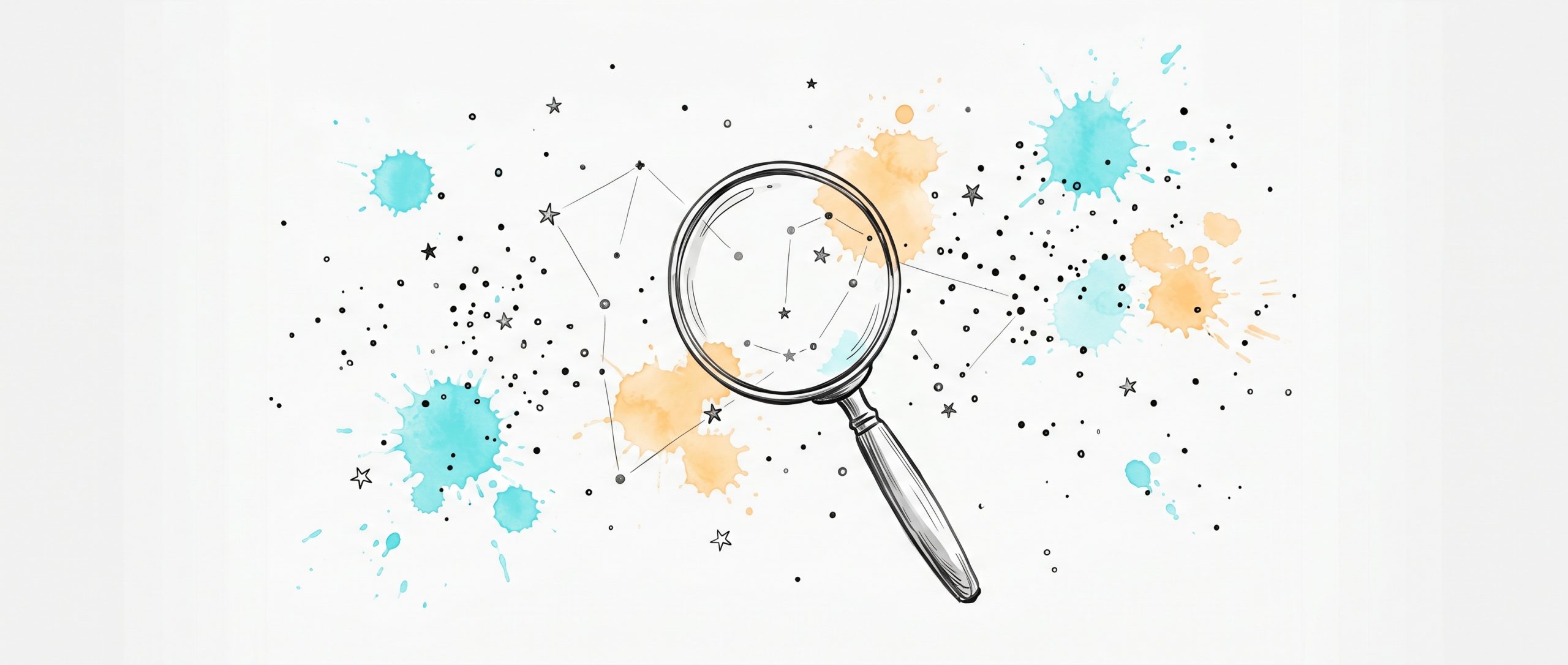
Apophenia is the tendency to perceive meaningful patterns, connections, or significance in information that is actually random or unrelated. It’s why a string of unlucky days starts to feel like a curse, why the number 11:11 seems to “follow” you, and why a partner’s slow text reply can suddenly look like proof they’ve lost interest. The pattern feels real. Often, it isn’t.
Almost everyone experiences apophenia. In small doses it’s harmless, even useful — it’s the same machinery that lets us recognise faces, learn language, and notice that the stove is hot. It becomes a problem when the patterns we find amplify anxiety, distort our relationships, or harden into beliefs that no evidence can shake.
Apophenia: definition and origin
The word apophenia was coined in 1958 by the German psychiatrist Klaus Conrad. He used it to describe an early symptom he had observed in patients developing schizophrenia: a state in which the world suddenly seemed saturated with meaning, where every glance, license plate, or radio lyric felt personally significant. Conrad called the experience Apophänie — from the Greek apo (“away from”) and phaínein (“to show”) — to capture the sense of meaning revealing itself unbidden.
In the decades since, the term has broadened well beyond psychiatry. Today, researchers in cognitive psychology use apophenia to describe a universal feature of the human mind: our drive to impose structure on noise. It’s the umbrella under which many smaller biases sit, and it shows up in everyone from gamblers to scientists to anxious 2 a.m. overthinkers.
Apophenia meaning in everyday life
If you’ve ever done any of the following, you’ve experienced apophenia:
- Noticed your ex’s car everywhere in the weeks after a breakup.
- Felt that a particular song “came on at the right moment” for a reason.
- Read deep significance into seeing 11:11, 333, or your birthday on a clock.
- Convinced yourself a coworker’s short email meant they were angry at you.
- Spotted a “trend” in three data points and acted on it.
- Felt that several small misfortunes in one week meant the universe was against you.
- Looked at a stock chart and seen a shape that “must” predict the next move.
None of these make you irrational. They make you a normal human being with a brain that evolved to find patterns first and ask questions later. A pattern that turns out to be wrong costs little. A pattern missed — the rustle that was actually a predator — could cost everything. Our ancestors who erred toward over-detection survived to become our ancestors.
Apophenia vs. pareidolia, confirmation bias, and the gambler’s fallacy
People searching for the meaning of apophenia often want to know how it differs from related ideas. The distinctions matter.
Pareidolia
Pareidolia is a specific subtype of apophenia: seeing familiar shapes — usually faces or figures — in random visual data. The face in a piece of toast, the man in the moon, a smiling car grille, a Virgin Mary outline on a water stain. Pareidolia is overwhelmingly visual or auditory (think of hearing hidden messages when a record is played backwards). Apophenia is the broader category and includes patterns of meaning, causation, and timing — not just shapes.
Confirmation bias
Confirmation bias is what happens after a pattern has taken hold: we then notice and remember the evidence that supports it, and quietly ignore the rest. Apophenia plants the seed; confirmation bias waters it. Together they’re an effective machine for keeping a belief alive long past its expiry date.
Gambler’s fallacy
The gambler’s fallacy is the belief that a streak of independent random events must somehow “correct” itself — red is “due” after a run of black, a coin is “owed” a tails. It’s apophenia applied to chance: we see a pattern (alternation, balance, fairness) in a sequence that has none.
Magical thinking and ideas of reference
At the further end of the spectrum, when apophenia hardens into a sense that random events are specifically directed at you — the news anchor is speaking in code, the song lyrics are a message — clinicians call this an idea of reference. In milder forms it’s a common stress response. In persistent and unshakeable forms it can be a feature of psychotic, paranoid, or severe anxiety states and is worth talking to a professional about.
Apophenia, anxiety, and stress: why the connection is so strong
The single most consistent finding in the psychology of pattern perception is this: we see more patterns when we feel less in control.
A frequently cited 2008 set of experiments showed that participants asked to recall a situation in which they had no control subsequently saw more patterns in pure visual noise, perceived more conspiracies in ambiguous stories, and were more likely to identify trends in random stock data. Restoring a sense of control — even through unrelated tasks like self-affirmation — reduced the effect. The pattern itself was the coping mechanism. If we cannot control the situation, we will at least try to control our understanding of it.
This is why apophenia surges during the experiences people actually book coaching or therapy for:
- Anxiety. An anxious brain is a pattern engine running too hot. It scans for threat, finds candidate threats everywhere, and stitches them into stories: my boss didn’t say hello, the project is failing, I’ll be let go, then evicted, then alone.
- Grief. Bereaved people often report “signs” — a particular bird, a recurring song, an electrical flicker. The pattern offers what the loss took away: contact, meaning, a thread of continuity.
- Breakups. Suddenly you see their car everywhere. You aren’t imagining it — you’re attending to that make and model with extreme sensitivity, and your brain is supplying continuity by linking unrelated sightings into a “they’re everywhere” narrative.
- Doomscrolling. A social feed isn’t a random sample of the world; it’s an algorithmic concentration of the most outrage-triggering content available. Apophenia takes the curated sample and produces a sincerely felt pattern: everything is collapsing, everyone is cruel.
- Health anxiety. Three unrelated bodily sensations get assembled into a single suspected illness, then googled into certainty.
- Relationship hypervigilance. Response times, emoji choices, and Spotify activity get woven into a coherent story about what your partner secretly feels. The story is detailed, emotionally vivid, and very often wrong.
The key insight is that the strength of a felt pattern is not a reliable signal of its truth. Under stress, the felt-significance dial gets turned up. The pattern feels obvious, undeniable, almost glowing. That is the brain compensating, not the world clarifying.
When apophenia is a strength
It would be a mistake to treat pattern-finding as a defect. Apophenia, in moderated form, is the engine behind a great deal of what makes human life rich:
- Science begins with someone noticing a pattern others have missed — and then doing the harder work of testing whether the pattern is real.
- Art and storytelling rely on our willingness to see meaning, character, and arc in arrangements of colour, sound, or words.
- Intuition, especially expert intuition, is largely fast pattern recognition built from thousands of prior examples.
- Meaning-making — the sense that one’s life has a thread, a direction, a story — depends on the same machinery that, mishandled, produces conspiracy theories.
The aim isn’t to switch apophenia off. It’s to add a small, kind layer of scrutiny between noticing a pattern and acting on it.
How to handle apophenia when it’s hurting you
A few practices, drawn from cognitive therapy and contemplative traditions, tend to help.
1. Ask what would disconfirm the pattern
If you find yourself certain of a pattern — “he’s pulling away,” “this is going to fail,” “people don’t like me” — pause and ask: what specific evidence would prove this wrong? Then look honestly for it. If nothing could possibly disconfirm the pattern, that’s diagnostic. You’re not perceiving reality; you’re inhabiting a belief.
2. Separate felt-significance from actual-significance
A useful question: does this feel meaningful, or is it meaningful? Felt-significance is an emotional response. Actual-significance is a claim about the world. They are different things and often disagree. The 11:11 on the clock feels charged; statistically you glance at clocks dozens of times a day and only the “special” times get remembered. The feeling is real. The pattern is not.
3. Notice the state that produced the pattern
Before you analyse the pattern, examine your state when you found it. Were you tired? Anxious? Lonely? Three drinks in? Mid-doomscroll? Apophenia spikes in exactly these conditions. A pattern noticed at 2 a.m. after an argument deserves to be re-examined at 10 a.m. the next morning, on a walk, with food in your system. Most of them quietly evaporate.
4. Count the misses, not just the hits
“I always think of her right before she calls.” Maybe. But how often do you think of her and she doesn’t call? How often does she call when you weren’t thinking of her? Apophenia depends on selectively remembering hits and forgetting misses. Writing down predictions and outcomes — even casually — collapses many “uncanny” patterns within a week.
A gentler relationship with your own pattern-finding
If you take one thing from this page, take this: your tendency to find patterns is not a malfunction. It is the same faculty that lets you read this sentence, recognise a loved one’s footsteps in the hall, and feel the shape of your own life. The work is not to silence it but to befriend it — to notice when it’s running hot, to ask it gentle questions, and to remember that a vivid pattern at the worst moment of a hard week is usually a sign of how you’re doing, not a revelation about how the world is.
If you’d like a quiet, private space to talk through the patterns that have been louder than usual — the ones around an anxiety, a relationship, a loss, or a stretch of feeling out of control — Aidx is an AI coach and therapist designed for exactly that kind of reflection, by voice or text, whenever you need it.
Related reading: Anxiety can keep the mind racing and spotting patterns that aren’t there — here’s how to stop overthinking.