
AI tools are changing how therapy progress is tracked, making the process easier for therapists and clients. Instead of relying on memory or lengthy questionnaires, these tools analyze therapy sessions directly to provide insights like symptom trends, emotional patterns, and goal progress. Here’s what they offer:
- Session Analysis: Extracts data from transcripts or audio to track progress without extra forms.
- Visual Dashboards: Displays trends and progress using charts and graphs.
- Real-Time Alerts: Identifies early signs of issues, helping adjust treatment plans faster.
- Goal Tracking: Links progress to personal therapy goals for better alignment.
- Time-Saving: Reduces therapist documentation time by up to 10 hours weekly.
Platforms like Aidx.ai integrate proven therapy techniques (e.g., CBT, DBT) with features such as SMART goal tracking, weekly accountability reports, and privacy-focused measures like AES-256 encryption.
These tools simplify therapy tracking by offering measurable insights, reducing client dropout rates, and supporting timely treatment adjustments.
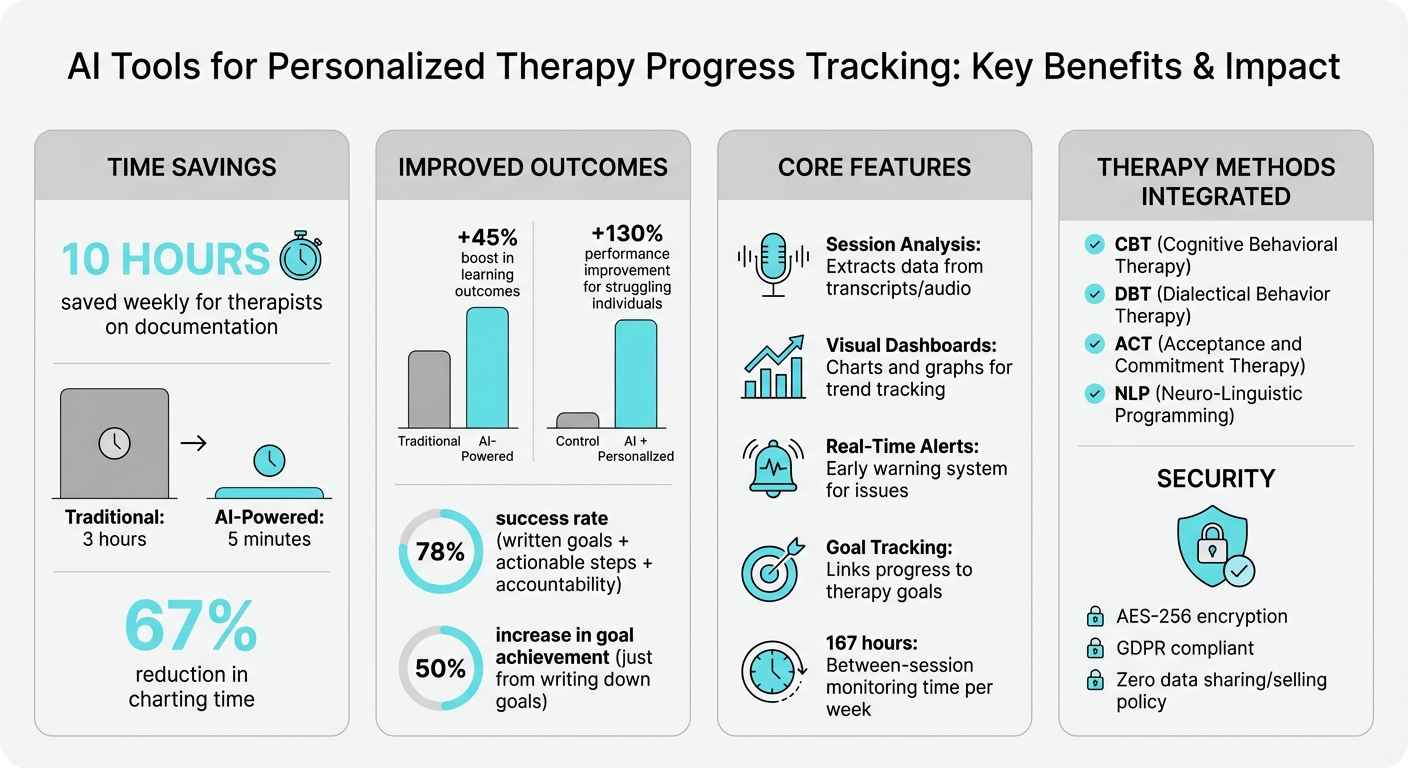
AI Therapy Tracking Tools: Key Benefits and Impact Statistics
Core Features of AI-Powered Therapy Tracking Tools
Personalized Metrics for Individual Goals
AI-powered tools bring a new level of precision to therapy by analyzing session transcripts, audio recordings, or therapist dictations. They identify clinically relevant details like specific symptoms, recurring themes, and moments tied to client goals. Unlike traditional questionnaires such as the PHQ-9 or GAD-7, these tools extract data directly from therapy conversations, reflecting the client’s natural language and unique presentation.
One standout feature is how these platforms link session notes to SMART (Specific, Measurable, Achievable, Relevant, and Time-bound) goals. This creates what’s often called a "Golden Thread" of care, seamlessly connecting treatment plans to progress tracking. Therapists can quickly gauge if a client is improving, stagnating, or regressing – all without adding extra paperwork. Some systems even track progress without requiring formal treatment plans, monitoring subtle changes in client behavior and the overall tone of sessions.
"AI-powered tools have a unique ability to transcribe and summarize the therapeutic process. They help me reflect and gain an objective perspective after a session. This way, I can create a stronger conceptualization of the client’s individualized path to wellness."
– Daniel Helvetius, Licensed Professional Counselor
These insights are then translated into visual progress maps, making it easier to track and celebrate client achievements.
Visual Goal Tracking and Progress Maps
AI tools take the data they gather and turn it into easy-to-understand visuals. Dashboards with graphs and charts reveal trends across sessions, helping therapists and clients spot long-term patterns and distinguish them from short-term setbacks. This reduces reliance on memory or subjective impressions, offering clear, measurable proof of progress.
Karen Martin, LPC, shares her experience:
"The treatment plan gives me a place to look with clients and say, here’s where we are and here’s where we’re aiming to go. It’s such a huge help."
By making progress visible, these tools empower both therapists and clients to stay aligned on treatment goals.
Real-Time Monitoring and Early Warning Systems
AI platforms provide a detailed, ongoing view of a client’s therapeutic journey. They analyze changes in language, emotional tone, and other subtle cues over time, helping therapists identify early signs of challenges like treatment resistance or gaps in intervention. This allows for timely adjustments to treatment plans before small issues escalate.
Between-session monitoring adds another layer of value. Some tools track mood shifts, behavioral patterns, and topic evolution during the 167 hours clients spend outside therapy each week [4]. This extra data helps therapists and clients address issues more quickly. As one therapy client shared:
"I finally saw why my mood lifted and when it stalled. My therapist and I worked on that sooner, and I felt better faster."
– Marta, Therapy Client
sbb-itb-d5e73b4
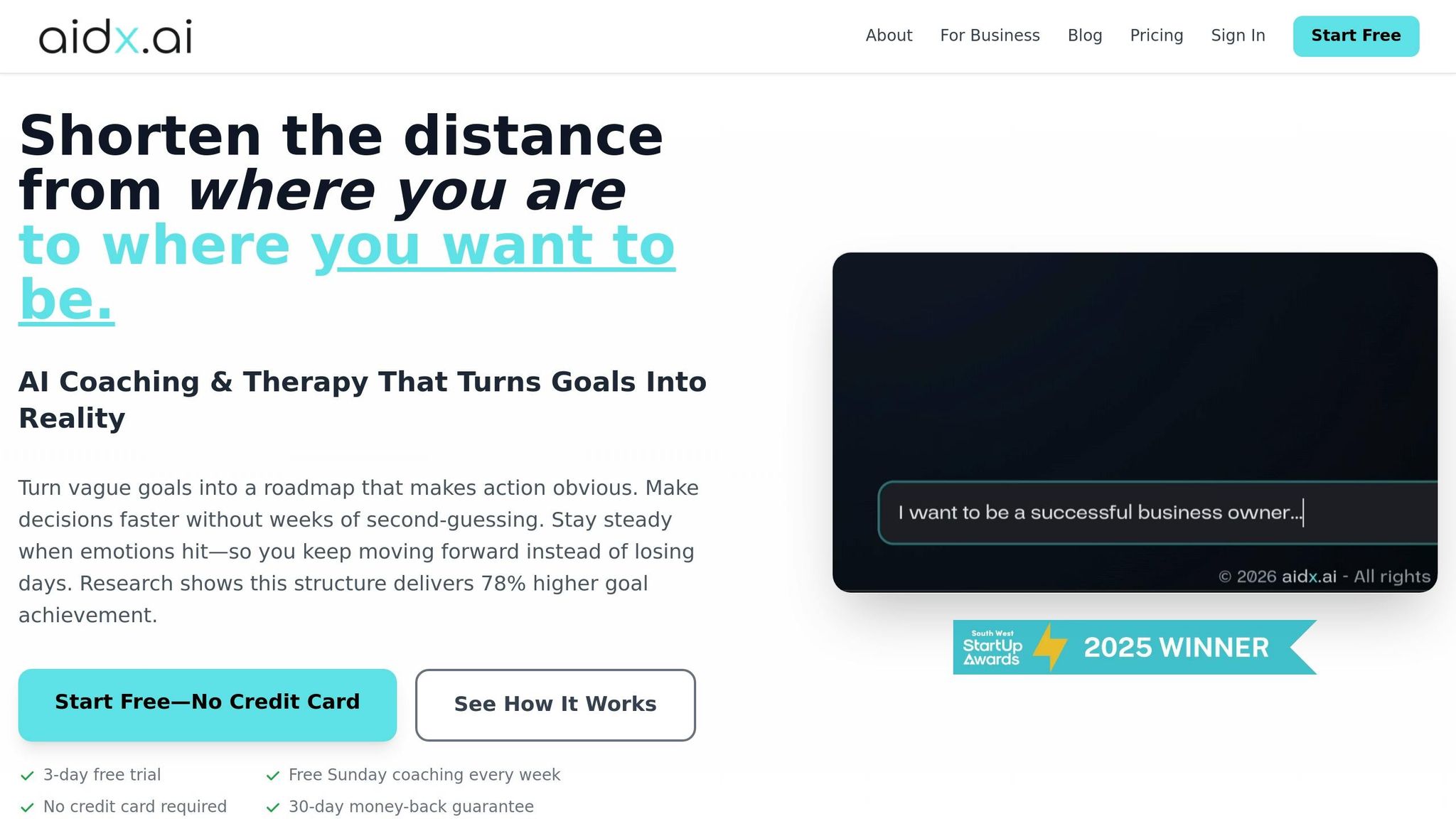
Aidx.ai for Personalized Therapy Progress Tracking
Built on Evidence-Based Therapy Methods
Aidx.ai incorporates techniques from Cognitive Behavioral Therapy (CBT), Dialectical Behavior Therapy (DBT), Acceptance and Commitment Therapy (ACT), and Neuro-Linguistic Programming (NLP) directly into its coaching sessions. This isn’t your average chatbot – it uses these clinically validated methods to understand each user’s unique patterns and adjust its guidance accordingly. By blending these approaches, Aidx.ai ensures its coaching evolves in real time to meet individual needs.
Mobility Coach and Founder Hali Holeszowski shared her experience:
"Aidx has been human in identifying problems & asking the right questions… I felt fully engaged in the conversation, as if speaking with an empathetic expert."
Professional Trader Sarid Harper also highlighted its impact:
"I have been using Aidx to help me overcome mental blocks… Aidx provided a clear framework that empowered me during challenging times." [7]
This evidence-driven strategy helps users set and achieve structured, actionable goals.
Structured Roadmaps and Weekly Accountability
Aidx.ai’s Visual Roadmap turns abstract goals into clear, trackable steps. Users can see their progress as goals are broken down into manageable actions, making the path forward less overwhelming. By showing both the current status and overall progress, Aidx.ai ensures users always know their next step. This feature helps eliminate the common struggle of “analysis paralysis,” where uncertainty about what to do next leads to inaction.
To keep users on track, Aidx.ai offers weekly accountability reports, sent every Monday to designated friends or family members. These recipients don’t need to sign up for the platform, making the process seamless. Research from Dominican University highlights the power of this approach: writing down goals can increase achievement by 50%, and adding specific steps and accountability boosts success rates to 78%. [7] With real-time updates, every session builds on measurable progress, ensuring users stay motivated and focused.
While tracking progress is critical, Aidx.ai prioritizes user privacy at every step.
Privacy and Data Security
Privacy is at the core of Aidx.ai’s design. Co-founded by cybersecurity expert Nicklas Wolff, the platform uses AES-256 encryption to protect user data, ensuring no human (not even the founders) reviews sensitive information. Aidx.ai guarantees that user data is never sold or shared, and users have the option to delete their information at any time. Fully compliant with GDPR, the platform also offers an incognito mode with a lock screen feature for added security on shared devices.
Robert Hartley expressed his confidence in Aidx.ai’s commitment to privacy:
"I was glad to hear that Aidx leans into privacy so heavily. It’s important to have a trusted platform for your sensitive information." [7]
Available 24/7 through any web browser, Aidx.ai offers a free Starter Plan with full access for three days. For those seeking more, paid plans start at $29.99/month, or $24/month when billed annually at $288, which includes unlimited chat and additional coaching tools.
AI for Therapists How to Choose the Right AI Note Taking Tool for Your Practic
How AI Tools Improve Therapy Progress Tracking
AI tools are reshaping therapy progress tracking by introducing smarter ways to personalize care, automate repetitive tasks, and refine treatment plans based on real-time data.
Tailoring Therapy Through Adaptive Learning
AI tools can dive into session transcripts to identify patterns like symptom frequency, recurring themes, and emotional changes [1]. By analyzing this data, they create detailed profiles for each patient, offering insights into cognitive, behavioral, and emotional trends that can guide therapy [8]. What’s remarkable is how these tools pull progress data directly from natural, everyday conversations during therapy sessions [1][2].
For example, studies have shown that AI-powered personalized feedback can lead to a 45% boost in learning outcomes compared to traditional methods [9]. Another system demonstrated a 130% performance improvement for individuals who were initially struggling, compared to a control group [9]. These tools not only fine-tune the overall sequence of therapeutic activities but also provide instant, tailored feedback during exercises, adapting to how patients engage [8].
Beyond personalizing care, AI also tackles the administrative workload that often bogs down therapists.
Streamlining Work With Automation
AI can drastically reduce the time therapists spend on documentation. In some cases, it has cut charting time by as much as 67%, turning a 3-hour task into just 5 minutes. This can save therapists up to 10 hours each week [2][3][5].
"It has cut my charting time by two-thirds, and in many ways – honestly – it does a better job than I did." – Robin M. Mathy, therapist using AI documentation [2]
But it doesn’t stop at note-taking. AI can also create customized therapeutic worksheets and homework assignments tailored to the specific content of each session [6]. By automating these time-consuming tasks, therapists can focus more energy on refining treatment strategies.
Using Data to Adjust Treatment Plans
AI tools turn raw session data into visual dashboards that highlight long-term trends [1][2]. These dashboards link session notes directly to treatment goals, reinforcing the "Golden Thread" that ties therapy documentation to the initial treatment plan [5][3]. This makes it easier for therapists to spot whether a patient’s symptoms are improving, staying the same, or worsening, all backed by measurable data [2][6].
"It helps align the note and the plan for moving forward with sessions … it’s been a really good aid in giving me direction." – Karen Martin, LPC [1]
By tracking progress session by session, AI helps therapists distinguish between normal ups and downs and more serious plateaus that may call for a change in approach [1][2].
These advancements bring a new level of precision, efficiency, and adaptability to therapy, allowing therapists to deliver care that’s more aligned with each patient’s unique needs.
Wrapping It Up
AI tools are reshaping how therapy progress is tracked by turning scattered session notes into clear, long-term insights. These platforms transform raw session data into visual dashboards, highlighting patterns, progress, and areas where growth has stalled. This not only enhances clinical decision-making but also saves therapists around 10 hours a week on documentation tasks [1][10].
For individuals focused on personal growth, platforms like Aidx.ai combine proven therapy methods – like CBT, DBT, ACT, and NLP – with structured goal tracking and weekly accountability. Studies reveal that writing down goals, paired with actionable steps and regular accountability, increases success rates by 78% [7]. Aidx.ai integrates this approach using visual roadmaps that track progress while monitoring stress, burnout, and emotional health over time.
This approach bridges gaps in traditional therapy by ensuring adjustments are made before setbacks escalate [4]. By offering objective, session-based insights and visual feedback, AI tools can pinpoint when therapy is stalling and guide timely changes – often before either the therapist or client recognizes the need.
As Tracy Collins, LCP at Mentalyc, puts it:
"Therapy progress tracking is not about proving effectiveness or reducing therapy to metrics. It is about understanding change as it unfolds; across sessions, over time, and in context." [1]
Whether you’re a therapist aiming for greater efficiency or someone seeking structured self-improvement, AI-powered tools make tracking progress more visible, measurable, and actionable. With features like automated documentation, real-time updates, and strong privacy measures, these platforms are making therapy tracking smarter and more personalized.
FAQs
Do AI therapy tools replace questionnaires like PHQ-9 and GAD-7?
AI therapy tools are intended to work alongside traditional assessments like the PHQ-9 and GAD-7 – not take their place. These validated screening tools are still critical in clinical decision-making because they offer standardized, research-supported metrics. While AI tools can add value to the therapeutic process, they are most effective when used in combination with these proven methods.
How accurate is AI at spotting setbacks or warning signs in therapy?
AI tools for tracking therapy progress have become highly sophisticated, with some boasting an impressive 93% accuracy in predicting mental health outcomes. They achieve this by analyzing a mix of mood logs, behavioral patterns, and real-time data. However, these tools aren’t perfect – they can sometimes overlook subtle emotional nuances or gradual changes that trained clinicians are more likely to catch. Their real value lies in serving as a supporting tool to complement clinical expertise, helping to identify potential setbacks or warning signs more effectively.
What happens to my session data, and can I delete it anytime?
Your session data, including call recordings, transcripts, logs, and metadata, is permanently erased after the retention period you specify. You can adjust this retention period through your security and data storage settings. Additionally, you have the option to delete your data manually at any time before it reaches the expiration date. Once data is deleted, it is gone for good and cannot be retrieved.