

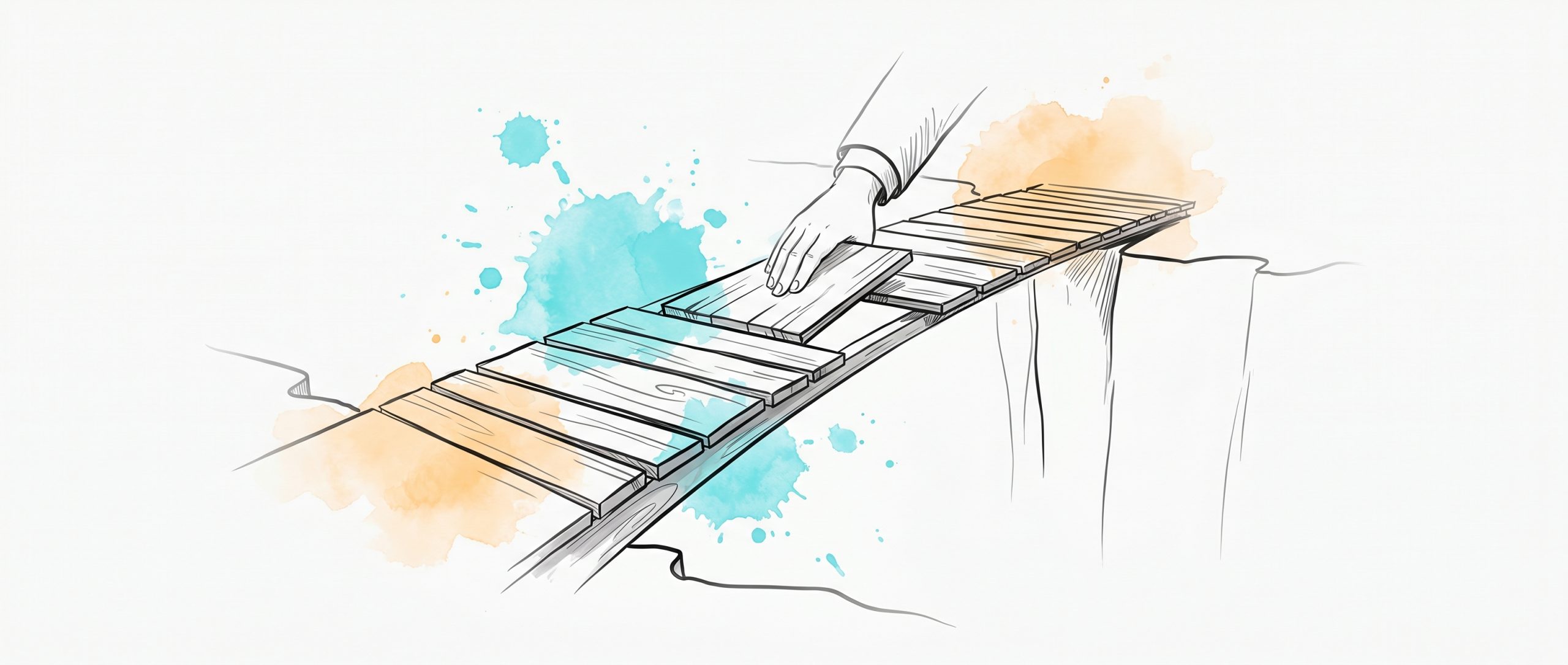
Changing careers is rarely a tidy line from one job to the next. It’s a stretch of in-between — a layoff you didn’t choose, a pivot you’ve been circling for years, a return to work after time away — where the practical questions (“what do I apply for?”) tangle with quieter ones (“who am I if not this?”). An AI career coach can’t make the decision for you, but it can be the steady, always-available thinking partner that helps you move through the messy middle: mapping transferable skills, rehearsing the hard conversations, and keeping you accountable to small experiments instead of one terrifying leap.
This guide is about that specific moment — the transition itself. If you want the broader picture of how AI career coaching works and how to choose a tool, start with our ultimate guide to AI career coaching. Here, we go deep on one thing: getting through a career change with your confidence and finances intact.
Why career transitions feel so heavy
If a job change has knocked you sideways, that’s not weakness — it’s the scale of the thing. On the Holmes–Rahe Social Readjustment Rating Scale, the classic 1967 inventory that weights life events by how much readjustment they demand, being fired or dismissed from work scores 47 “life change units” — putting it in the same heavyweight range as marriage (50) and ahead of a serious personal illness. Retirement scores 45, a business readjustment 39, and a “change to a different line of work” 36. Stack two or three of those in one year and your body and mind are carrying a genuine load.
The financial worry is real too, and it tends to peak at the worst time. Involuntary job loss, in particular, takes a measurable toll on wellbeing. The most rigorous evidence comes from a large meta-analysis by Paul and Moser, pooling 324 studies: across them, 34% of unemployed people showed symptoms of psychological distress, versus 16% of employed people, an average effect size of about d = 0.51 — and the longitudinal data point to unemployment causing the distress, not merely coinciding with it (Paul & Moser, 2009, Journal of Vocational Behavior). If you’re in this and struggling, that’s a normal response to a hard event — and worth treating as seriously as the job search itself.
It’s not just a job — it’s an identity
Part of why career change cuts deep is that work isn’t only what we do; for many of us it’s part of who we are. The Yale researcher Amy Wrzesniewski and colleagues found that people relate to work in roughly three ways — as a job (a means to a paycheck), a career (a path of advancement), or a calling (intrinsically meaningful) — and the three orientations were split fairly evenly across their sample, independent of the actual occupation (Wrzesniewski et al., 1997, Journal of Research in Personality). If your work has been closer to a calling, losing or leaving it lands as more than a financial event — it’s a loss of meaning, and grieving it a little is not melodrama. Naming that out loud is often the first useful step.
The shape of a career transition
Transitions feel chaotic partly because we expect them to be a single clean event. The change-management writer William Bridges drew a useful distinction: the change is the external event (the new title, the redundancy), but the transition is the internal process of catching up to it — and it has three phases (William Bridges Associates):
- The Ending. Letting go of the old role and the identity attached to it. There’s loss here, even in a transition you wanted.
- The Neutral Zone. The disorienting in-between — the old is gone, the new isn’t real yet. Bridges called this the core of the work: uncomfortable, but where the actual reorientation happens.
- The New Beginning. A new identity and energy take hold — usually later than we’d like, and rarely on schedule.
Knowing which phase you’re in changes what’s useful. In the neutral zone, forcing a five-year plan tends to backfire; small experiments serve you far better.
Act your way into clarity, not the reverse
The most counter-intuitive — and most freeing — finding in the career-change literature comes from Herminia Ibarra’s work on “working identity.” Studying professionals who successfully reinvented their careers, Ibarra found they did not follow the conventional advice to introspect first, find their “true self,” then act. They did the opposite: they ran small experiments, and discovered who they wanted to become by doing, not by thinking (Ibarra, Working Identity; see also her HBR article). Side projects, short courses, volunteering, conversations with people already in the field — these “test-and-learn” moves give you real information instead of more anxious speculation. A career change is less a leap than a series of stepping stones, which is exactly the spirit of our guide on how to change careers.
Where an AI career coach actually helps
So where does an AI career coach fit into a process that’s this human? Not as an oracle that names your destiny — but as a practical, always-on partner for the work the frameworks above point to. A few places it genuinely earns its keep:
| The transition task | How an AI coach can help |
|---|---|
| Naming the loss / processing the change | A judgment-free space to think out loud at 11pm, with evidence-based reframing techniques (CBT/ACT) to untangle catastrophic thoughts from facts. |
| Mapping transferable skills | Reflective prompts that surface what actually carries over — the project management hidden inside “I ran a classroom,” the negotiation inside “I managed clients.” |
| Running small experiments | Turning vague intentions into specific next actions, and checking back on how they went. |
| Rehearsing hard conversations | Practising the interview answer about your career gap, the salary negotiation, the “why are you switching?” question — out loud, as many times as you need. |
| Staying accountable | Tracking progress and confidence over time, and nudging you back on track when momentum dips. |
The thread running through all of these is that the most valuable assets in a transition are human skills, and they’re trainable. In the World Economic Forum’s Future of Jobs Report 2025, employers expect 39% of workers’ core skills to change by 2030, and the skills they rate most essential are not only technical — analytical thinking, resilience, flexibility and agility, and curiosity and lifelong learning top the list. Those are precisely the muscles a transition forces you to build, and the ones a coach can help you practise deliberately.
Why “always-on” matters in a transition
A career change doesn’t keep office hours. The 2am spiral of self-doubt, the pre-interview nerves, the wobble after a rejection email — these arrive when no human coach is available. This is the honest, specific advantage of an AI coach: it’s there in the moment the feeling is, not at next Thursday’s appointment. That immediacy matters most for the small, repeated moments of a transition — steadying yourself before a networking event, or debriefing a conversation while it’s fresh — rather than for any single big decision.
At aidx.ai, this is the role our AI life coaching is built for. The platform draws on evidence-based techniques from CBT, ACT, DBT and NLP through a proprietary AI system we call ATI (Adaptive Therapeutic Intelligence), and runs in chat or voice so you can rehearse an interview answer out loud while you walk. It’s coaching and therapy-grade support for the emotional side of change — without pretending to be a human clinician. Aidx.ai is an award-winning AI coaching and therapy service (named AI Startup of the Year at the 2024 and 2025 UK Startup Awards, South West), and for the parts of a transition that need a human — a deep career strategy session, or support that crosses into clinical territory — it’s built to hand off, not to hold you hostage.
A practical playbook for your transition
Frameworks are only useful when they become actions. Here’s how to put the above to work, whether you’re pivoting by choice or recovering from a layoff.
1. Steady yourself first
Before strategy, regulation. If you’re in the raw early days of a layoff, the priority is not a perfect plan — it’s getting your nervous system out of threat mode so you can think clearly. Name what you’ve lost, talk it through, and treat your wellbeing as part of the job search, not a distraction from it. (If a transition tips into something heavier — persistent hopelessness, thoughts of self-harm — that’s the point to reach for professional human support, not a coaching tool. There’s no shame in it; it’s the right call.)
2. Inventory what actually transfers
Most people undersell themselves in a pivot because they describe their last job rather than their skills. Translate. “Taught Year 9 for six years” is also: public speaking, curriculum design, managing thirty stakeholders at once, de-escalating conflict. A coach’s reflective questions are good at pulling these out — and naming them is what makes a career-change CV and an interview answer land.
3. Set specific goals — and “if-then” plans
Decades of research are unambiguous: specific, challenging goals beat vague “do your best” intentions (Locke & Latham, 2002, American Psychologist). And the simplest reliable booster is the implementation intention — an “if X, then Y” plan. A meta-analysis of 94 studies found these plans have a medium-to-large effect (d = 0.65) on actually following through (Gollwitzer & Sheeran, 2006). So instead of “I’ll network more,” try: “If it’s Tuesday morning, then I’ll send two outreach messages before coffee.” An AI coach is well-suited to helping you write these and then checking in on them.
4. Run experiments, and build evidence of yourself
Following Ibarra, treat the next month as a set of experiments, not a verdict. A coffee chat, a freelance gig, a weekend course — each one tells you something real and, crucially, builds self-efficacy. Bandura’s foundational work showed that the strongest source of self-belief is mastery experience — small, real wins (Bandura, 1977, Psychological Review). Confidence isn’t something you summon before you start; it’s something you accumulate by starting. Tracking those wins — something an AI coach can do alongside you — turns a foggy stretch into visible progress.
5. Rehearse the conversations that scare you
The career-gap question, the “why are you leaving a stable field?” challenge, the number you’ll say when they ask your salary expectation — these go better with practice. Rehearsing them out loud, repeatedly, in a low-stakes space takes the charge out of them. This is one of the clearest uses of a voice-enabled AI coach: an infinitely patient mock-interviewer that never sighs.
A note on returning to work
Re-entering the workforce after a break — for caregiving, health, study, or anything else — carries its own weight, much of it about confidence rather than capability. The structural headwinds are real: UK Government Equalities Office data found that 17% of women leave employment entirely in the five years after childbirth, compared with 4% of men, and returners are disproportionately likely to come back to lower-paid roles. None of that is a reflection of your worth or your skills; it’s a system effect, and it’s navigable. The same playbook applies — translate your skills (caregiving is logistics, budgeting, crisis management), run small experiments to rebuild momentum, and rehearse the story you’ll tell about the gap until it feels like a chapter, not an apology.
Does changing careers actually pay off?
Often, yes — though it’s worth being precise about the evidence. In a tight labour market, the Pew Research Center found that among U.S. workers who changed employers between April 2021 and March 2022, 60% saw an increase in real (inflation-adjusted) earnings, with the median switcher gaining 9.7% — while among those who stayed put, fewer than half (47%) saw a real gain and the median worker’s real earnings actually fell 1.7%. That’s a snapshot of one high-inflation period, not an iron law, so don’t read it as a guarantee. But it’s a useful counterweight to the fear that changing course is reckless: done deliberately, a transition is frequently a step up, not a gamble.
The bottom line
A career transition is one of the more demanding things a working life asks of you — emotionally, financially, and at the level of identity. The research points to a consistent path through it: tend to your wellbeing first, translate your skills honestly, set specific goals with concrete if-then plans, and act your way to clarity through small experiments rather than waiting to feel certain. An AI career coach won’t choose your path, and it shouldn’t try to. What it can do — better than almost any other tool — is be there in the in-between moments, helping you think clearly, practise the hard parts, and keep moving one stepping stone at a time.
For the wider landscape — how AI career coaching works, its benefits, and how to pick a platform — see our ultimate guide to AI career coaching. And if the change you’re facing is bringing more stress than you expected, our guide to easing the stress of job changes goes deeper on steadying yourself through it.
Last reviewed: June 2026. This article is general information about navigating career change, not professional career, financial, or medical advice. If a transition is affecting your mental health — persistent low mood, anxiety that won’t lift, or any thoughts of self-harm — please reach out to a qualified professional or, in a crisis, your local emergency services.