
Struggling to make decisions under tight deadlines? AI brainstorming tools can help you generate ideas, organize thoughts, and create actionable plans in seconds. Here’s why they work:
- Speed: AI can produce 20+ ideas in seconds, saving hours of manual effort.
- Bias-Free: It avoids common mental roadblocks like anchoring bias and groupthink.
- Continuous Output: Unlike humans, AI doesn’t fatigue and keeps generating fresh ideas.
- Real-Time Insights: AI pulls current data, ensuring decisions are based on up-to-date information.
- Action-Oriented: Tools like Aidx.ai turn ideas into visual roadmaps and track progress with accountability features.
How to Use AI as a Thinking Partner (for Better Strategy and Decisions)
sbb-itb-d5e73b4
What is AI-Driven Brainstorming?
AI-driven brainstorming uses tools powered by natural language processing (NLP), machine learning, and generative models to come up with, refine, and organize ideas [6][1]. Unlike traditional brainstorming sessions, which often lose steam after 15–20 minutes due to mental fatigue, AI can keep generating ideas around the clock [2]. Plus, it doesn’t shy away from “ugly” or unconventional ideas because it’s immune to the social pressures that can stifle human creativity [4]. As Everyday AI explains:
"AI doesn’t replace the team. It replaces the first conversation. The raw, ugly, directionless one humans are oddly bad at having together."
- Everyday AI [4]
This approach allows AI to propose connections across different fields – ideas that people might miss because of their own limited experiences [2][7]. Studies have shown that while AI alone might not always enhance individual creativity, a partnership between humans and AI consistently outperforms humans working solo. Together, they excel in generating ideas that are more fluent, flexible, and original [8].
Today, 45% of marketers use AI tools to brainstorm content ideas, and teams that incorporate AI into their ideation process report completing projects 27% faster [7]. By combining efficiency with an expanded pool of ideas, AI-driven brainstorming helps teams make quicker, better-informed decisions.
How AI Speeds Up Decision-Making
AI’s real advantage lies in its ability to cut through overwhelming amounts of information and guide you toward decisive actions quickly.
We’re often paralyzed by too much data, not too little. AI tackles this by analyzing massive datasets to uncover patterns that would take humans hours – or even days – to identify[3]. The result? A sharper focus on what truly matters, allowing you to act with confidence instead of getting stuck in endless deliberation.
Learning from User Patterns
Modern AI tools go beyond simply responding to commands – they actually learn. With persistent memory, these platforms adapt to your preferences, decision-making habits, and recurring challenges over time[7]. This means that as you interact more, the AI becomes better at anticipating your needs. For instance, if you often struggle with prioritizing tasks under tight deadlines, the AI might start suggesting tailored frameworks to help you manage your workload more efficiently. This ability to evolve with you eliminates the need to re-explain your context every time, making the decision-making process smoother and faster.
Creating Scenarios and Visual Roadmaps
AI is particularly strong at creating scenario maps, offering "what-if" analyses to help you evaluate decisions before committing resources. It can even simulate personas – like a Skeptical CFO or a Frustrated Customer – to challenge your ideas from different perspectives and highlight potential risks you might overlook[7]. Take the pre-mortem technique, for example: you can ask the AI to simulate a failure scenario and list the top 10 risks. This proactive approach helps you address issues before they arise, reducing hesitation and uncertainty. By laying out clear pros and cons in visual roadmaps, AI makes it easier to prioritize your options and move forward with clarity. And because it continuously updates its insights, you’re always working with the most current information.
Pulling Real-Time Data
AI doesn’t just rely on historical data; it pulls real-time insights from online sources to ensure your decisions are based on today’s conditions, not outdated assumptions[7]. Whether you’re validating markets, analyzing consumer behavior, or tracking emerging trends, AI eliminates hours of manual research by synthesizing focused summaries. It even highlights gaps or conflicting information so you can address them upfront. This shift transforms meetings from endless discussions into opportunities for decisive action, letting you make informed choices faster than ever.
Key Techniques for AI Brainstorming
The leap from scattered thoughts to actionable decisions often hinges on using the right approach. AI brainstorming thrives when specific strategies are employed to clarify ideas and push boundaries.
Mapping and Visualizing Scenarios
AI can turn messy thoughts into structured visuals. Instead of manually sorting through endless text, ask AI to organize key elements and uncover hidden relationships [9]. Visual tools generated by AI, such as SWOT tables or 2×2 prioritization matrices, can help you stress-test ideas in different market scenarios, offering deeper insights [2][9].
For instance, you could use the Alternative Worlds Framework by asking how a company like Netflix might handle customer onboarding for your gardening app. This type of cross-industry thinking often leads to connections that traditional brainstorming might overlook [7]. AI also excels at transforming text-based ideas into frameworks like Kanban boards or strategic roadmaps in just moments [2][6].
Challenging Cognitive Biases
AI serves as a neutral, judgment-free collaborator, eliminating the social dynamics that can stifle creativity in group settings [1][2]. Use prompts like "Play Devil’s Advocate" to have AI pinpoint potential flaws in your ideas before you invest time or resources [2].
Because AI pulls from vast datasets spanning various fields, it introduces perspectives that go beyond personal experience. It also avoids anchoring bias by generating multiple independent ideas at once [2][9]. To broaden your thinking, ask AI to simulate different viewpoints – optimistic, cautious, or even emotional – to ensure you’re considering every angle [9].
Refining Ideas Through Rapid Iteration
After examining your ideas from every perspective, the next step is refining them through quick, repeated iterations.
AI’s first outputs are rarely perfect. The key is to refine them step by step: Prompt → Review → Tweak → Repeat [1]. For example, you can narrow down broad ideas by asking specific questions like, "What features set this apart from competitors?" [2]. Combine the best parts of several AI suggestions into a single, cohesive plan [2]. If the output feels too general, add constraints like, "List actionable ways to reduce waste by 50% for a subscription business" [2]. Once you’ve honed your idea, ask AI for a "first 30-day roadmap" to ensure it’s practical [2]. Studies show that this iterative process can speed up idea generation by 27% while improving overall quality [5].
"AI doesn’t replace human creativity – it accelerates it. A designer equipped with an AI assistant moves from ideation to execution faster, running through multiple iterations without sacrificing quality."
- Ethan Cole, Technology Writer, Stormap.ai [9]
Aidx.ai Features for Decision-Making
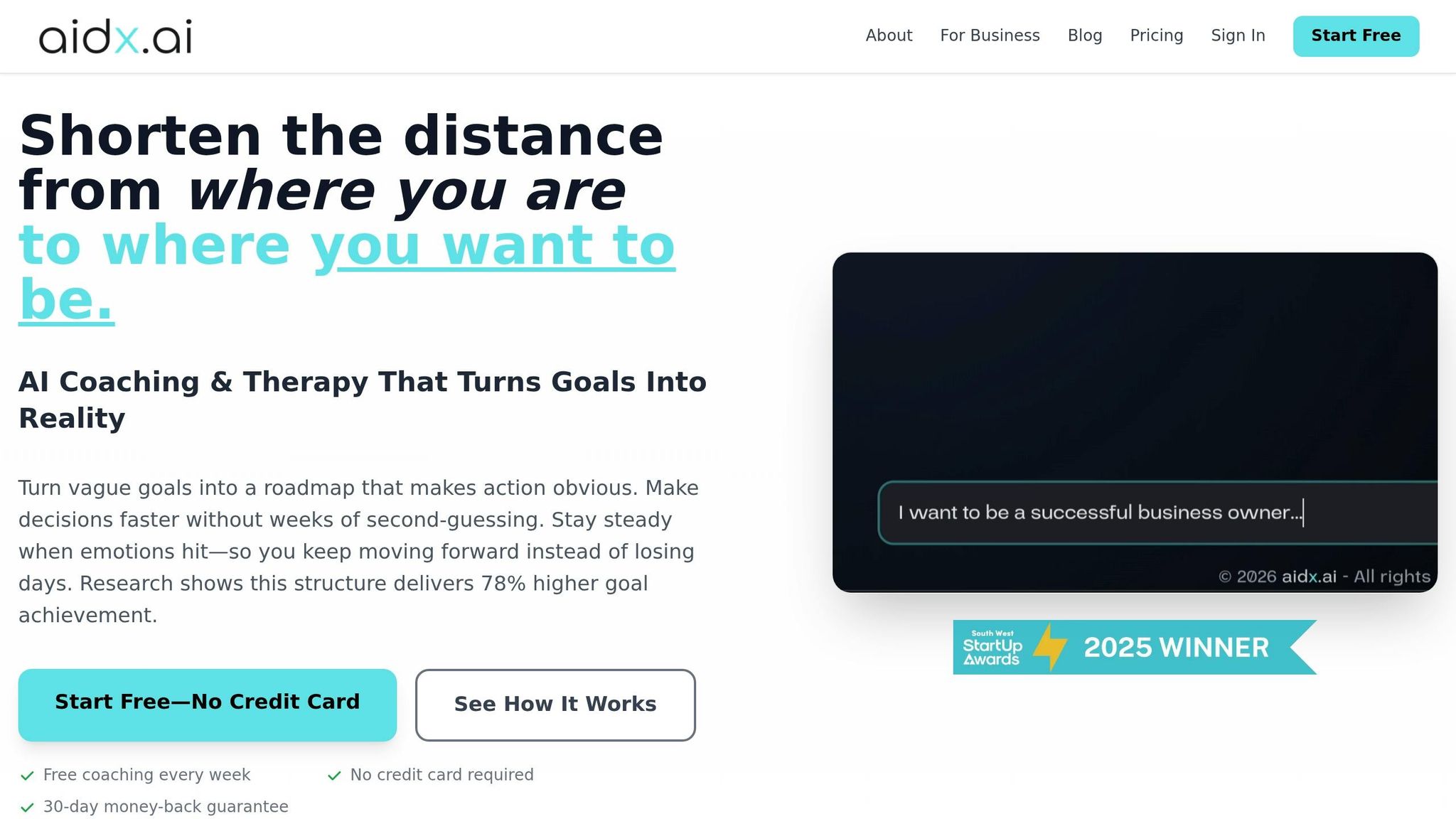
When brainstorming feels stuck or decisions take too long, having the right tools can make all the difference. Aidx.ai offers features that turn ideas into strategies, blending AI-powered coaching with structured accountability. Research shows this combination can boost goal achievement rates by 78% [10]. These tools are designed to support quicker, more confident decision-making.
Goal Roadmaps and Accountability Reports
Aidx.ai’s roadmap feature transforms vague ideas into clear, actionable plans. With trackable steps and real-time progress updates, it eliminates the dreaded analysis paralysis. Each coaching session builds on historical trends and current progress, ensuring users stay on course. By pairing written goals with specific actions and automated accountability, the platform helps users stay focused [10].
To make accountability even easier, users can share progress updates with friends or family via email every Monday – no account required for recipients. As Sarid Harper, a Professional Trader and Business Owner, shared:
"Aidx helped me build a framework from which to work that empowered me during times of difficulty…" [10]
Insights and Emotion Tracking
In addition to roadmaps, Aidx.ai offers emotional analytics to complement the decision-making process. It tracks conversations over time to monitor stress, burnout risk, and overall emotional well-being. By flagging negative patterns early, the platform helps users address issues before they disrupt productivity [10]. If anxiety strikes during brainstorming, the AI provides tools to manage intense emotions in just five minutes, keeping distractions at bay. Hali Holeszowski, a Mobility Coach and Founder, explained:
"Aidx has been surprisingly human in identifying problems & asking the right questions. But faster! I got sucked into the conversation like I was talking to an educated & empathetic therapist…" [10]
Using evidence-based methods like Cognitive Behavioral Therapy (CBT), Dialectical Behavior Therapy (DBT), and Acceptance and Commitment Therapy (ACT), Aidx.ai helps users spot burnout signs early, ensuring consistent and steady decision-making.
24/7 Access to Business and Life Coaching
While traditional therapy can cost over $1,000 a month, Aidx.ai offers 24/7 expert-level coaching for just $29.99 per month – or free with limited Sunday access on the Starter plan. Users can switch between Life, Business, and Performance Coaching modes to suit their needs. For professional challenges, the Business Coaching mode provides constructive feedback and helps uncover blind spots, making it easier to evaluate trade-offs. Vera Martins, a Psychologist and Business Owner, noted:
"I shared a very specific topic and was guided through relevant questions, practical tips and actionable steps. The process was very natural and, above all, it was very useful." [10]
Accessible directly from any browser, Aidx.ai ensures privacy with encrypted sessions that comply with GDPR standards. For extra-sensitive brainstorming, incognito mode leaves no digital trace – perfect for tackling high-stakes business decisions or personal breakthroughs.
Benefits and Limitations of AI Brainstorming
AI brainstorming tools bring a level of efficiency and neutrality that’s hard to match with traditional methods. For instance, a study by Harvard Business School and the University of Washington revealed that AI generated 730 solutions in just 5.5 hours at a cost of $27.01. In contrast, human crowdsourcing took 2,520 hours and cost $2,555 to produce only 125 ideas[11]. Interestingly, the AI-generated ideas were rated as higher in quality and strategic viability compared to those from human participants[11].
However, AI brainstorming isn’t without its drawbacks. The same speed and volume of ideas can lead to predictable or overlapping results – 73% of AI outputs were found to be generic, and 94% showed significant overlap among users[12][7]. This highlights AI’s role as a starting point for idea generation while emphasizing the importance of human judgment in refining and contextualizing those ideas. AI excels at eliminating cognitive biases, such as anchoring and groupthink, and provides a judgment-free zone to explore unconventional ideas without social pressures[9]. It’s also available around the clock, avoiding delays caused by scheduling conflicts or mental fatigue[9]. However, AI lacks the emotional sensitivity and cultural awareness that humans bring to the table[3].
Comparing Benefits and Limitations
| Benefits | Limitations |
|---|---|
| Speed: Generates hundreds of ideas in minutes, compared to hours of manual brainstorming[11] | Genericity: 73% of outputs may feel predictable or uninspired[12] |
| Objectivity: Free from biases like anchoring and groupthink[9] | Reduced Diversity: Heavy overlap (94%) when multiple users rely on the same tool[7] |
| Privacy: Encrypted sessions with GDPR-compliant platforms like Aidx.ai[10] | Context Gaps: Limited understanding of company culture or emotional nuance[3] |
| Psychological Safety: Encourages "out-there" ideas without fear of judgment[2] | Prompt Dependency: Quality of results depends heavily on the clarity of input prompts[1] |
| 24/7 Availability: Costs $29.99/month for instant access vs. $1,000+/month for traditional coaching[10] | Empathy Limits: Cannot fully interpret human intent or navigate ethical subtleties[13] |
Some tools, like Aidx.ai, are working to address these limitations. Features such as Emotion Tracking and Accountability Reports aim to bridge the gap between AI efficiency and human context. These additions not only bring more depth to the decision-making process but also ensure ideas move beyond the conceptual stage into actionable plans[10]. By blending AI’s speed with structured follow-through, users can generate ideas quickly while maintaining the accountability needed to see them through. Next, we’ll explore a 5-step process to make the most of AI brainstorming tools.
How to Start Brainstorming with AI
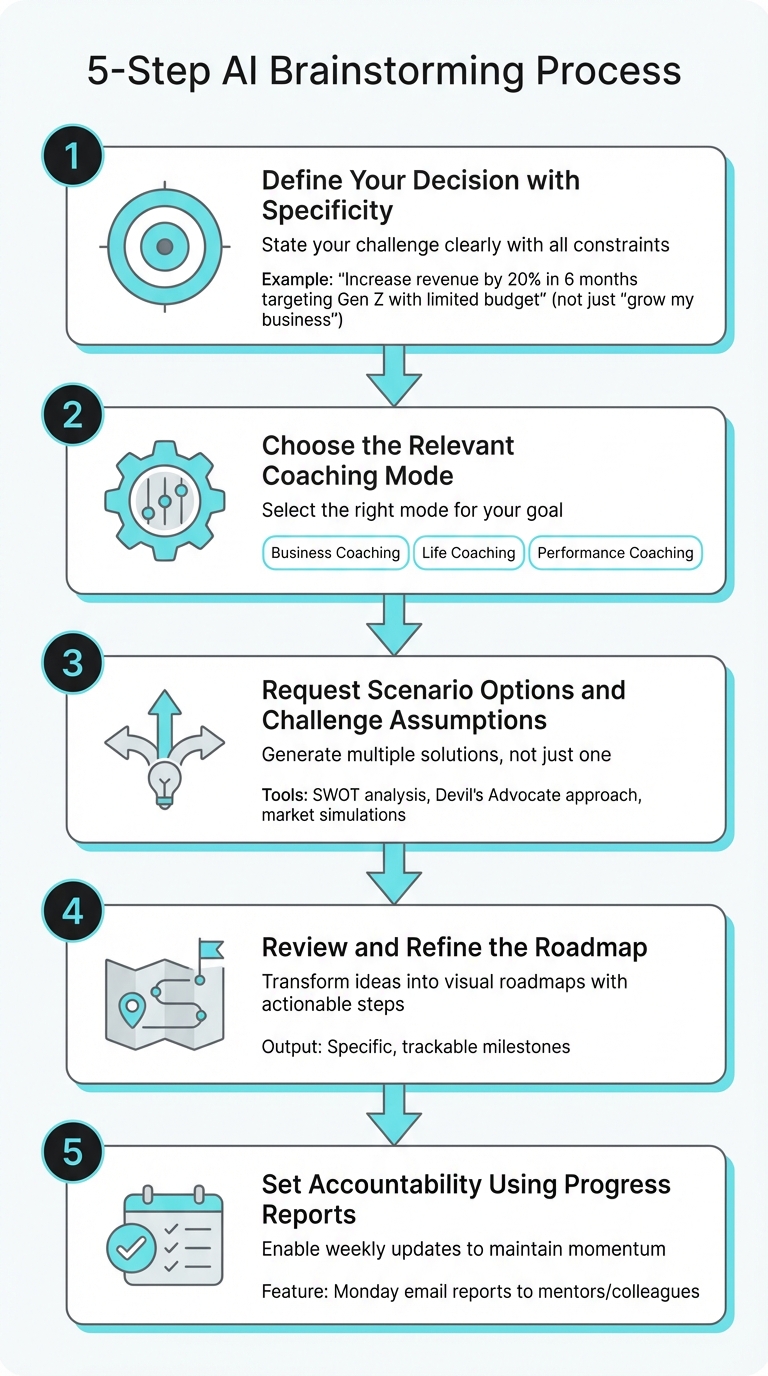
5-Step AI Brainstorming Process for Faster Decision-Making
To kick off brainstorming with AI, you need one essential ingredient: a clear definition of your problem. A common pitfall is treating AI like a search engine, tossing in vague prompts and expecting magic. The reality? The quality of AI’s output depends entirely on how specific and detailed your input is. For example, instead of typing "give me ideas", provide context – describe your target audience, constraints, and the outcome you’re aiming for[2][1].
Think of AI as a collaborator, not a quick-fix solution. The first idea it spits out is rarely the best. Engage with it by asking follow-up questions, challenging its suggestions, and blending the strongest pieces. This back-and-forth process – prompting, reviewing, refining, and repeating – can uncover deeper insights and help you avoid generic, surface-level results[1][2]. AI also eliminates the bottlenecks that often slow down traditional brainstorming sessions. Here’s a simple approach to go from defining your challenge to actionable outcomes.
5-Step Brainstorming Process
Use this streamlined process to turn challenges into solutions with AI tools like Aidx.ai:
- Define Your Decision with Specificity
Start by clearly stating your challenge in plain language, including all known constraints. Be specific. Instead of saying, "I want to grow my business", try something like, "I want to increase revenue by 20% in six months by targeting Gen Z with a limited budget." The more precise your description, the more useful the AI’s suggestions will be[2][1]. - Choose the Relevant Coaching Mode
Select a mode that matches your goal. Platforms like Aidx.ai offer tailored coaching modes for various needs. For example, Business Coaching is great for strategic and revenue-focused challenges, Life Coaching can tackle personal decisions, and Performance Coaching helps with productivity and goal-setting. Picking the right mode ensures the AI provides advice that fits your situation. - Request Scenario Options and Challenge Assumptions
Ask the AI to generate multiple paths forward instead of a single solution. For example, request a SWOT analysis to weigh feasibility or use a "Devil’s Advocate" approach to test your ideas for weaknesses. You can even simulate how different market conditions or economic scenarios might impact your options. This helps you better understand risks and rewards[2][9]. - Review and Refine the Roadmap
Once you’ve identified the most promising direction, ask the AI to turn it into a visual roadmap with actionable steps. Tools like Aidx.ai’s Goal Roadmaps can break down abstract ideas into specific, trackable milestones, turning brainstorming into a clear plan. - Set Accountability Using Progress Reports
Even the best ideas can stall without follow-through. Use features like Aidx.ai’s Accountability Reports to send weekly updates to someone who can keep you on track – a mentor, colleague, or friend. A simple email every Monday can act as a powerful nudge to maintain momentum.
This method combines AI’s speed and objectivity with a structured approach, helping you transform initial ideas into concrete, actionable results.
Conclusion
AI-driven brainstorming isn’t about replacing human intuition – it’s about accelerating the journey from uncertainty to action. Traditional decision-making often stalls due to cognitive biases, social dynamics, or the mental fatigue that creeps in after just 15–20 minutes of intense focus [2]. AI steps in to tackle these obstacles by instantly generating a variety of options, analyzing scenarios to test ideas, and turning scattered thoughts into clear, actionable plans – all while avoiding groupthink and uninspired "safe" choices [4].
The numbers speak for themselves: teams using AI-powered ideation tools report a 27% boost in project delivery speed [7], and 64% of organizations now see AI as a driving force for innovation [7]. The real magic, however, lies in the collaboration between humans and AI. AI shines during the divergent phase, generating high volumes of ideas and uncovering unexpected connections. Humans, on the other hand, excel at the convergent phase, applying judgment, emotional intelligence, and context to refine those ideas into practical solutions [7][2].
This is where Aidx.ai comes in. It’s built to tackle these challenges head-on. The platform learns from your patterns, sharpens your ideas, and converts them into structured, actionable roadmaps. With tools designed for fast, informed decision-making, Aidx.ai doesn’t just help you brainstorm – it ensures your ideas are ready for execution. Features like accountability tracking and 24/7 availability mean you can refine your decisions whenever inspiration strikes, not just during planned meetings. Research backs this approach: written goals paired with action steps and regular accountability lead to 78% higher achievement, according to Dr. Gail Matthews of Dominican University. Aidx.ai integrates this proven framework into every coaching session.
Start with a clear problem, collaborate with AI, and refine your ideas through continuous iteration. By following the 5-step process discussed earlier, you can seamlessly bridge brainstorming with execution. The result? Faster, more confident decisions and a well-defined path forward – without the overwhelm of too many options or the lack of structure that often derails progress.
FAQs
What should I include in my prompt to avoid generic AI ideas?
If you want AI to generate ideas that stand out, you need to be specific in your instructions. The key is to focus on details like your target audience, any constraints, and the level of originality you’re aiming for.
For example, instead of saying, “generate ideas,” try something like: “Provide unique ideas tailored to [your context or goal], avoiding overused or generic concepts.” This gives the AI a clear direction and helps steer it toward more relevant and creative outcomes.
Vague prompts often lead to predictable results. By being clear and direct about what you need, you’ll get suggestions that are more aligned with your goals and less likely to feel repetitive or uninspired.
How do I validate AI suggestions before making a final decision?
To ensure AI suggestions are accurate and relevant, it’s important to cross-check them using additional research or trusted data sources. This might involve fact-checking, comparing the ideas against established knowledge, or even testing them in practical, real-world situations. While AI can offer a variety of perspectives, taking the time to verify its suggestions ensures they are both useful and reliable before making any final decisions.
How does Aidx.ai turn brainstormed ideas into an action plan?
Aidx.ai turns your ideas into clear, actionable plans with its structured tools for goal-setting and progress tracking. The platform lets you break big ideas into smaller, doable steps using a visual roadmap that monitors your progress over time. To keep you on track, it also provides weekly accountability reports, helping you stay focused and tweak your strategies when needed. This approach ensures your ideas are organized into concrete actions, making decision-making quicker and results easier to measure.